Key Takeaways
- Segment contact lists on an android phone as sms gateway by consent, traffic class, locale, and SIM capacity — not by CSV convenience alone.
- OTP and transactional routes must never share list exports with promotional segments; modem queue contention and spam scores cross-contaminate deliverability.
- Apply suppression lists globally before segment splits; opt-out in one segment must block all marketing classes on that MSISDN.
- Map each segment to pace caps aligned with measured per-SIM throughput; aggregate list size means nothing if peak hour exceeds modem safe rate.
- Use /features/contacts-and-lists for list storage patterns; pair with /features/auto-reply-sms for inbound keyword handling on marketing segments.
- Service pricing meters devices and volume (Priced by devices and SMS send volume. You use your own phone and operator SMS credit.); 300 SMS lifetime on free tier suits list import testing — operator airtime for campaigns remains yours per SIM.
- MMS-capable segments belong on /features/mms-gateway routes only when content requires media; default OTP and alerts stay SMS segments.
- Industry messaging practice guides (CTIA and similar) frame consent and opt-out expectations — align segment policies before scaling bulk through handset gateways.
One CSV is not a send plan. If OTP and promo share the same export, the modem queue will punish both — and your carrier will not care which segment “meant well.”
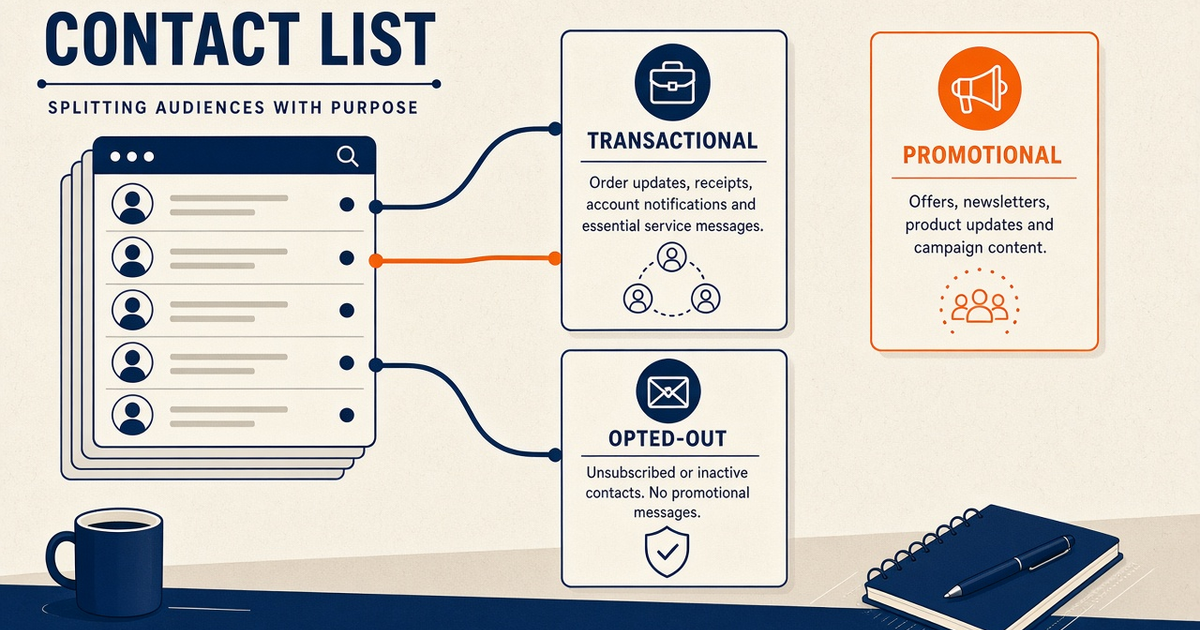
Contact list segmentation turns a monolithic CSV into routes your modem can actually deliver. When you operate an android phone as sms gateway, blasting one undifferentiated list through a single SIM ignores consent classes, peak throughput, operator fair-use, and the isolation OTP requires. This spoke defines segmentation dimensions, suppression discipline, SIM mapping, pacing math, auto-reply interactions, MMS splits, and glossary terms ops teams share during incidents. Anchor the program at the hub: How to use an Android phone as an SMS gateway.
Service pricing is based on device count and total SMS sent through the gateway. You need a working Android phone with a SIM and SMS credit from your mobile operator. Operator message costs are yours—we do not sell carrier SMS balance. Priced by devices and SMS send volume. You use your own phone and operator SMS credit.. Free tier on device and SMS volume pricing includes 300 SMS lifetime on one device — enough to test import, dedupe, and small segment canaries. Production campaigns at scale typically need paid plans from $19/month when device count and monthly volume grow. Segmentation reduces wasted airtime on wrong audiences; it does not replace operator SMS credit per SIM.
Messaging industry associations publish principles for responsible SMS programs — see CTIA for U.S.-oriented best-practice framing on consent and user respect. Local law always overrides industry guides; segment design implements counsel-approved policies in export rules and metadata.
Why segmentation matters on handset gateways
Cloud ESPs hide segmentation behind audience UI and shared aggregator capacity. Handset gateways expose physical limits: one modem queue, one prepaid balance, one operator relationship per SIM. Sending “everyone” at once hits that ceiling and collapses deliverability for every use case sharing the route — including OTP if you mixed lists carelessly.
Segmentation is also liability control. Promotional SMS to numbers without promotional consent is regulatory risk regardless of transport. Transactional service notices may be permitted by relationship but still need accurate lists. Separate segments force explicit consent scope before export.
Operationally, segments make metrics readable. Delivery rate per promotional locale segment reveals template or translation issues faster than account-level averages. Failure spikes confined to “win-back dormant 90d” segment implicates list quality, not modem hardware.
Glossary: list and segment terms
- Contact list
- A named collection of MSISDN records (and optional metadata) used as the audience for one or more send jobs. Lists should have an owner, consent basis, and last-scrubbed date.
- Segment
- A subset of a list or database filtered by rules — locale, product tier, last purchase, opt-in channel, or risk score — routed with its own template, SIM, and pace cap.
- Static segment
- Membership frozen at export time (CSV snapshot). Suitable for one-off campaigns with audit trail.
- Dynamic segment
- Membership recomputed from query on send time (e.g., “active in last 30 days”). Requires idempotent send guards to avoid duplicate messages on reruns.
- Suppression list
- Numbers that must never receive marketing SMS — opt-outs, complaints, invalids, competitors. Applied before every segment export.
- OTP route
- Dedicated send path (SIM + template + rate limit) for one-time codes, isolated from bulk marketing segments to protect latency and deliverability.
- Pace cap
- Maximum messages per hour per segment or SIM enforced by scheduler — prevents fair-use throttle that would hurt other segments on shared infrastructure.
- ICCID tag
- SIM identifier attached to outbound jobs for per-route deliverability metrics; segments map to ICCID tags in multi-SIM fleets.
- Double opt-in
- User confirms SMS consent twice (e.g., web form + reply YES). Stronger evidence for promotional segments in regulated markets.
- List churn
- Rate of invalid numbers, port-outs, and opt-outs; high churn segments need more frequent scrubbing before send.
Keep this glossary in the ops wiki beside export runbooks. Incident threads confuse “list” and “segment” easily; precise language speeds triage when marketing says “we only changed the list” but ops sees a new dynamic query.
Consent before segments
Segment design starts with consent class, not SQL filters. Each contact row stores: opt-in timestamp, channel, message classes allowed (transactional, promotional, OTP service), and locale. Export pipelines filter promotional_consent = true before promotional segments run — not the reverse.
Double opt-in segments for cold acquisition; single opt-in may suffice for existing customer transactional extensions depending on counsel. Document jurisdiction per row when operating multi-country lists from one dashboard.
Suppression list updates must propagate within minutes. Delayed STOP handling is a complaint vector and carrier complaint ratio driver — segment architecture includes real-time suppression, not nightly batch only.
Segmentation dimensions that work
Useful dimensions map to different templates, schedules, or SIM routes. Vanity segments (“users who like blue”) without route difference add complexity without operational benefit.
| Dimension | Example | Typical route |
|---|---|---|
| Traffic class | OTP, transactional, promotional | Separate SIM + template family |
| Locale / language | en-US, bn-BD, es-MX | Template variant per segment |
| Timezone | America/Chicago morning slot | Scheduler quiet hours |
| Product tier | Free vs paid users | Different pace and copy |
| Risk / fraud | New accounts < 24h | OTP-only SIM, stricter rate limit |
| Channel opt-in | Web vs retail POS | Audit trail in metadata |
| Last engagement | Active 30d vs dormant | Win-back vs maintenance segments |
| MMS capability | Handset supports MMS | MMS gateway route only |
Combine dimensions carefully. Locale + timezone + traffic class yields many small segments — each needs pace cap. Prefer hierarchical export: filter traffic class first, split locale second, schedule third.
Isolating OTP from marketing lists
OTP is not a marketing segment. It is a security route with rate limits, short templates, and dedicated SIM. Never derive OTP recipients from promotional list membership. Auth flows generate sends per attempt — list semantics do not apply.
Read OTP verification for flow design. Segment contact lists article addresses bulk and lifecycle audiences; OTP stays outside list exports entirely, sharing only global suppression where regulations forbid even transactional contact (rare for auth).
If product requests “OTP plus welcome offer in one campaign,” reject at architecture — two routes, two templates, optional delayed nurture segment minutes after verified signup, not one PDU.
Routing segments to SIMs and devices
Each segment export should declare target ICCID or device ID and pace cap. Morning appointment segment to SIM A; promotional weekend segment to SIM B on second phone if peak math exceeds one modem safe rate.
Multi-device fleets scale aggregate throughput by adding phones — service pricing meters device count. Segment router maps segment_id → device pool with failover order documented.
Dynamic segment reruns without dedupe keys duplicate messages when query results overlap day to day. Store last_sent_campaign_id on contact or use send log anti-join before export.
Auto-reply and inbound segments
Marketing segments must connect to inbound keyword handling. Auto-reply SMS routes STOP to suppression, HELP to support copy, JOIN to double opt-in confirmation. Segment membership updates from inbound events — not only from web UI edits.
Two-way support segments (conversations) share modem time with outbound campaigns on one SIM. Pace outbound lower when inbound SLA matters, or split SIMs.
MMS vs SMS list splits
MMS subscribers belong in explicit segments after capability verification. MMS gateway routes cost more airtime and fail on devices without MMS APN settings. Default new imports to SMS segment; promote to MMS only with flag and tested route.
OTP and transactional alerts remain SMS segments even when MMS gateway is enabled for marketing rich media.
Data hygiene and scrubbing
Segments amplify list quality problems. Invalid MSISDNs fail at modem; port-outs generate complaints. Scrub before every large export: normalize E.164, remove duplicates, apply suppression, flag dormant numbers for win-back sub-segment with lower priority.
List churn metrics belong on dashboard beside delivery rate. Segment “dormant 180d” with 40% invalid rate needs re-permission campaign, not louder repeats.
Import logs: source file hash, row count, reject count, operator of test send. Audit trail for compliance questions months later.
Import and dedupe workflow
Standard workflow: upload CSV to Contacts and lists → validate schema → dedupe by MSISDN → merge consent metadata → tag list version → define segment query → dry-run count → manager approval → schedule with pace cap → post-send DLR review per segment.
Dry-run count prevents “export all rows” accidents. Require typed confirmation when count exceeds threshold (e.g., 10,000).
Version lists when source data changes. list_v2026_08_01_promo beats reusing generic customers.csv in incident forensics.
Campaign pacing per segment
Pace cap formula: segment_size / completion_hours = messages per hour required. Compare to measured safe MPH per target SIM at 70% utilization. If required MPH exceeds cap, extend completion window or split segment across devices.
Stagger timezone segments locally — “9am local” exports per region instead of one UTC blast that hits one SIM at false peak.
Re-run pace math when template changes segment count (Unicode vs GSM) — airtime per hour rises even if message count flat.
Compliance and CTIA-style practice
Industry guides emphasize permission, transparency, and opt-out respect. Handset delivery does not reduce legal obligation. Segment exports should log consent basis string in job metadata for each run.
Promotional segments need identifiable sender and opt-out path in template body where regulations require. Transactional segments still need accurate content — no promotional sneaking through “alert” wording.
CTIA and similar bodies update guidance periodically — assign compliance owner to review segment policies quarterly, not only at launch.
Metrics per segment
Minimum per segment: sent, delivered, failed, opted out during window, complaint proxy (STOP rate spike), delivery rate, P95 latency. Compare segment to segment — not only to account average.
Roll segment metrics into deliverability dashboards described in measure deliverability. template_id and segment_id tags on same DLR pipeline.
Pricing and fleet sizing
More segments do not directly increase platform fee — device count and total send volume do. If segmentation reveals need for second phone to meet pace caps, paid tier may apply. Plan fleet from peak segment math on device and SMS volume pricing.
Wasted sends to invalid numbers still consume operator airtime and platform volume counters — scrubbing is cost control, not bureaucracy.
Contacts and lists feature
Use Contacts and lists as system of record for MSISDN rows, tags, and export history. Segments defined as saved filters reduce ad hoc SQL from marketing laptops. API integrations should sync consent changes bidirectionally — web form opt-in updates contact row within seconds.
Real-world scenarios
| Scenario | Segment design | Common pitfall |
|---|---|---|
| Clinic appointment reminders | Transactional 24h before; OTP for portal login separate | Reminder blast on OTP SIM Monday morning |
| E-commerce flash sale | Promo opt-in only; exclude purchasers last 1h | No suppression sync — buyers get sale after checkout |
| Fintech signup | OTP segment rate-limited; marketing nurture separate list | Welcome promo in same PDU as login code |
| NGO field updates | Locale by region; low pace on single Grameenphone SIM | Full CSV to 50k rows one hour — throttle block |
Walk scenarios in tabletop exercises before peak season. Marketing describes intended segment; ops validates SIM and pace math; support confirms opt-out macros match template.
Lifecycle segments and CRM sync
CRM systems (HubSpot, Salesforce, custom Postgres) often hold the canonical customer record — SMS Gateway contact rows should sync bidirectionally with segment tags. Stale CRM segment membership causes “why did they get promo?” tickets when sales marked churned but SMS list lagged 48 hours.
Define sync SLA: opt-out within 60 seconds from inbound STOP to CRM and back to suppression. Promotional segment exports run against SMS-side materialized view refreshed after sync — not live CRM query during send unless latency proven.
Lifecycle stages map cleanly to segments: onboarding day 0–7, activated, dormant 30d, churn-risk, win-back. Each stage gets pace cap and template family — not one “customers” blob.
Segment A/B tests without deliverability damage
A/B promotional copy tests split segment 50/50 with same SIM pace cap — combined rate must not exceed measured safe MPH. Never A/B test OTP templates on production auth without canary isolation — fraud and lockout risk too high.
Holdout groups (5% no message) validate incrementality for marketing ROI — holdout MSISDNs still need suppression so they are not accidentally included in blast later.
International list segmentation
One CSV with mixed country codes routes poorly through single domestic SIM. Segment by country prefix; route international segments to aggregator or dedicated SIM with intl plan — handset gateway domestic SIM sending intl SMS often fails or costs 10× without warning in dashboard.
Quiet hours segment by local timezone per country — UTC+6 Bangladesh and UTC-5 US cannot share “9am send” without split schedules.
B2B vs B2C segment policies
B2B lists (staff phones, field technicians) may use transactional class for ops alerts with employment relationship basis — still document consent. B2C promotional requires explicit marketing opt-in. Mixing B2B numbers into consumer promo segment because “they are employees” fails when personal MSISDN on file.
Role-based segments for internal OTP (admin panel login) mirror external OTP isolation — internal auth codes never on marketing SIM even if numbers overlap IT staff personal phones incorrectly imported.
Retention, dormancy, and win-back
Dormant segments (no purchase 90d) need re-permission in strict markets before promo — segment query checks last_consent_refresh date, not only last_purchase. Win-back pace lower than acquisition blast — operators flag sudden old-list reactivation.
Churned-with-active-subscription segment (payment failed) is transactional service notice — different template and legal basis than “come back 20% off” promo. Split even if same MSISDN receives both in same week with clear class separation and hours apart.
Incident response by segment
When deliverability collapses on one segment, pause that segment export first — not entire platform. OTP route untouched if isolated. Incident ticket records segment_id, ICCID, template_id, failure code top-N.
Post-incident: shrink segment to canary size before full re-send — “resume” is not “re-blast full 80k.”
Tooling and export hygiene
Spreadsheet exports are error-prone — formula cells corrupt MSISDN leading zeros. Force text column or E.164 in export spec. Reject files with scientific notation (5.017E+11).
Hash source file at import; reject duplicate hash re-import same day unless explicit override — prevents double campaign from marketing clicking upload twice.
Worked segment examples
Example 1 — E-commerce promo: Base list = all contacts with promotional_consent=true and country=BD. Segment A = purchased last 30d (loyalty offer). Segment B = dormant 90d (win-back). Segment C = cart abandon 24h (transactional class, different template, higher pace priority). Each export dry-run count; A routes SIM 2, B routes SIM 3 low pace, C routes OTP SIM forbidden — transactional uses SIM 1 only if class verified transactional with counsel.
Example 2 — SaaS trial nurture: Dynamic segment trial_day in (3,7,14) with cap one SMS per user per day dedupe key. Timezone segment from user profile UTC offset bucket. Free-tier users on 300 SMS gateway testing use tiny canary segment before full trial cohort.
Example 3 — Logistics POD: Transactional segment drivers with active route_id; message class service not promo. STOP keyword still honored if driver replies — employment relationship does not eliminate opt-out on optional notices; counsel defines required vs optional notices.
Document worked examples in your wiki — new marketers clone structure instead of inventing flat lists.
Fleet sizing math from segments
Sum peak-hour demand across segments scheduled same hour — if total MPH required exceeds 70% of one SIM safe rate, add device or stagger schedules. Paid plan from $19/month per additional device on device and SMS volume pricing is often cheaper than carrier throttle damage to OTP on shared SIM.
Spreadsheet column: segment_id, row_count, completion_window_hours, implied_mph, assigned_iccid, sim_safe_mph, utilization_pct. Red row when utilization > 70%.
CTIA-style alignment without overclaiming
Industry associations such as CTIA publish messaging principles — clear consent, opt-out respect, responsible sending. Handset gateway operators are not exempt from carrier enforcement because traffic leaves a phone in a drawer. Segment architecture implements those principles structurally: consent fields, suppression, class separation, pace caps.
Do not claim “CTIA certified” unless your organization completed a specific program — say “aligned with industry messaging best practices” when processes match. Legal approves outward-facing compliance language.
Complaint ratio monitoring per segment — sudden STOP rate spike on segment X triggers pause before carrier complaint threshold. Inbound auto-reply on Auto-reply SMS feeds complaint proxy metric.
OTP verification vs list segments (reprise)
The OTP verification use case describes auth flows — not CSV audiences. Segment list articles confuse teams who ask “which list is OTP?” Answer: none; OTP is event-driven per auth attempt. List segmentation applies to outbound campaigns you plan — auth stays on dedicated route metadata without list export.
Segmentation onboarding playbook (30 days)
Week 1 — Foundation: Import contacts to Contacts and lists; define consent schema; build global suppression; document OTP route outside lists. No promotional sends yet.
Week 2 — Measurement: Wire segment_id on test campaigns; per-segment DLR dashboard; dry-run exports mandatory; pace cap on smallest segment canary (500 rows max).
Week 3 — Scale one segment: Promotional segment with full consent proof; single SIM; schedule off-peak; monitor STOP rate and delivery rate hourly first 24h.
Week 4 — Multi-segment: Add second segment on second SIM or staggered schedule; fleet math spreadsheet reviewed; auto-reply STOP tested on Auto-reply SMS; post-mortem template filled even if no incident — habits matter.
Service pricing is based on device count and total SMS sent through the gateway. Week 1–2 fits free tier 300 SMS lifetime for canaries; week 3–4 production volume typically exceeds free allowance — plan paid tier from $19/month before week 3 if device or volume caps bind.
Hub architecture context: android phone as sms gateway. Deliverability per segment: measure deliverability. MMS segments only when needed: MMS gateway.
Common mistakes
- One master list for OTP, alerts, and promo — no traffic class dimension.
- Suppression list updated weekly while campaigns run daily.
- Dynamic segment reruns without dedupe — duplicate promos annoy users.
- Export count skipped — full 100k CSV to one prepaid SIM.
- Locale segment without template variant — wrong language erodes trust.
- MMS segment includes all contacts by default — deliverability and cost spike.
- Segment metrics absent — cannot tell which list caused failure wave.
- Consent field nullable — null treated as yes in export bug.
- Ignoring timezone — “9am send” hits one modem simultaneously.
- Assuming segmentation replaces legal review of message class.
Dedupe and overlap rules (deep dive)
When contact appears in segment A and segment B, export union must dedupe before send — send once, log which segment won priority (document priority order: transactional beats promo; higher urgency beats lower). Priority table in wiki prevents engineering guessing during incident re-send.
Overlap detection query should run at dry-run: “rows in A ∩ B” count surfaced to marketing before approve click. Non-zero overlap requires explicit ack — “I understand 12,400 users receive A not B.”
Dynamic segments recomputed hourly can shrink overlap naturally — still run dedupe at send job materialization, not assume query logic perfect. Off-by-one timezone in query adds duplicate promos easily.
Dedupe keys for campaign sends: msisdn + campaign_id + calendar_day minimum. OTP auth events dedupe separately with msisdn + flow + minute bucket — never merge OTP dedupe with marketing dedupe tables.
Archive sent log 90 days minimum for dedupe and compliance — cold storage cheaper than carrier fine or user trust loss from duplicate promos after “unsubscribe.”
Quarterly segment audit questions
Ask every quarter: (1) Which segments sent in last 90 days lack documented consent basis? (2) Which segments share a SIM above 70% utilization? (3) Which dynamic queries overlap >5% with another segment? (4) Which segments lack post-send report archive? (5) Which locales have promo segments but no native template variant? (6) Where does STOP rate exceed 2%? Any non-empty answer becomes backlog ticket before next quarter’s first campaign.
Audit output shared with leadership in one page — segment count is not success metric; healthy segment count with clear ownership and metrics is. Prune segments that no longer justify operational overhead — “birthday SMS” segment unused 18 months should retire, not linger as landmine in dropdown.
Audit ties to OTP verification isolation check: confirm no OTP traffic accidentally tagged with marketing segment_id in send logs — SQL spot check five minutes, prevents catastrophic compliance miss.
Service pricing is based on device count and total SMS sent through the gateway. Audit includes platform volume vs operator spend per segment — finance sees which segments consume paid tier allowance on device and SMS volume pricing and which SIMs need recharge before next scheduled export.
Export runbook (one page)
Step 1: Confirm segment_id and consent class in registry. Step 2: Run dry-run count; lead approves if >10k. Step 3: Verify suppression applied; spot-check 20 random MSISDNs for opt-out flags. Step 4: Confirm ICCID pace cap and schedule window. Step 5: Execute export; monitor first-hour delivery rate vs baseline. Step 6: Pause if delivery drops 10 points or STOP spikes. Step 7: Archive post-send report within 24h. Pin runbook in ops channel — not buried in wiki orphan page.
Runbook owner rotates monthly so bus factor >1. New owner shadow prior export before solo approval authority.
Link runbook from Contacts and lists UI as “export checklist” if platform supports custom links — reduces skipped dry-run steps during Friday 5pm launches.
Governance council (lightweight)
Monthly 30-minute segment governance: review new segment definitions, consent basis changes, suppression growth, and incident log. Attendees: marketing ops, support lead, engineering owner, compliance delegate. Reject segments without documented consent class or pace cap — council is gate, not brainstorm.
Council maintains segment registry spreadsheet: segment_id, owner, query definition, ICCID route, last send date, last delivery rate, opt-out rate. Registry linked from Contacts and lists saved filters — single source of truth prevents shadow lists in personal CSVs.
When expanding to new country, council triggers international segment review — domestic SIM routes rarely suit new MSISDN country codes. CTIA-style principles from CTIA inform US-facing programs; local counsel overrides for in-market rules.
Segmentation maturity separates hobby gateway usage from messaging program operators — You need a working Android phone with a SIM and SMS credit from your mobile operator. Operator message costs are yours—we do not sell carrier SMS balance. Handset hardware is commodity; list discipline is moat.
Cross-functional alignment beats tooling alone: marketing owns segment definitions, engineering owns routing and dedupe, support owns STOP handling, compliance owns consent evidence. When roles blur, segments blur — and modem queues pay the price on your android phone as sms gateway fleet.
Invest in segment documentation early — future you will not remember why “segment_promo_bd_v2” excludes cart abandon rows. Plain-language description field mandatory in registry; forbid cryptic IDs without glossary entry in the dl section of this article’s wiki copy.
When in doubt, split segments rather than merge — modem pace and compliance both favor smaller, well-defined audiences over one heroic CSV. The hub at android phone as sms gateway links every spoke; segmentation is the bridge between list data and radio reality.
Start the 30-day onboarding playbook this week even if volume is small — habits formed on ten-row segments prevent disasters on ten-thousand-row segments. You need a working Android phone with a SIM and SMS credit from your mobile operator. Operator message costs are yours—we do not sell carrier SMS balance. Segmentation discipline costs staff time, not platform fees; the ROI is fewer carrier blocks and fewer OTP outages during your busiest campaigns. Export runbook and governance council notes belong in the same wiki space as this glossary — ops should not hunt three docs during a live incident. Review segment registry against Auto-reply SMS keyword rules quarterly so inbound STOP always matches outbound segment assumptions. When fleet grows past one phone, segment-to-ICCID mapping becomes mandatory — undocumented routing is the primary cause of “segment looked fine in staging” production failures on multi-device accounts. Pin this article’s glossary in #sms-ops — shared vocabulary reduces segment miscommunication between marketing and engineering during launch crunches. That alone justifies maintaining a segment registry from day one.
Next steps
Define consent fields, build global suppression, map segments to SIMs with pace caps, and dry-run counts before first large campaign. Continue the hub: Android phone as SMS gateway cornerstone, OTP flows on OTP verification, lists on Contacts and lists, inbound on Auto-reply SMS, MMS on MMS gateway, deliverability on measure deliverability, and pricing on device and SMS volume pricing. Segmentation is how a handset gateway behaves like a professional messaging program instead of a spreadsheet with a radio attached. Review segment registry monthly; retire unused segments before they surprise you on a holiday weekend launch.
Related product pages
Jump to the live product docs for this topic—not another long-form article.
- device and SMS volume pricingPlans and allowances
- contacts, lists, and segmentsAudience hygiene
- Android SMS gateway product guideDefinition, product, and how to buy
- SMS API documentationLive endpoint reference