Key Takeaways
- Using an Android phone as an SMS gateway means a real handset + SIM becomes the send/receive path for your software via a gateway app and API.
- You bring the phone and operator SMS credit; service pricing is based on device count and send volume — not aggregator per-message fees.
- Throughput is physical: plan around peak messages per hour per SIM, not only monthly totals.
- One phone is a proof of concept; two phones are the minimum for anything customer-facing like OTP.
- Respect carrier limits, consent rules, and device uptime — the modem will not forgive spammy bursts or a dead battery.
An android phone as sms gateway setup is exactly what it sounds like: an ordinary handset with a SIM becomes the pipe your software uses to send and receive text messages. No rack modem required. No rented long code from an aggregator required to start. Your code calls an API; the phone does the radio work on your operator plan.
This is the Hub B cornerstone for that search intent — step-by-step and phone-centric. It complements the broader setup and scale guide, the app uptime guide, and the definitional Android SMS gateway overview. If you want to use android as sms gateway hardware today, stay here.
A phone gateway is a charger, a SIM with a balance, and an honest peak-hour number. Everything else is software sitting on top of those three remaining true.
What it means to use a phone as a gateway
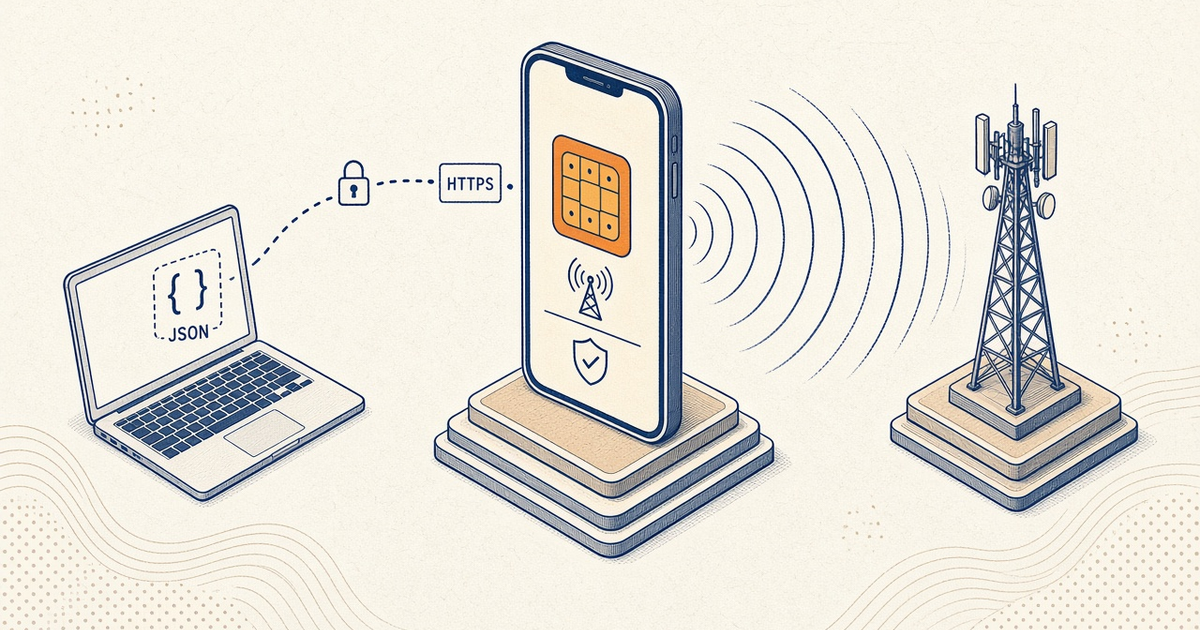
In networking, a gateway connects two worlds. Here those worlds are your application stack and the mobile SMS network. The Android phone is the bridge: it speaks HTTP to the control plane on one side and cellular SMS on the other.
People also search android phone sms gateway and sms gateway using android phone — same idea, different word order. The practical definition never changes:
- A physical Android device with a SIM that can send SMS.
- Gateway software on that device (the app).
- An account and API so your systems can enqueue messages.
- Operator credit that pays for the actual texts.
That last bullet is easy to forget when you are staring at JSON. The phone is not a free SMS printer. It is a modem with a bill attached to a carrier.
Glossary
Layout L002 asks for a glossary so humans and answer engines share vocabulary.
Android phone as SMS gateway
A handset configured so software can send/receive SMS through its SIM via a gateway app and API.
SIM / MSISDN
The subscriber identity and phone number recipients see. You own the relationship with the mobile operator.
Gateway app
The Android agent that stays online, accepts jobs, and drives platform SMS APIs. See the app guide.
Control plane / server
The cloud (or local) layer that authenticates API calls and routes work to paired phones. See gateway server.
DLR
Delivery report — status of a message after accept (Pending, Delivered, Failed, etc.). See the DLR guide.
Dual SIM
Two SIMs in one chassis for routing flexibility. Still one physical failure domain. See multi-device and dual SIM.
Aggregator SMS API
Cloud providers that rent numbers and bill per message via carrier interconnects — different model from a phone gateway.
Architecture: phone, SIM, app, API
Strip the marketing and you get four boxes:
- Phone: power, Wi‑Fi (or data) for the control channel, cellular radio for SMS.
- SIM: identity and operator plan that actually carries messages.
- App: agent that binds the phone to your account and executes sends/receives.
- API / dashboard: how humans and backends enqueue work and read status.
Your CRM never talks to AT commands. It talks HTTPS to the gateway service; the service talks to the app; the app talks to Android's SMS stack; the modem talks to the tower. When something fails, locate which box broke — power, SIM, app permissions, or API auth — instead of rewriting all four at once.
| Layer | Job | Typical failure |
|---|---|---|
| Your backend | Business events → send requests | Bad numbers, missing retries, leaked keys |
| Gateway API | Auth, queue, device routing | 401, plan limits, unknown device |
| Android app | Stay online, call SmsManager | OEM battery kill, revoked SMS permission |
| SIM / operator | Radio delivery | No credit, spam throttle, weak signal |
Android’s public SMS APIs are the last hop the app can see; the tower is not an HTTP resource. The Android SmsManager reference is a reminder that the operating system, not your REST client, talks to the modem.
Message flow step by step
Outbound, happy path:
- Your app decides a user needs a text (OTP, reminder, alert).
- Backend calls the SMS Gateway API with recipient + body (+ optional device preference).
- Control plane authenticates, checks plan volume/devices, assigns a paired phone.
- The Android app on that phone receives the job.
- The phone sends SMS over the mobile network using the SIM.
- Status returns via DLR polling or webhook; you store the terminal state.
Inbound, happy path:
- Someone texts the SIM.
- The app observes the inbound message.
- A webhook posts to your HTTPS endpoint.
- Your system replies via another send call if needed.
Full HTTP shapes live in the API guide and SMS API documentation. The phone-centric point: without a healthy handset in step 4, steps 1–3 are theatre.
Before you start checklist
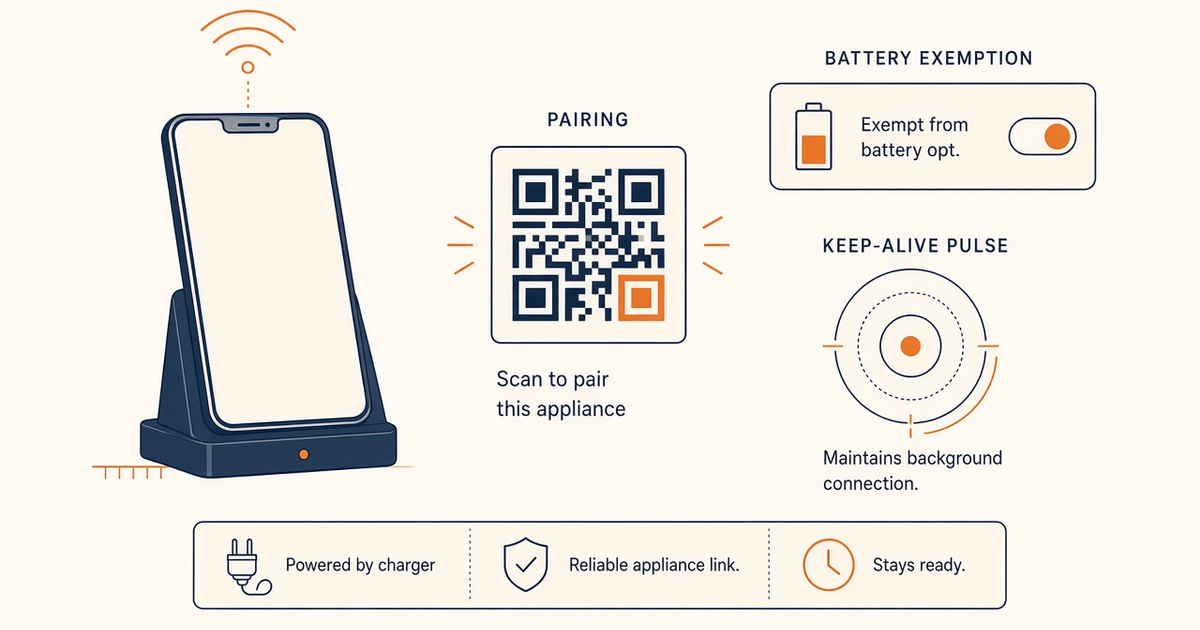
- Android phone you can leave plugged in (dedicated preferred).
- SIM that sends SMS; known balance or bundle.
- Stable Wi‑Fi where the phone will live.
- Account on SMS Gateway; free tier is enough to prove the path.
- A second handset to receive the test message.
- Thirty minutes on the calendar for install + overnight online check.
Skip the overnight check and you will learn about OEM battery policy from your users instead of from your lab.
Choosing which phone to use
You do not need a flagship. You need predictability.
- Age: Android 5.0+ minimum; 8.0+ preferred for fewer background surprises.
- Condition: stable charging port beats a prettier cracked screen you babysit.
- Role: dedicated gateway phone for anything customer-facing; personal phone only for a short POC.
- Radio: known-good signal in the mounting location — test a manual SMS from that spot.
- Dual SIM: useful if you want two identities without a second chassis; still buy a second phone for failover.
Emulators help you learn screens. They do not replace a SIM for real delivery. If your plan is “BlueStacks in production,” stop and buy a used Pixel or mid-range Samsung instead.
SIM and operator strategy
The phone is visible; the SIM is decisive. A beautiful handset with an empty prepaid balance is still a brick.
- Start simple: any SIM that can send SMS proves the architecture.
- Match the market: local SIMs for domestic users usually beat foreign routes for OTP trust and filtering.
- Know the meter: unlimited-talk plans are not always unlimited-SMS. Read the fine print before a campaign week.
- Ramp new numbers: day-one bulk from a fresh MSISDN is how you meet the spam team.
- Separate roles: OTP SIM stays quiet; marketing SIM accepts the noisier reputation risk.
- Watch rejects: rising Failed DLR with healthy phones often means operator policy, not app bugs.
If you operate across countries, think in SIMs per region under one account rather than one “world phone.” Dual SIM helps inside a country pair; multi-device helps across borders. Geo pages such as the geo hub sketch market context once the phone path works.
Step-by-step: phone to first SMS
1. Prepare the handset
Insert the SIM, connect Wi‑Fi, plug into power. Disable the most aggressive battery features you can find before install — you will fine-tune OEM quirks after pairing, but starting gentle helps.
2. Install the gateway app
Download the official build from the downloads page. Install, launch, sign in. Grant SMS and related permissions. Exempt the app from battery optimisation.
3. Pair until the dashboard says connected
Watch the web dashboard until this phone appears online. If it does not, fix network and account device caps before debugging code.
4. Send a test from the panel
Use the dashboard to text a number you control. Confirm arrival. This isolates phone+SIM from your backend.
5. Confirm delivery status
Open the message status / DLR path and wait for a terminal state. Pending forever means radio or permissions, not “API success.”
6. Call the API from your backend
Move the same send into server-side code with the API key in a secret store. Save the message ID. Prefer webhooks for status in production. A minimal mental model of the payload is recipient + message body; exact parameter names live in the SMS API documentation. Do not put the key in an Android WebView, a WordPress theme, or a Shopify script tag — those leak.
7. Leave it overnight
Morning heartbeat + one more test SMS. If both pass, you are using an Android phone as an SMS gateway — not just demoing one.
Optional day-two stretch: trigger a send from your staging backend with a real API key, confirm the message ID lands in your database, and fire a test inbound SMS to the gateway SIM to ensure webhooks reach your tunnel or staging URL. That closes the loop from “phone works” to “our software works with this phone.”
Limits you must respect
Every phone gateway hits the same physical and policy walls. Ignoring them is how SIMs get blocked.
- Throughput per SIM: hundreds to low thousands per hour is the honest planning range; verify with your operator.
- Device uptime: a sleeping phone is a down gateway. Charger + OEM exemptions are mandatory.
- Plan caps: free tier volume and device count are finite; paid tiers raise both. See device and SMS volume pricing.
- Consent and content rules: owning the SIM does not waive spam law or carrier AUP.
- Geographic reach: a local SIM is strong at home and not magic worldwide. Add regional phones or a hybrid aggregator path for global blast.
- Single point of failure: one phone is one failure domain until you add another.
Architecture without limits is fan fiction. Put the ceilings in your capacity sheet next to feature dreams.
Capacity example (peak hour)
Suppose a clinic must send 2,400 appointment reminders between 07:30 and 08:30. That is 2,400 in one hour — right at the edge of what many consumer SIMs should attempt alone. Two phones sharing the load at ~1,200/hour each is calmer, leaves headroom when one device drops, and looks less like a spam burst to the operator.
The same clinic might only send 25,000 messages across a whole month. Monthly total says “one phone is fine.” Peak hour says “bring two.” Always size the Android phone SMS gateway fleet from the worst hour, then sanity-check the monthly plan tier on device and SMS volume pricing.
When a phone gateway fits
- OTP and transactional alerts in markets where you already have SIMs and operator plans.
- Regional business messaging where local numbers deliver better than foreign routes.
- Teams that can own light device ops (power, Wi‑Fi, monitoring).
- Cost-sensitive volume where aggregator per-message pricing hurts.
- Developers who want API control without buying GSM modem appliances.
- Agencies hosting a few client SIMs under clear device labels and quiet-hour rules.
- Internal tooling — on-call pages, warehouse alerts — where a local MSISDN is a feature, not a bug.
For feature depth beyond raw send — bulk CSV, auto-reply, scheduling — start from SMS gateway features after the phone path works. Use-cases like OTP verification and transactional SMS describe product patterns once the handset is boringly reliable.
When it does not fit
- Instant multi-country bursts with no hardware appetite.
- Regulated short-code programmes that require aggregator / operator products you do not have.
- Zero-ops cultures that will not watch a heartbeat alert.
- “Unlimited SMS forever on one consumer SIM” fantasies — carriers disagree.
Hybrid is allowed: phone gateway for primary markets, aggregator for the long tail. Compare models on Twilio vs Android SMS gateway. If you need short codes, guaranteed multi-region blast, or a team that refuses to touch hardware, do not force a phone into that job — you will hate the pager.
From one phone to several
The day your peak hour exceeds one SIM's comfort zone, add phones — each running the same app under one account (within plan device limits). Dual SIM helps on a single chassis; a second chassis helps when the first loses power.
- Shard OTP vs marketing across SIMs.
- Label devices in the dashboard and on the hardware.
- Route with round-robin for mixed traffic; pin critical OTP to a quiet phone.
- Alert per-device offline, not only global send errors.
Multi-device behaviour is documented on multi-device and dual SIM. Capacity planning maths sit in the complete guide.
Lab phone vs production phone
Keep a cheap lab handset for experiments — firmware updates, OEM toggle discovery, webhook dry runs. Keep production phones boring: frozen settings, labeled SIMs, monitored heartbeats, no random sideloads.
Promoting a lab phone to production without re-running the overnight online test is how “it worked on my desk” becomes “OTP is down.” Treat promotion like a mini go-live: permissions, battery exemptions, test SMS, DLR, morning check.
Cost model on a real phone
Three lines again — keep them separate on the spreadsheet:
- Hardware: used Android + charger (often cheaper than a month of aggregator fees at scale).
- Service: devices + SMS volume. Free: 300 SMS lifetime on one device. Paid from $19/month.
- Operator: airtime or SMS bundle on the SIM. We do not resell that balance.
Example: 8,000 transactional SMS/month on one quiet SIM. Aggregator list rates can turn that into a noticeable per-message bill. On the phone model you pay the plan tier that covers that volume plus whatever your operator already charges for those texts. The phone is CapEx and ops; the API is not a third surprise meter beyond plan volume.
Physical and account security
- Screen lock on every gateway phone.
- Official APK only — no forum mirrors.
- Phone in an access-controlled place; SIM theft equals send-path theft.
- API keys only on servers; never typed into a phone note you screenshot into Slack.
- Separate OTP SIMs from public marketing numbers when reputation matters.
- Remove retired devices from the account so lost handsets cannot linger paired.
A phone gateway collapses the distance between “cloud credential” and “plastic in a drawer.” Your threat model should include both.
Automation notes (API and beyond)
Once the phone works, automation is just clients of the same API: cron workers, shop webhooks, CRM plugins, scripts. Keep secrets on the server. Queue sends so a slow modem never blocks your user-facing HTTP.
Looking further ahead, teams wiring agent toolchains sometimes expose messaging as a tool behind protocols like the Model Context Protocol (MCP). That does not replace the phone. It is another way for software agents to call the same send/receive capabilities once your gateway API is solid. Get the handset reliable first; fancy orchestration second.
Common mistakes
- Using a daily-driver phone and wondering why Doze killed OTP at 2am.
- Trusting HTTP 200 without reading DLR.
- Bursting a brand-new SIM like a spam cannon.
- Putting API keys in mobile apps or storefront themes.
- One phone in production with no offline alert.
- Mixing marketing blasts and login codes on the same quiet number until it is no longer quiet.
- Skipping the overnight online test after “it worked once.”
Fix these and most “Android phone SMS gateway is unreliable” stories evaporate — or relocate to an actual carrier issue you can measure.
Troubleshooting the phone path
Work the layers in order:
- Power and Wi‑Fi: is the phone actually on and networked?
- Dashboard online? If not, fix pairing/permissions/OEM battery before touching code.
- Manual SMS from stock Messages: proves SIM and operator credit.
- Dashboard/API send: proves app + control plane.
- DLR terminal state: proves radio completion; see SMS delivery reports (DLR).
- Webhook delivery: proves your backend can hear status and inbound events.
Most outages stop at step 1 or 2. Deep API debugging before those checks wastes hours.
Next steps
Take one spare Android phone, follow the seven steps above, and prove send + DLR + overnight heartbeat. Download from download the Android gateway app, deepen app uptime with the app guide, then wire production clients via the API guide. When you add a second handset, revisit multi-device and device and SMS volume pricing.
Using an Android phone as an SMS gateway is not mystical. It is a charged handset, a paired app, an honest rate limit, and an API your backend already knows how to call.
If you only remember four numbers after this article, make them these: devices on the plan, messages in your worst hour, operator credit on the SIM, and minutes since the last heartbeat. Everything else — frameworks, MCP tooling, CRM plugins — hangs off those four staying healthy. Prove them on one phone before you buy a drawer full of handsets and scale further.
Related product pages
Jump to the live product docs for this topic—not another long-form article.
- device and SMS volume pricingPlans and allowances
- Android SMS gateway product guideDefinition, product, and how to buy
- SMS API documentationLive endpoint reference
- download the Android gateway appGet the APK