Key Takeaways
- The Android SMS Gateway app turns a phone with a SIM into a send/receive endpoint your API and dashboard can drive.
- A dedicated handset on charger + Wi‑Fi beats a personal phone for anything customer-facing; emulators cannot send real SMS without a SIM.
- Most “app is online but nothing sends” failures are permissions, OEM battery policy, or a dead radio path — not bad API code.
- You supply the phone and operator SMS credit. Service pricing is by device count and send volume; the APK itself downloads free.
- For OTP, keep the app on a quiet SIM, monitor heartbeat, and run a second paired device before login codes depend on it.
Search android sms gateway app and you will get download pages, screenshots, and a pile of “just install it” tutorials that skip the part that actually breaks: keeping a phone awake, permitted, and paired for days without babysitting. This guide is about that app as infrastructure — install, pair, and keep it online — not about re-explaining the whole product.
Grab the binary from the downloads page (v7.0 at time of writing). For end-to-end architecture see the setup guide, server modes, and API patterns. Here the camera stays on the handset.
The APK is the easy part. The job is a phone that is still paired, charged, and permitted on Thursday the way it was on Monday — without anyone opening the closet.
What the Android SMS Gateway app is
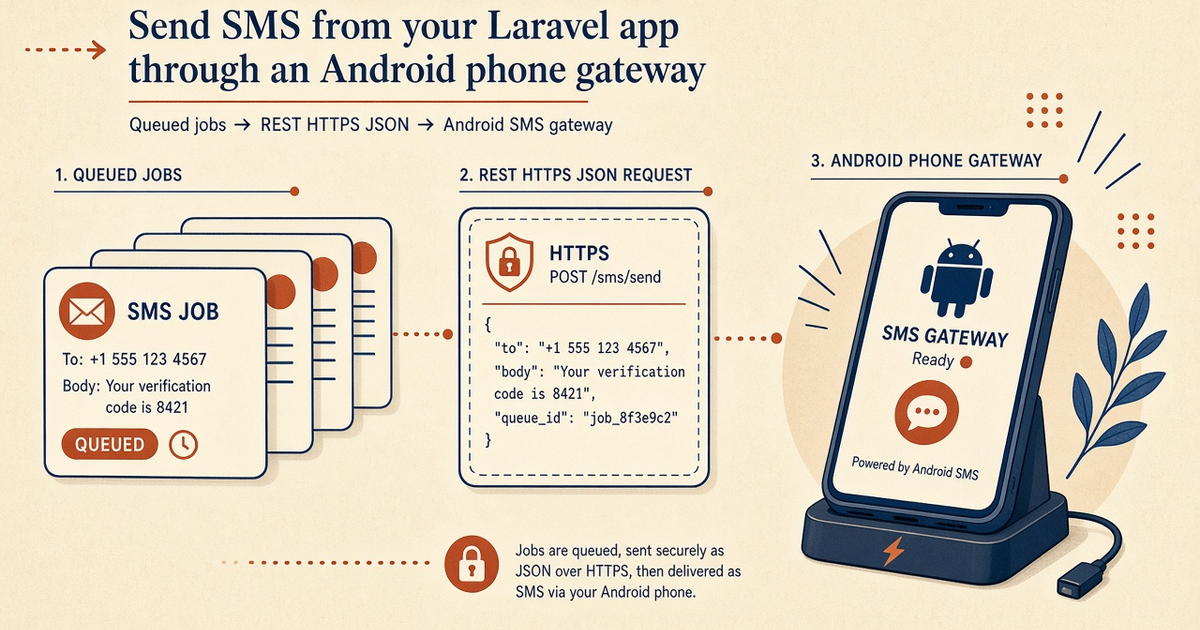
The app is the agent that lives on an Android phone with a SIM. It registers with your account, stays reachable over the internet (typically Wi‑Fi), accepts send jobs from the control plane, invokes the platform SMS APIs, and reports delivery. Incoming SMS on that SIM can be forwarded to your backend so you can build two-way flows.
It is not a consumer messaging client you chat from all day. It is closer to a small appliance: plugged in, online, boring. People searching android app sms gateway often want exactly that — software that makes an ordinary phone behave like a programmable modem without buying rack hardware.
Conceptually it sits beside, not instead of, client-side helpers like Google's SMS Retriever API. Retriever helps your user's app read an OTP that already arrived. The gateway app is how you send that OTP from a SIM you control.
Decision tree: which phone should run it?
Layout L004 starts with a decision tree. Answer in order; stop at the first yes that fits.
- Do you only need to learn the UI? → Any spare Android 5.0+ phone or even an emulator for screens only. Stop here for classroom demos.
- Do you need real SMS to leave the mobile network? → Physical phone + working SIM. Emulators are out.
- Is this for a weekend proof of concept? → Personal phone can work if you disable battery killers for a few days. Accept that a software update may break it.
- Will customers depend on OTP or alerts? → Dedicated handset on charger, locked screen, monitored heartbeat. Prefer two devices before go-live.
- Do you send bulk campaigns and OTP on the same number? → Split SIMs or devices. Quiet SIM for login; louder SIM for campaigns.
- Do you need multi-country sending? → Local SIMs per market where deliverability matters, each running the same app under one account.
If you answered “dedicated + monitored” and then left the phone in a drawer on 12% battery, you did not follow the tree — you decorated it. The hardware choice only works with the keep-online habits later in this article.
Comparison matrix: personal vs dedicated vs emulator
| Dimension | Personal daily driver | Dedicated gateway phone | Emulator (BlueStacks, etc.) |
|---|---|---|---|
| Real SMS send | Yes (SIM) | Yes (SIM) | No (no real modem/SIM path) |
| Background stability | Poor — OS fights you | Good when configured | Irrelevant for delivery |
| Battery / power | Unreliable | Mains charger required | Host PC dependent |
| OTP production | Risky | Appropriate | Not suitable |
| Learning the app UI | Fine | Fine | Fine |
| Cost | Opportunity cost on your phone | Cheap used handset + SIM plan | Free software, zero delivery |
| Best use | Short POC | Production gateway | Screenshots / training |
The matrix is the whole argument in one glance: if delivery matters, buy or reclaim a dedicated Android. Mid-range used phones are enough; the app does not need a flagship camera.
Install and first launch
How to set up the Android SMS Gateway app in practice is mostly ceremony around a careful first launch. Rushing the next ten minutes is how you spend the next ten days debugging.
Download the official APK from download the Android gateway app. Current marketing build is v7.0 (version 7.0). Size is on the order of A few megabytes on disk — light enough for slow links (check the live SHA-256 on the Downloads page after each release).
- On the phone, allow installs from your browser or file manager if Android asks.
- Open the APK and install. You do not need to uninstall older builds first for normal upgrades; settings should carry over.
- Launch the app and sign in with the same account you use on the web dashboard.
- Grant permissions when prompted — next section explains why each one matters.
- Confirm the device appears connected in the dashboard before you celebrate.
Requirements: Android 5.0+ for core use; prefer 8.0+ when you care about the wider feature set. Works across common OEMs (Samsung, Pixel, Xiaomi, OnePlus, and others), but OEM battery policy differs — see quirks below.
Unknown-sources prompts vary by Android version: some ask once per installer app (Chrome vs Files), some bury the toggle under a per-app setting. If install blocks, open Settings → open the installer app's permission to install unknown apps → allow → retry. When the OS warns about Play Protect, confirm you are on the official SMS Gateway download URL before proceeding. Random mirror APKs are not a shortcut; they are an incident.
Permissions that actually matter
Skipping permissions is the fastest way to get a green “installed” state and a dead gateway.
- SMS: required to send and read for two-way / DLR-related device behaviour. Without it the app is a shell.
- Notifications / foreground service style access: keeps the agent visible enough for modern Android not to pretend it is idle junk.
- Phone / device state (when requested): helps dual-SIM and network awareness on some builds.
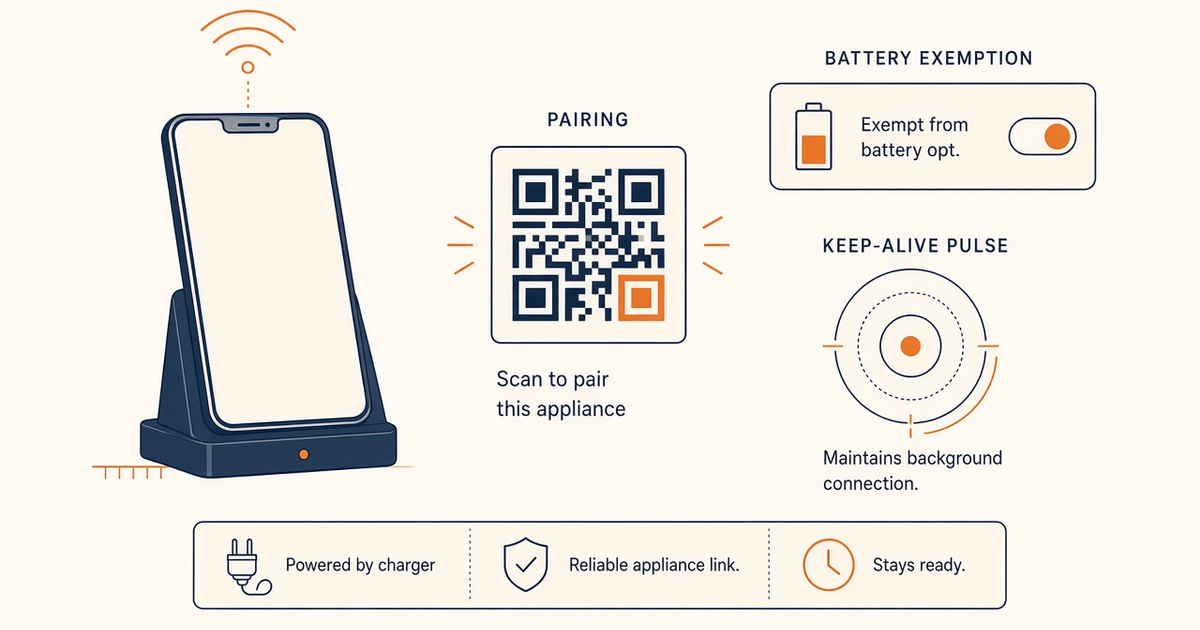
- Ignore battery optimisations: not always labelled as a “permission,” but it is mandatory for production. Exempt the gateway app explicitly.
Re-check permissions after major Android OS upgrades. OEMs love to reset aggressive defaults.
Pair the device and prove it works
Pairing binds this handset to your account so API traffic can find it. After sign-in, wait until the dashboard lists the device as connected. Then send one test SMS to a phone you can hold — from the panel or via the API.
Prove three things, not one:
- The text arrives on the target handset.
- Delivery status moves beyond Pending (DLR or dashboard).
- The device still shows online thirty minutes later without you touching the screen.
That third check catches battery and OEM kills that a single successful send will never reveal.
Pairing failures you will see once
- Wrong account: signed into a personal test account while the API key belongs to production.
- Clock skew / offline install: phone with no network during first sign-in never completes registration.
- Stale session: app shows an old user; sign out, sign in, confirm the dashboard device list updates in real time.
- Plan device cap: account already at max devices — free tier is one device; paid tiers raise the ceiling. Remove an old handset or upgrade before pairing another.
When pairing looks stuck, force-close the app, confirm Wi‑Fi, reopen, and watch the dashboard while you wait thirty seconds. If it still fails, check whether another device is consuming the only free slot.
Keep the device online (the hard part)
This is the section that separates a demo from a gateway. Treat the phone like a Raspberry Pi that happens to have a modem.
- Power: leave it on a charger. Cable quality matters; flaky cables equal flaky uptime.
- Network: stable Wi‑Fi for the app's internet channel. The SMS itself rides the mobile network; the control plane rides Wi‑Fi or data. Prefer Wi‑Fi for the always-on channel.
- Screen: locked is fine; sleeping forever with aggressive doze is not. Follow OEM steps to allow background activity.
- Heat and placement: a phone under a stack of papers on a radiator will thermal-throttle and disconnect. Give it air.
- Monitoring: alert when the dashboard heartbeat goes stale. A silent offline device is how OTP outages start on Friday night.
If you cannot name who gets the alert when the device drops, you do not have operations — you have hope.
First 24 hours runbook
Day one is when most teams “set and forget” and day two is when they discover forgetfulness. Use this runbook once per new device.
- Hour 0: install, sign in, grant permissions, exempt battery optimisation, confirm dashboard connected.
- Hour 0 + 15 min: send test SMS A; confirm delivery and DLR.
- Hour 1: lock the screen, walk away, confirm still connected.
- Hour 4: send test SMS B without unlocking the phone first (unlock only if the OEM forces it).
- Hour 12: overnight on charger; morning heartbeat check.
- Hour 24: send test SMS C; review whether any OEM “optimise” prompt appeared overnight; document the exact settings toggles you used for that phone model.
Write the OEM toggles in your runbook wiki. The next person to swap a dead handset should not rediscover Xiaomi autostart folklore under pressure.
SIM, signal, and plan health
The app cannot out-negotiate a dead SIM. Before you blame the APK:
- Confirm the SIM can send a manual SMS from the stock Messages app.
- Check prepaid balance or postpaid SMS allotment — silent carrier rejects look like gateway failures.
- Verify signal bars in the intended mounting location, not on your desk by the window.
- Avoid roaming as a production posture; roaming policies and data firewalls create weird control-plane gaps.
- New SIMs that suddenly burst look like spam. Ramp volume for the first days.
If manual SMS works and gateway SMS fails, you are back in permissions, pairing, or account routing. If manual SMS fails, fix the operator path first — no app setting will invent airtime.
OEM quirks that kill background apps
Stock Pixel behaviour is the gentle case. Many popular OEMs ship “battery savers” that murder background work.
- Xiaomi / HyperOS / MIUI: autostart + unrestricted battery + lock the app in recents are recurring fixes.
- Samsung: sleep unused apps and deep-sleep lists will catch a quiet gateway; remove it from those lists.
- Huawei / Honor (where present): protected apps / app launch management must allow the gateway.
- OnePlus / Oppo / realme: similar “optimize” toggles; set to don't optimize for the gateway.
After every system update, re-verify. OEMs reset settings more often than documentation admits. When the app shows connected but sends stall, assume OEM policy before you rewrite your backend.
Physical setup that survives a week
Software settings fail when the physical story is sloppy. Aim for boring permanence.
- Mount: upright or flat with airflow; not under linen, not on a heat register.
- Power: wall adapter rated for the phone; consider a small UPS if your office power blinks.
- Network: known Wi‑Fi SSID with a reservation or obvious password ownership; guest Wi‑Fi that expires overnight is a classic own-goal.
- Label: tape the device id / role on the back (“OTP-1”, “Bulk-2”) so humans can match dashboard rows to plastic.
- Access: locked room or cabinet; SIM theft is quieter than server theft and just as damaging.
Optional companion utilities from the downloads ecosystem (always-on helpers, etc.) can help specific OEMs stay awake, but they are supplements — not a substitute for exemption settings and a charger. Start with stock configuration; add helpers only when a model still kills the app after correct battery settings.
Dual SIM inside the app
If the handset has two SIMs, the app can expose both as sending identities depending on your plan and device capabilities. That helps spread load and separate use cases without buying a second chassis — with one caveat: both SIMs still die together if the phone dies. Dual SIM is capacity and routing flexibility, not high availability.
Deeper product behaviour sits on multi-device and dual SIM. For true failover, pair a second physical phone running the same app.
Running a small fleet of apps
One app instance equals one phone. Scaling means more phones, each with the app installed and paired under the same account (within your plan's device cap). Operational habits that keep a fleet sane:
- Identical install checklist per device — do not freestyle OEM settings.
- Role labels in the dashboard matching physical labels.
- Staggered test sends after building power events.
- Spare charged handset imaged with the app for cold swap.
- Document which SIM is OTP vs bulk so a replacement does not mix reputations.
Plan tiers map device count to capacity — see device and SMS volume pricing — because each additional app instance is literally another billable device endpoint, not a free software clone.
Using the app for OTP traffic
OTP is intolerant of a sleepy app. On the device side:
- Dedicate a SIM that never runs marketing bursts.
- Keep the app exempt from battery optimisation 24/7.
- Watch heartbeat as part of your auth SLO.
- Run a second paired device before launch.
On the user side, your mobile app may use SMS Retriever or user consent APIs to read the code — again, that is separate from this gateway app. Your send path is: auth service → gateway API → this app → SIM → user handset. See also OTP verification.
Using the app for bulk and auto-reply
Bulk does not require a different APK — it requires pacing and list hygiene so the same app does not get your SIM flagged. Import and campaign tools are covered on bulk SMS from Excel and CSV. Keep hourly send rates inside what your operator tolerates; the app will happily accept work that a carrier will later punish.
Auto-reply and STOP handling need the app online to receive inbound SMS and your webhook endpoint healthy to act. Wire webhooks and review auto-reply before you promise two-way support hours.
What this app is not for
Clarity prevents angry installs.
- Not a replacement for aggregator global blast. If you need hundreds of thousands of messages in minutes across dozens of countries with no hardware, this app path is the wrong tool.
- Not an invisible background widget on a phone you also game on. Mixed-use personal devices will betray you.
- Not a way to bypass consent law. The app sends as a normal subscriber number; spam rules still apply.
- Not SMS Retriever. Retriever reads codes on the user device; this app sends codes from yours.
- Not an emulator modem. No SIM, no real SMS — regardless of how pretty the UI looks in BlueStacks.
If those constraints are unacceptable, use a cloud aggregator or a hybrid. If they are fine, the Android SMS Gateway app is a straightforward way to own the last mile.
Updates, versions, and safe installs
Install updates from the official downloads channel. Side-loaded random “SMS gateway” APKs from forums are how credentials and SIMs get stolen. You generally do not need to uninstall first; install over the existing app and confirm pairing afterwards.
After updating, repeat the thirty-minute online check. App updates and Android updates are the two most common quiet killers of previously stable gateways.
App and device security
- Download only from SMS Gateway official links.
- Use a screen lock; a stolen unlocked phone is a stolen send path.
- Do not root unless you fully understand the trade — root expands attack surface and is unrelated to normal app operation.
- Keep API keys out of the Android UI screenshots you paste into tickets.
- Store the gateway phone somewhere access-controlled, not on a public retail counter.
- Separate OTP SIMs from public-facing marketing numbers when reputation matters.
The app inherits the trust of the account it signs into. Treat physical access as part of your security model, not an afterthought.
What running the app costs
Three lines on the spreadsheet:
- APK: free to download.
- Service plan: priced by device count and SMS volume. Free tier: 300 SMS lifetime on one device. Paid plans from $19/month. Details on device and SMS volume pricing.
- Operator credit: your SIM's airtime or SMS bundle. We do not sell carrier balance.
Optional hardware budget: a used Android phone and a dedicated charger. That CapEx is still usually tiny next to aggregator per-message fees at steady regional volume — covered in the Twilio comparison.
Worked monthly sketch: one dedicated phone on Starter-class volume for OTP. Service fee is a flat plan line; operator cost is whatever your SIM bundle already covers for those texts. Add a second phone when you want failover — that is another device on the plan, not a surprise per-message multiplier. The app makes that hardware real; pricing simply counts it.
Troubleshooting checklist
Work top-down. Do not start in your Nest controller.
- Is the phone powered and the cable actually charging?
- Is Wi‑Fi connected and working in a browser on that phone?
- Does the dashboard show the device online?
- Are SMS and battery exemptions still granted after the last OS update?
- Does a manual test SMS from the phone's default Messages app still send? (SIM/plan check.)
- Does a gateway test send return an ID but never deliver? Check DLR and operator filtering.
- Are you hitting plan volume or device limits on the account?
Only after those pass should you dig into API clients and retry logic. Most “app bugs” are power, permissions, or SIM.
Keep a paper or digital “last known good” config per OEM model in your team notes: screenshots of battery screens help more than memory. When a replacement phone arrives from a different brand, assume zero transfer of those toggles — re-run the first 24 hours runbook from scratch.
Next steps
Install v7.0 from download the Android gateway app, pair on a dedicated phone, and leave it overnight with monitoring on. If it is still online and can send in the morning, you have an Android SMS Gateway app worth building on. Then wire the API, read SMS delivery reports (DLR) and webhooks, and size the plan on device and SMS volume pricing.
The app is the hands. The API is the voice. The operator SIM is the network. Keep the hands awake and the rest of the system has something reliable to talk to.
Related product pages
Jump to the live product docs for this topic—not another long-form article.
- OTP and 2FA SMS on AndroidAuthentication flows
- device and SMS volume pricingPlans and allowances
- device setup guidePair and go live
- download the Android gateway appGet the APK