Key Takeaways
- Android SMS gateway webhooks limits: your URL’s timeout, retry budget, and how many events you can digest — not a second SIM.
- Confirm numeric caps in Developer Center. This spoke is the failure modes when you blow them.
- A 30-second handler plus automatic retries is how you double-apply refunds and re-send SMS.
- Bulk campaigns produce DLR bursts. Size the receiver before the CSV.
- Priced by devices and SMS send volume. You use your own phone and operator SMS credit. Free is 300 SMS lifetime.
- Architecture lives on the server webhook in-depth. This page is the ceiling.
Feature spoke on android sms gateway webhooks limits — timeouts, retries, payload, and how your receiver saturates. Overview: webhooks overview. Setup: webhooks setup. Control-plane depth: server webhook in-depth.
Priced by devices and SMS send volume. You use your own phone and operator SMS credit.
If your endpoint thinks for three seconds per DLR, a campaign does not “complete.” It DDoSes you with your own receipts.
What “webhooks limits” means here
Caps on how long the control plane waits, how often it retries, how large a body may be, and how many concurrent posts you will actually survive. Product pages describe the feature. This page is what breaks when the CSV is honest.
HTTP limits vs radio limits
OEM/Android SMS rate ceilings govern how fast the modem sends. Webhook limits govern how you hear about it. Raising one does not raise the other. Carrier fair-use still applies either way.
Limit table: timeout, retries, payload, concurrency
| Ceiling | If you blow it | Design |
|---|---|---|
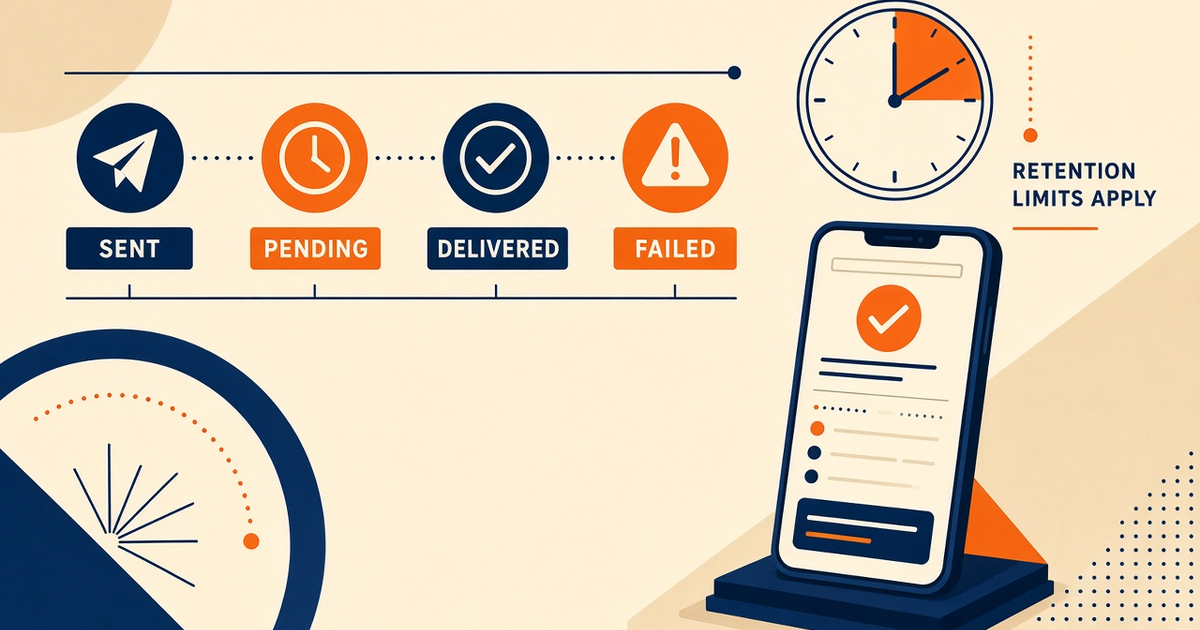
| Handler timeout | Retries; duplicate side effects | Ack fast; queue work |
| Retry count / backoff | Eventual drop or a storm | Idempotent keys; dead-letter |
| Body size | Truncated inbound / 413 | Do not stuff MMS bytes into the hook |
| Your concurrency | DB lock pileup | Serialize per message id |
| Signature clock skew | All events 401 | NTP; then open a ticket |
API usage spoke: webhooks API usage. Numeric values: Developer Center.
Retry storms and duplicate side effects
500 then retry is correct for the sender and lethal if you charge a card or send a second SMS in the handler. Webhooks should record state, not originate new radio work without an idempotency key.
Bulk DLR is not a firehose you ignore
A 20k-row import is 20k receipts (plus retries). Size Redis/SQS before marketing hits send. bulk CSV.
OTP cannot wait on a saturated receiver
If DLR for login shares a clogged queue with campaign receipts, verification UX dies. Separate consumers or priority in your bus. OTP priority queue overview.
Limits are not prepaid SMS packs
Priced by devices and SMS send volume. You use your own phone and operator SMS credit. Dropped webhooks do not refund operator airtime. Platform volume is still devices + SMS sent. Free 300 is not a load-test allotment for retry storms.
Checklist
- Live timeout/retry numbers from Developer Center.
- Handler returns 2xx quickly.
- Idempotency on message id + type.
- Dead-letter for poison payloads.
- Bulk DLR capacity estimated.
- OTP events not stuck behind promo receipts.
- Signatures verified.
- No send-from-webhook without keys.
- MMS/large bodies not assumed.
- No “unlimited SMS” reading of webhook throughput.
Next steps
Read overview and server webhook in-depth, then load-test the URL with a dummy burst — not customer OTP. Pricing stays devices and volume.
Related product pages
Jump to the live product docs for this topic—not another long-form article.
- SMS webhook integrationInbound and status events
- SMS API documentationLive endpoint reference
- device and SMS volume pricingPlans and allowances
- Android SMS gateway product guideDefinition, product, and how to buy