Key Takeaways
- Auto-reply and STOP only run while the Android device is online and the SIM can send. An unread inbox is a missed opt-out, not a software freeze.
- Keep keyword replies to one GSM-7 segment. Long auto-replies burn operator credit and look like spam even when the intent is helpful.
- STOP, STOPALL, UNSUBSCRIBE, CANCEL, END, and QUIT must set a suppression flag before any later campaign send — across every device on the account.
- Never attach keyword automation to the OTP SIM. A HELP loop on a login number is an outage with extra steps.
- Priced by devices and SMS send volume. You use your own phone and operator SMS credit. Confirmation SMS still uses carrier airtime. Free includes 300 SMS lifetime to prove the path.
What “limits” means here
People open this page hoping for a single integer: “you may have 12 rules.” The binding limits on an Android SMS gateway are messier. Auto-reply is an inbound SMS the phone must read, a match against your keyword list, and an outbound SMS the operator must accept. Each step can fail without the panel showing a red banner.
The product overview lives on SMS auto-reply and STOP keywords. Setup is a sibling spoke. This article is the ceiling: what you should not ask the radio to do, and what happens when you do it anyway.
If the confirmation is longer than the inbound STOP, you have already lost the plot. One segment, then silence.
The radio is the hard cap
Keyword engines in the cloud can fire as fast as your webhook. This path cannot. The same OEM SMS rate ceilings and carrier fair-use that bound bulk sends bound auto-replies. A burst of “HOURS?” texts at opening time will queue behind each other on one modem. If you also scheduled a campaign on that SIM, HELP replies wait, and customers send HELP again. That is a self-inflicted loop.
Offline is a hard limit too. No pairing, no keyword match, no suppression flag. Treat battery exemptions as compliance gear. The device setup guide is not optional reading for STOP.
Limit table
| Limit | Practical ceiling | If you ignore it |
|---|---|---|
| Device online | App running, charged, paired | STOP unread; campaigns keep sending |
| Reply length | One GSM-7 segment (~160 chars) | Unicode split, extra airtime, spam score |
| Keyword overlap | Zero collisions on the same inbound | Double replies or missed STOP |
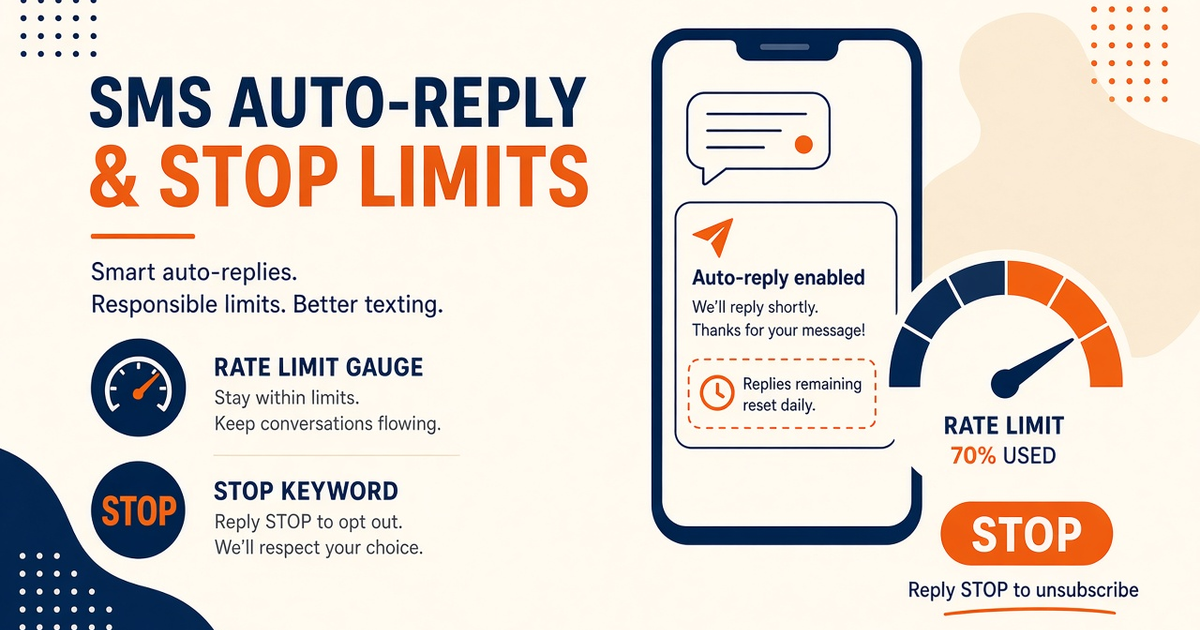
| Per-number inbound flood | Stop auto-replying; open inbox | Airtime burn, operator throttle |
| Message class | Promotional SIM only | OTP latency and confused users |
| Account-wide STOP | One flag for every device | Phone B sends after phone A heard STOP |
US keyword expectations are summarized by CTIA messaging principles. Counsel still owns your market.
Loop and flood limits
The dangerous pattern is auto-reply that invites another keyword. “Text MENU for options” on a HELP reply will bounce forever with a bored teenager. Fallback for unmatched inbound should be silence plus an inbox flag, or a single “we got this, a person will reply.” Never “sorry, try HOURS or PRICE or STATUS or MENU.”
Two-way threads that need a human belong in the two-way SMS inbox, not in a longer rule list.
OTP is out of bounds
Do not auto-reply into login or password-reset threads. Do not put STOP footers on OTP templates “to be safe.” Campaign limits and authentication limits are different jobs. Isolate devices, then see OTP and 2FA SMS on Android.
How to stay inside the limits
- List keywords you will actually receive. STOP family first, then HELP, then a handful of FAQ tokens. Delete anything you cannot test this week.
- Write one-segment replies. Brand, answer, path to a human. No coupon. No second question that invites another auto-reply.
- Put rules on the promotional SIM only. OTP and password-reset devices stay silent except for the code your backend sends.
- Prove STOP end to end. Second phone texts STOP, confirmation arrives, flag is set, next campaign skips the number.
- Add a flood brake. If the same MSISDN hits a keyword ten times a minute, stop auto-replying and open the inbox.
- Re-test after OEM updates. A “limit” that appears overnight is often Doze, not a rule count.
Live webhook fields for inbound events stay in the SMS API documentation. Operational STOP runbook: how to handle STOP and opt-outs.
What replies cost
Service pricing is based on device count and total SMS sent through the gateway. You need a working Android phone with a SIM and SMS credit from your mobile operator. Operator message costs are yours—we do not sell carrier SMS balance. HELP and STOP confirmations are real sends. Budget them. Paid plans from $19/month. Free is 300 SMS lifetime — enough to test keywords, not to run a public HELP line. Device and SMS volume pricing.
Limit mistakes
- A 400-character auto-reply “welcome pack.”
- STOP on device 1, campaign still leaving device 2.
- Keyword rules on the OTP phone.
- No flood brake, so a stuck customer drains prepaid.
- Assuming the panel will auto-reply while the handset is in a drawer.
Next steps
Read the pillar auto-reply and STOP, keep lists honest on contacts and lists, and do not let unmatched inbound vanish without an owner.
Related product pages
Jump to the live product docs for this topic—not another long-form article.
- two-way SMS inboxReplies on your SIM
- SMS auto-reply and STOP keywordsOpt-out and keywords
- SMS API documentationLive endpoint reference
- device and SMS volume pricingPlans and allowances