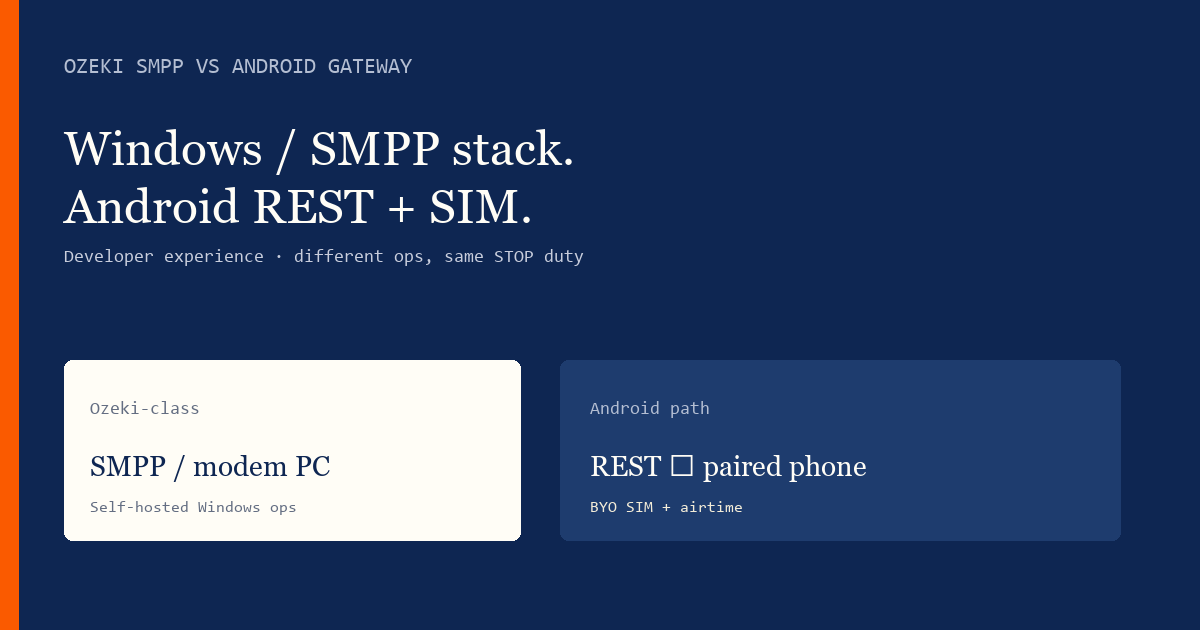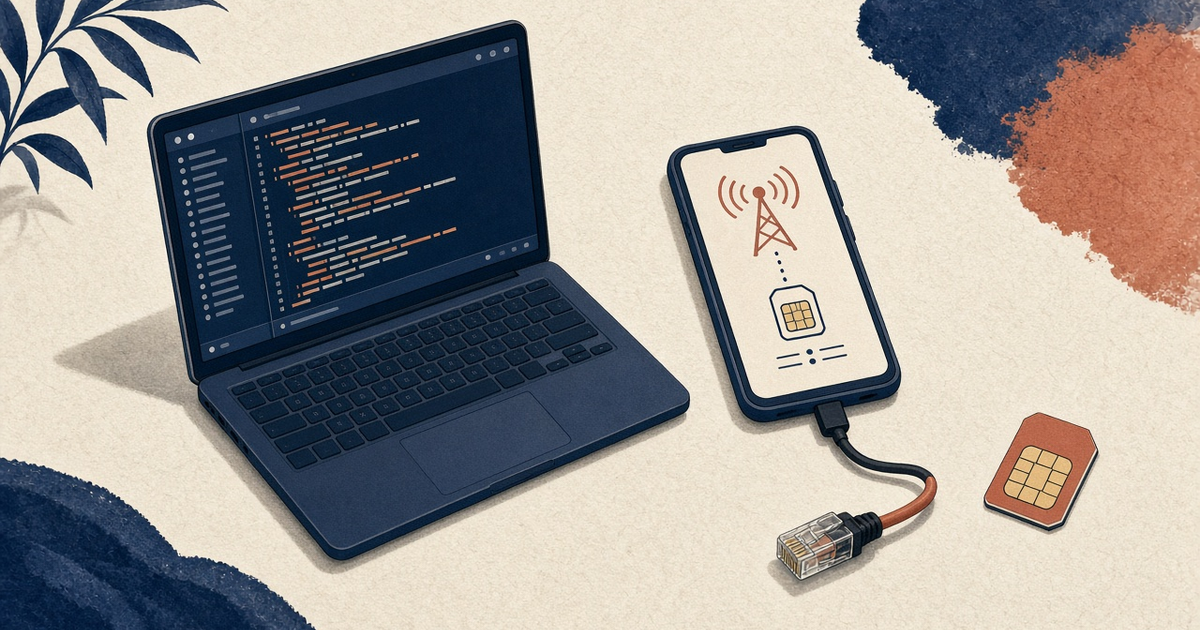
Key Takeaways
- “Android SMS gateway open source” usually means DIY apps/servers on GitHub that drive a phone’s SIM via HTTP — powerful, and you own every failure mode.
- A maintained SaaS gateway still uses your phone and operator credit; it sells the control plane, pairing, DLR, and multi-device ops so you are not on-call for the stack.
- Choose OSS when you need air-gapped control, custom forks, or learning. Choose maintained when OTP uptime and staff time matter more than zero license fees.
- Evaluate GitHub projects on last commit, issue hygiene, webhook/DLR support, OEM battery docs, and whether one person can run it at 2am.
- Service pricing here is devices + SMS volume; the APK path is free to start — operator airtime is always yours either way.
Search android sms gateway open source and you will find GitHub repos, forks, and forum threads promising “free forever SMS APIs.” Some of those projects are excellent engineering. Some are abandoned experiments with a README that outlived the maintainer. This guide helps you tell which is which — and when a maintained SaaS Android gateway is the cheaper choice even if it is not zero dollars.
A MIT license does not pay for OEM battery exemptions, carrier airtime, or the person who wakes up when the phone Doze-kills at 2am.
Related reading if you already chose a path: phone as gateway, app uptime, server modes, API patterns. Here the question is strategic: DIY open source versus operated product.
What people mean by "open source"
In this niche, android sms gateway github results usually fall into a few buckets:
- Android apps that expose a local HTTP server on the phone.
- Apps that pair to a self-hosted or public relay.
- Server projects (Go, Node, PHP) that talk to an Android companion.
- Scripts that wrap
adbor vendor APIs — closer to hacks than products.
Open source means you can read and often modify the code under a license. It does not mean the mobile operator stops charging for SMS. It does not mean OEM battery policy becomes friendly. It does not mean security patches arrive on a schedule. Keep those distinctions sharp or the word “free” will lie to you.
There is also a marketing abuse of the phrase: closed binaries wrapped in “community edition” labels, nulled commercial panels, and mirror APKs that have nothing to do with inspected source. If you cannot clone a repo, read a license file, and build from a tagged commit, you are not evaluating open source — you are gambling on a random download. Stick to projects you can audit.
Decision tree: OSS or maintained gateway?
Layout L005 is a troubleshooting / decision tree. Walk it in order.
- Must the control plane stay entirely on your LAN with no vendor cloud? → Bias to OSS or self-hosted private server. Maintained cloud relay may be disallowed by policy.
- Do you have an engineer who can own Android OEM quirks, TLS, and on-call for the phone? → If no, bias to maintained SaaS.
- Is OTP or revenue-critical alerting on the line? → Prefer the path with monitoring, multi-device failover, and a support channel you did not invent.
- Do you need to fork the protocol or embed custom modem logic? → OSS wins; SaaS APIs are fixed contracts.
- Is the GitHub project actively maintained (recent commits, triage, releases)? → If no, treat it as a learning lab, not production.
- Are you optimizing license fee to $0 while ignoring staff hours? → Recalculate. Staff time is the real meter.
If you hit “no engineer / critical OTP / inactive repo,” stop romanticizing open source for this workload. Use it to learn, then run production on something operated.
Comparison matrix
| Dimension | Open-source DIY gateway | Maintained SaaS Android gateway |
|---|---|---|
| Source access | Full (per license) | Client app + documented API; hosted control plane |
| Who patches CVEs | You / the community | Vendor + your config hygiene |
| Multi-device routing | Often DIY | Usually built into the account |
| DLR / webhooks | Varies wildly by repo | First-class product surface |
| OEM battery docs | README luck | Product + support path |
| Software fee | Often $0 license | Devices + SMS volume plans |
| Carrier SMS cost | You pay operator | You pay operator |
| Best fit | Control, forks, air-gap, learning | Uptime, speed to production, small teams |
Notice the shared row: operator cost. Neither path sells you “unlimited carrier SMS.” Anyone implying that is selling fantasy.
Common open-source shapes
Local-only HTTP on the phone
The app listens on the LAN. Great for factories and labs. Painful the moment your API moves to a VPS behind CG-NAT. You will invent tunnels. Some teams are fine with that; most SaaS backends are not.
Cloud or self-hosted relay + Android companion
Closer to commercial architecture. Quality depends on whether the relay is documented, authenticated, and still maintained. Self-hosting the relay means you now run two systems: phone agent and server.
Server-centric with thin Android client
Useful when you want business logic in Go/Node/PHP. The Android piece still has to survive OEM kills — server elegance does not fix a sleeping handset.
Abandoned forks
Stars without commits after 24 months are a smell. Forks that only change package names are a smell. Issues titled “does this still work on Android 14?” with no answer are a smell. Treat them as archaeology.
How to evaluate a GitHub SMS gateway
When you land on an sms gateway android github repo, run this review before you pair a SIM:
- Last commit and last release — weeks vs years.
- Open vs closed issues — is anyone triage-ing?
- License — can you legally ship a fork in your product?
- Auth model — basic auth on LAN only, or production-grade secrets?
- Delivery reports and inbound webhooks — or send-only hope?
- Multi-device story — or one phone forever?
- OEM battery guidance — or silence?
- Dependency health — abandoned Firebase/OkHttp pins are future pages.
- Bus factor — one maintainer with no CODEOWNERS is a risk register item.
A beautiful README demo is not a production evaluation. Overnight online + DLR terminal state is.
README red flags
You can often reject a candidate in five minutes of reading — before you waste a weekend on install.
- “Unlimited SMS” with no carrier disclaimer.
- Screenshots only on Android 7; silence on Android 13/14/15.
- No mention of delivery reports or inbound messages.
- API keys hard-coded in sample apps “for convenience.”
- Last release tagged before the current Android major version existed.
- Issues closed with “works on my phone” and no reproduction template.
- Telegram-only support with no public tracker.
- Claims to bypass operator filters as a feature.
Any one of those is a pause. Two or more is usually a hard no for production OTP.
Production readiness checklist
Print this. Score yes/no. Anything “no” on critical rows blocks go-live.
- ☐ Dedicated phone on charger with labeled role
- ☐ SMS + battery exemptions verified after last OS update
- ☐ Dashboard/API auth secrets only on servers
- ☐ Send → DLR path proven (not only HTTP 200)
- ☐ Inbound webhook signature verification
- ☐ Offline heartbeat alert to a human
- ☐ Second device for OTP failover (or accepted risk written down)
- ☐ Rate limits aligned with operator fair use
- ☐ Backup APK/version pin and rollback notes
- ☐ Someone named for 2am ownership
- ☐ License reviewed by someone who ships legal
- ☐ Dependency update plan (Dependabot is not a plan by itself)
OSS projects rarely ship this checklist for you. Maintained products encode parts of it into the service. Either way, the checklist is yours.
A week of ops: OSS vs maintained
Imagine a Monday-to-Sunday slice for a two-person startup sending OTP.
Open-source DIY week
- Monday: Android security patch reboot clears battery exemption; OTP stalls until someone notices.
- Wednesday: dependency CVE blog post; you decide whether to bump libraries and retest the APK.
- Friday: marketing asks for scheduled blasts; you discover the fork has no scheduler and hack a cron.
- Sunday: phone charger fails; no second device; login codes wait until Monday hardware run.
Maintained gateway week
- Monday: dashboard shows device offline; alert fires; you reseat the cable — same physical risk, faster detection.
- Wednesday: vendor-side API remains stable; you did not rebuild the APK for a transitive CVE in a demo server.
- Friday: scheduled SMS exists as a product feature — see scheduled SMS— instead of a bespoke cron you must babysit.
- Sunday: second paired device takes over if you sized the plan for failover.
The point is not that SaaS removes phones. It removes undifferentiated engineering around the control plane so your scarce hours go to product. OSS keeps those hours on your calendar by design.
Troubleshooting decision tree
When “open source gateway broken” hits Slack, branch like this:
- Phone offline in UI? → Power, Wi‑Fi, OEM battery, app permissions. Do not touch Laravel yet.
- Phone online, API 401/403? → Secrets, clock skew, rotated tokens.
- API accept, no DLR? → SIM credit, signal, carrier filter, missing DLR feature in the project.
- Works on LAN, fails from cloud? → You chose local-only architecture; add relay or move callers onto the LAN.
- Broke after Android update? → Upstream issue or your fork; check tracker, pin versions, consider whether you want to be the OEM compatibility team.
- Maintainer ghosted? → Freeze features, plan migration, stop building product bets on the fork.
Deep DLR semantics for the maintained path live in the DLR guide. The same discipline applies to OSS: status after accept is the truth.
True cost of "free"
Model cost in hours and risk, not only invoices.
- Integration hours: auth, webhooks, retries, OEM docs — often days.
- Ongoing ops: every Android major version is a potential regression test.
- Incident cost: OTP down for an hour can dwarf a year of SaaS fees.
- Opportunity cost: your senior engineer debugging MIUI autostart is not shipping product.
- Carrier bill: identical category on both paths.
A maintained Android SMS gateway like ours charges for devices and send volume — free tier includes 300 SMS lifetime on one device; paid from $19/month — while you still bring phone and operator credit. See device and SMS volume pricing. Compare that number to the loaded cost of a half-time engineer babysitting a repo .
Feature parity questions
Before you commit to a repo because send works, ask whether you will need these within six months:
- Delivery reports with stable IDs you can store.
- Inbound SMS and STOP handling.
- MMS or attachments — commercial depth on MMS gateway.
- Scheduling and quiet hours.
- Multi-device and dual SIM routing.
- Contact lists / CSV bulk without melting a SIM.
- Audit-friendly message history retention.
Building each of those on a thin OSS base is a product roadmap of its own. Sometimes that is the mission. Often it is accidental scope creep born from avoiding a monthly plan.
Who owns what on your team
Ambiguous ownership kills DIY gateways. Name roles before the first SIM goes live.
- Device owner: chargers, OEM settings, spare handset, physical access.
- Platform owner: APK builds or vendor updates, dependencies, staging proofs.
- Application owner: API client, queues, idempotency, webhook handlers.
- On-call: who gets the heartbeat page at 2am — not “the group chat.”
On a maintained SaaS path, device owner and application owner still exist; platform owner shrinks because the control plane is vendor-operated. On OSS, all four roles are internal whether you admit it or not. If three of them map to the same overworked person, you do not have a resilient design — you have a hero narrative.
When a maintained SaaS gateway fits
- Small teams that need OTP or transactional SMS without a telephony platform squad.
- Multi-device routing, DLR, and webhooks as productized features.
- You want a downloadable Android app plus hosted control plane — start at download the Android gateway app.
- You value a documented API and support path over forking freedom.
- You still want SIM ownership and operator economics — not aggregator per-message pricing as the default.
Product overview: what an Android SMS gateway is. Feature depth (MMS, scheduling, etc.) once the path works: MMS, scheduled SMS.
Hybrid paths that actually work
You do not owe ideology to a single camp.
- OSS in lab, SaaS in prod: learn modem behaviour on a fork; run customer traffic on maintained infra.
- SaaS primary, aggregator backup: Android SIMs for regional OTP; cloud aggregator for global burst — see Twilio comparison.
- Self-hosted relay where policy demands, SaaS elsewhere: split by compliance zone, not by tweet threads.
Hybrids fail when nobody writes down which path owns OTP. Write it down.
Laravel and other backends
Framework choice is orthogonal to OSS vs SaaS. Your Laravel app (or Nest, Django, Rails) should wrap the gateway behind a notification channel or client interface: queue the job, call HTTPS, store message IDs, verify webhooks. Official Laravel docs cover queues, HTTP client, and env configuration — use them. Do not paste gateway keys into Blade templates.
If you later swap OSS for SaaS (or the reverse), the interface stays; only the adapter changes. That is the real portability win — not copying curl from a README into controllers forever. Language samples for the maintained API also live under PHP and the SMS API documentation.
Security differences
- OSS: you control the code path; you also inherit supply-chain and patch burden. Pin dependencies. Review permissions the Android app requests.
- SaaS: you trust a vendor with control-plane availability and practices; you still secure keys, webhooks, and the physical phone.
- Both: stolen handset = stolen send path; leaked API key = abuse; unsigned webhooks = forged OTP status.
Neither model deletes the need for HTTPS, secret storage, and physical access control. OSS does not automatically equal “more secure”; SaaS does not automatically equal “less secure.” Execution does.
Licensing and compliance notes
Before you embed a GitHub gateway into a commercial product:
- Read the license (MIT, Apache, GPL, proprietary wrappers mislabeled as OSS).
- GPL copyleft may force you to share modifications if you distribute — get counsel if unsure.
- Attribution requirements are real; ignore them and you create legal debt.
- Carrier and privacy law still apply to messages you send — license ≠ consent.
“It was on GitHub” is not a compliance strategy.
How to migrate without rewriting everything
- Introduce a
SmsGatewayClientinterface in your backend now — even if only one implementation exists. - Map message IDs and statuses into your own tables (do not treat vendor IDs as your only source of truth).
- Proof the new path on a non-OTP traffic slice first.
- Dual-run critical flows until DLR ratios look sane.
- Decommission the old phones/repos deliberately — revoke keys, unpair devices.
Migrations fail when controllers call three different curl shapes. Centralize early. The API guide shows the disciplined patterns for the maintained side.
Budget a migration weekend only after dual-run metrics look boring: similar deliver ratios, webhook error rates under your threshold, and on-call comfortable with the new dashboard. Dramatic cutovers on Friday before a holiday are how OSS-vs-SaaS debates become war stories.
Common mistakes
- Equating stars on GitHub with production readiness.
- Deploying local-only servers for cloud APIs without a relay plan.
- Skipping DLR because the demo only showed “sent.”
- One personal phone as the entire “open source infrastructure.”
- Ignoring licenses until a customer’s security questionnaire arrives.
- Building features on a fork you cannot upstream — then drowning in merges.
- Assuming open source removes operator cost or spam rules.
- Confusing “we can fork it” with “we will maintain it for three years.”
- Skipping the overnight online test because the first curl succeeded.
Next steps
If the decision tree pointed to DIY: shortlist two repos, run the checklist, proof overnight, and write an ownership name next to the phone. If it pointed to maintained: install from download the Android gateway app, follow phone setup, and wire the API. Either way, judge on delivery reports and staff hours — not on whose marketing said “free.”
Open source is a tool. A maintained Android SMS gateway is a tool. The wrong one is whichever you cannot operate when OTP stops at midnight.
If you want a concrete proof path on the maintained side today: download the app, pair one dedicated phone, send one OTP-shaped message, confirm DLR, leave it overnight, then price the device count you actually need. That experiment costs less than debating stars on GitHub for another week — and it gives you evidence instead of vibes. If the experiment fails for a reason OSS would also hit (dead SIM, OEM kill), fix the phone path first; switching license models will not charge a battery. Keep notes from the experiment: OEM model, settings toggles, deliver ratio, and minutes to recover from a forced reboot. That notebook becomes your acceptance test for any future GitHub candidate as well. Re-run that notebook after every Android major update before you trust either stack with login codes in production traffic. Keep the notes next to your runbook so the next engineer inherits evidence, not folklore.
Related product pages
Jump to the live product docs for this topic—not another long-form article.
- SMS API documentationLive endpoint reference
- device and SMS volume pricingPlans and allowances
- Twilio vs Android SMS gatewayCloud vs own-SIM cost model
- Android SMS gateway product guideDefinition, product, and how to buy