Key Takeaways
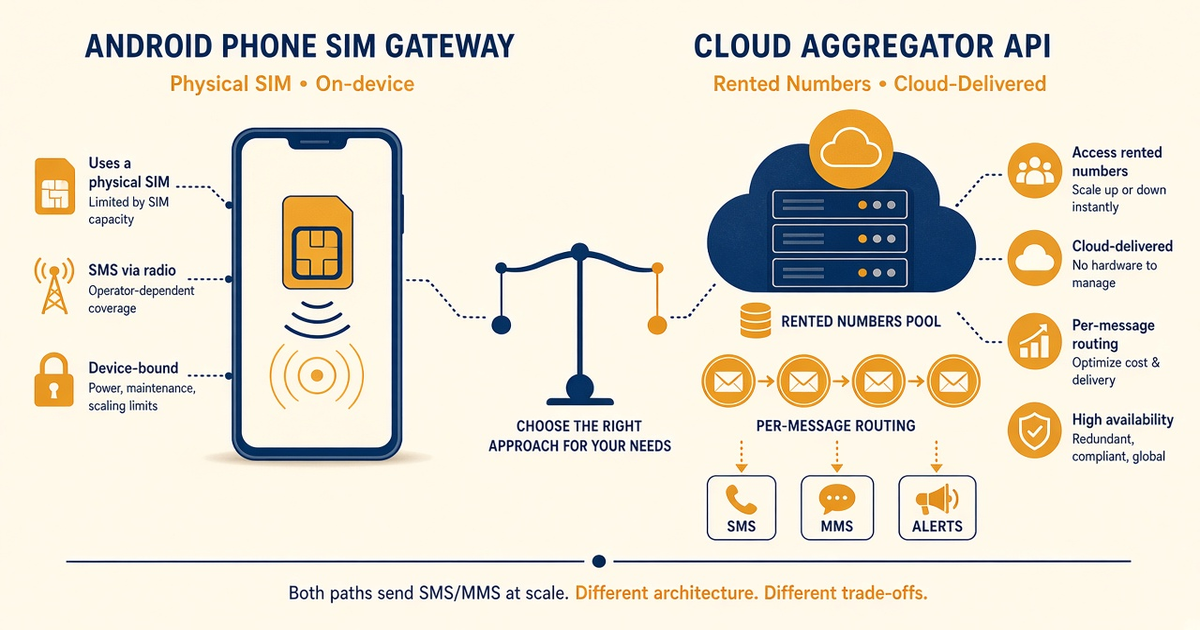
- android sms gateway app vs twilio is a last-mile choice: your SIM and MSISDN versus rented aggregator numbers and per-message interconnect.
- Plans are billed as device + SMS volume tiers—not aggregator-style $0.0x-per-message platform charging. Starter, Professional, and Business include unlimited platform send volume; Developer and Free have published SMS caps. Operator airtime remains separate, and carrier fair-use still applies.
- Twilio-style APIs win when you cannot host a phone, need many countries with no radio ops, or want managed sender IDs.
- The Android app wins when recipients should see a real local number, you already buy airtime, and you can keep a handset online.
- Do not mix OTP and marketing on the same SIM pool just because the HTTP looks similar.
- Confirm live Android gateway fields in Developer Center; do not treat this page as either vendor’s OpenAPI.
Teams searching android sms gateway app vs twilio usually have a working HTTP client and a finance question. Keep the comparison honest: one path is a phone with a SIM, the other is an aggregator. The app cornerstone covers uptime. The product comparison page is Twilio vs Android SMS gateway. This spoke is the app-shaped version of that fork.
Priced by devices and SMS send volume. You use your own phone and operator SMS credit.
If you need the recipient to reply to a number they already save as “the shop,” a rented cloud code is a different product — not a cheaper Twilio.
The actual fork
Twilio-class APIs sell you connectivity and a number as a service. The Android app sells you a control plane in front of hardware you operate. Both speak HTTPS. Only one of them cares whether the charger is in the wall.
Side-by-side matrix
| Dimension | Android SMS gateway app | Twilio-style CPaaS |
|---|---|---|
| Last mile | Your SIM / operator SMSC | Aggregator interconnect |
| Sender identity | The MSISDN on the SIM | Rented long code / sender ID / short code |
| Platform bill | Devices + send volume tiers | Usually per message + number rental |
| Carrier bill | You pay the operator | Bundled into the vendor rate |
| Ops | Keep phones online, charged, funded | No handset drawer; vendor SLA theatre |
| Two-way | Replies hit the same SIM | Replies hit the rented number |
| Global long tail | You need a SIM in that country | Usually one API, many destinations |
For Twilio’s own model, read their SMS docs — not as an endorsement, as the other side of the invoice.
When the Android app wins
- Domestic OTP and alerts where a local mobile number builds trust.
- You already buy airtime in bulk and hate per-message platform markups on that traffic.
- Two-way support on a number customers already text.
- A small team that can own a charged drawer of phones.
Throughput is still a radio. Plan peak hour per SIM, not a marketing “unlimited” story. Starter and up uncap platform send volume; devices still meter; your operator still has fair-use. Do not put “Unlimited SMS” in a title and pretend the tower got the memo.
When a CPaaS API wins
- No one will keep a phone online. That constraint is decisive.
- You must reach many countries from day one without local SIMs.
- You need managed sender IDs, short codes, or carrier registration the aggregator already runs.
- Compliance teams require a vendor questionnaire the handset model does not satisfy yet.
Saying the Android app “replaces Twilio” for every lane is how projects fail. It replaces the lanes where a SIM is the point.
Hybrid is normal
Route Bangladesh/India/domestic OTP to the Android pool. Route US/EU long-tail to CPaaS. Share a message-id in your own database so support does not care which pipe fired. Fail over with a feature flag, not a weekend rewrite.
Isolate OTP from marketing on the SIM side either way. A Twilio campaign and a SIM campaign can still starve the same user if you retry both.
Cost model without theatre
Plans are billed as device + SMS volume tiers—not aggregator-style $0.0x-per-message platform charging. Starter, Professional, and Business include unlimited platform send volume; Developer and Free have published SMS caps. Operator airtime remains separate, and carrier fair-use still applies. Paid Android plans start from $19/month. Add operator airtime, electricity, and the person who notices last-seen. Twilio-style TCO is rate × volume + numbers + engineering against their console. Spreadsheet both with the same OTP volume — do not compare sticker prices.
Failed retries spend SIM airtime and platform volume. They also spend CPaaS credits. Idempotency is cheaper than ideology.
Developer experience, honestly
Both are HTTPS + JSON + webhooks if you want them. The Android path adds deviceIds, dual-SIM, and “is the phone awake.” Twilio adds messaging services, copilot, and a giant catalog. Confirm Android fields in SMS API documentation. Language samples on this site are REST examples, not a fake multi-language SDK product.
Decision checklist
- Must recipients see a real local MSISDN?
- Can we keep a phone online 24/7 with a spare?
- How many countries in the first quarter?
- OTP isolated from promo on whatever pipe we pick?
- TCO includes airtime or per-message rates, not only SaaS?
- Fallback written if the chosen pipe dies?
Next steps
If the SIM path is the job, install from Downloads and prove one canary. If zero phone ops is mandatory, stay on CPaaS for that lane. Read device and SMS volume pricing before you tell finance “it’s just like Twilio.”
Related product pages
Jump to the live product docs for this topic—not another long-form article.
- device and SMS volume pricingPlans and allowances
- Twilio vs Android SMS gatewayCloud vs own-SIM cost model
- Android SMS gateway product guideDefinition, product, and how to buy
- SMS API documentationLive endpoint reference