Key Takeaways
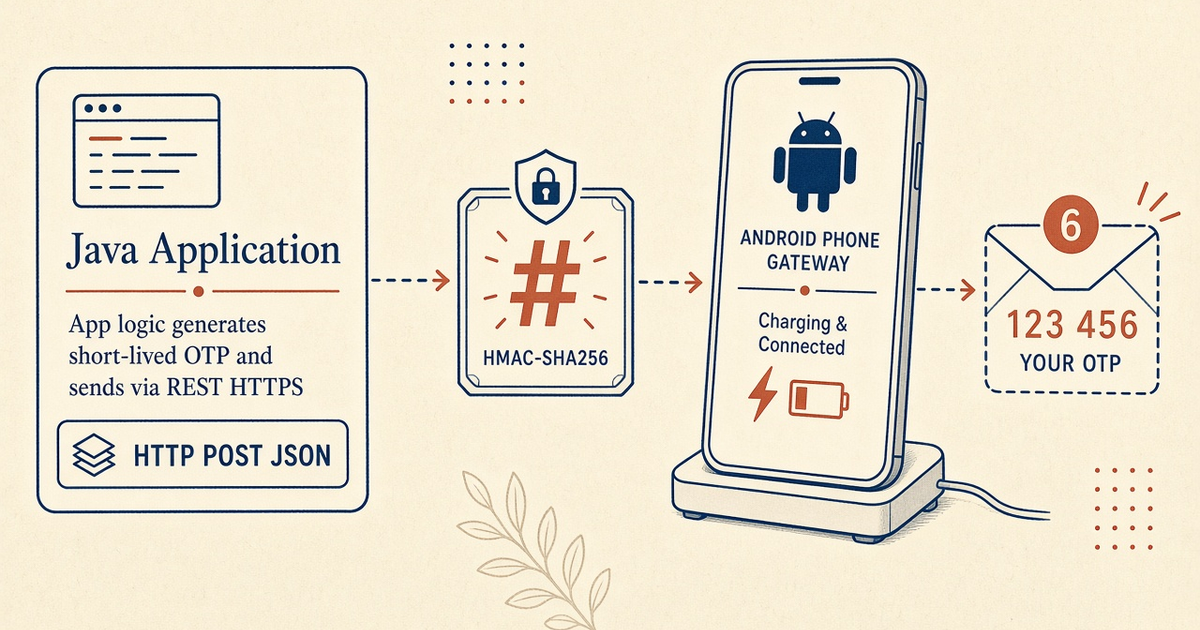
- Java send OTP on an Android SMS gateway API: HttpClient POSTs Bearer JSON to a named radio. Store a hash, not the code, after accept.
- Hub C language spoke. Not a Maven/Gradle “complete Java SDK,” not NuGet, not composer.
- Never put OTP on the promo nickname. MMS is the wrong channel for login.
- Accept is not delivered. Time out the challenge on DLR/webhook, not on HTTP 200.
- Priced by devices and SMS send volume. You use your own phone and operator SMS credit. Free is 300 SMS lifetime.
- Live fields: Developer Center.
Hub C: android sms gateway api send OTP from Java. Cornerstone: Android SMS gateway API. Product: OTP verification. C sibling (same JSON): C send OTP. Keys: secure API keys in env.
Priced by devices and SMS send volume. You use your own phone and operator SMS credit.
If the OTP servlet and the Friday blast share a device nickname, you do not have two-factor. You have a queue argument at 18:00.
HttpClient is not a Java SMS SDK
POST JSON, Authorization Bearer, read the message id. Confirm POST /api/v1/messages in Developer Center. No Maven coordinate we sell, no “Complete Java SDK,” no JNI modem kit.
Named OTP device, hashed challenge
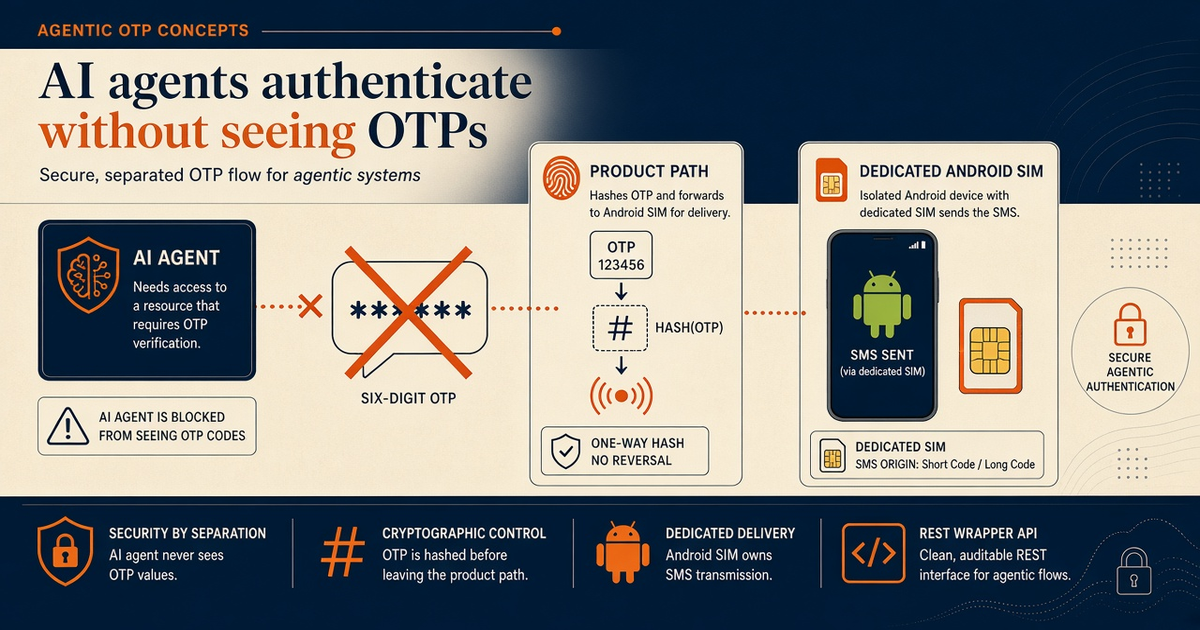
Store hash + expiry + attempt count. Compare on verify. Do not log the plaintext code. OTP priority queue. If last-seen is stale, fail closed — offline queue behavior.
Lane table: OTP vs MMS vs promo
| Lane | Java job | Must not |
|---|---|---|
| OTP | Short SMS, hashed row, tight TTL | Share promo nickname |
| Transactional | Receipts / alerts | Reuse the login template |
| Promo | Queued campaign | Jump the OTP device |
| MMS | Never for 2FA | “Branded” login slides |
One POST is not login complete
HTTP 200 is accept. Gate the UX on DLR or a conservative timeout plus inbound if you use reply codes. API delivery reports.
Bearer in env, not the WAR
Environment on the app server. Never a properties file in git. REST samples on PHP and C# are the same contract — not language SDKs.
Failed logins still spend the SIM
Priced by devices and SMS send volume. You use your own phone and operator SMS credit. Cooldown after resend. Attackers will burn airtime and platform volume if you have no cap. We do not refund operator tariffs.
Shape of a send
Illustrative only — confirm fields in Developer Center:
HttpRequest req = HttpRequest.newBuilder(URI.create(sendUrl))
    .header("Authorization", "Bearer " + System.getenv("SMS_GATEWAY_TOKEN"))
    .header("Content-Type", "application/json")
    .POST(HttpRequest.BodyPublishers.ofString(json))
    .build();
// persist message id; do not treat 200 as delivered
Checklist
- Named OTP device.
- Hash + expiry stored.
- Key in env.
- Idempotency on resend.
- No MMS for login.
- Last-seen check before send.
- No Java SDK branding.
- Developer Center checked.
- Resend cooldown.
- Canary staff MSISDN.
Next steps
Read OTP verification and pricing. The JVM is fast. The SIM still has a ceiling.
Related product pages
Jump to the live product docs for this topic—not another long-form article.
- OTP and 2FA SMS on AndroidAuthentication flows
- SMS API documentationLive endpoint reference
- device and SMS volume pricingPlans and allowances
- Android SMS gateway product guideDefinition, product, and how to buy