Key Takeaways
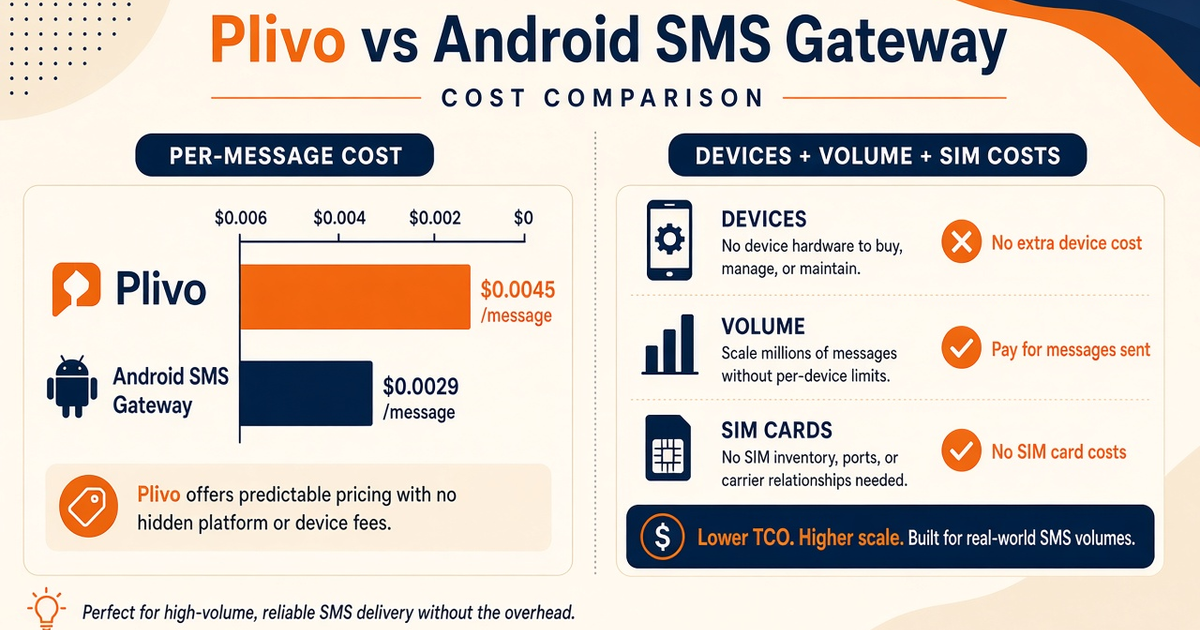
- Twilio-style CPaaS typically bills aggregator per-message (plus number fees); an Android SIM gateway bills devices + platform SMS volume while you pay the operator for airtime.
- Do not compare sticker price alone — include engineer hours, phone ops, and retries.
- Priced by devices and SMS send volume. You use your own phone and operator SMS credit. Free is 300 SMS lifetime; Developer is 25,000 SMS per year; paid from $19/month.
- Twilio wins on global reach and zero handset ops; Android wins on local SIM economics and device control.
- Link the cornerstone comparison — this spoke deepens pricing only.
- Never frame either path as unmetered carrier SMS in titles or H1s.
Summary
This Hub H spoke deepens twilio vs android sms gateway around the pricing model. Start from Twilio vs Android SMS Gateway so this page does not rewrite the full overview. On the Android path, Priced by devices and SMS send volume. You use your own phone and operator SMS credit.
If your spreadsheet only has “price per SMS,” you are modeling an aggregator. If it has devices, platform volume, and operator airtime as three rows, you are modeling a SIM gateway.
Two pricing models
Twilio-style: rented numbers, aggregator routes, typically per-message (plus fees). You do not operate the last-mile radio.
Android SIM gateway: your phone, your operator plan/prepaid, service fee by devices and platform send volume (Starter meters 2 devices; Free 300 SMS lifetime; paid from $19/month).
Cost comparison table
| Line item | Twilio-style CPaaS | Android SIM gateway |
|---|---|---|
| Software / platform | Account + usage fees | Devices + SMS volume meter |
| Numbers | Often rented | Your SIM MSISDN |
| Carrier airtime | Bundled into aggregator price | Paid by you to the operator |
| Phone ops | None | Pairing, battery, OEM, spares |
| Retries | Usually billable attempts | Burns platform volume + airtime |
TCO you must model
Include staff time for handset ops, spare devices, prepaid top-ups, and failed OTP loops. Twilio TCO includes number rental and multi-country premiums. Fair comparison uses the same traffic mix for both columns. See device and SMS volume pricing and Twilio SMS pricing for primary sources.
When each wins
- Twilio: global reach, rented numbers, zero phone ops, heavy compliance tooling.
- Android: local SIM economics, BYO airtime, device-level control.
Ops cost of phones
Dashboard green is not free SMS. OEM battery killers and empty prepaid look like “platform outages” until support is trained. Budget on-call for radios if you choose this path.
Checklist
- Three-row Android model written (devices, volume, airtime).
- Aggregator per-message + number fees written for the same traffic.
- No unmetered-carrier claims in titles.
- Cornerstone comparison linked, not rewritten.
Next steps
Re-read Twilio vs Android, open pricing, and confirm APIs in the SMS API documentation.
Related product pages
Jump to the live product docs for this topic—not another long-form article.
- device and SMS volume pricingPlans and allowances
- Twilio vs Android SMS gatewayCloud vs own-SIM cost model
- Android SMS gateway product guideDefinition, product, and how to buy
- SMS API documentationLive endpoint reference