Key Takeaways
- Spring Boot talks to an Android SMS gateway over HTTPS/JSON (REST) with server-side secrets — not a Complete Spring SDK product.
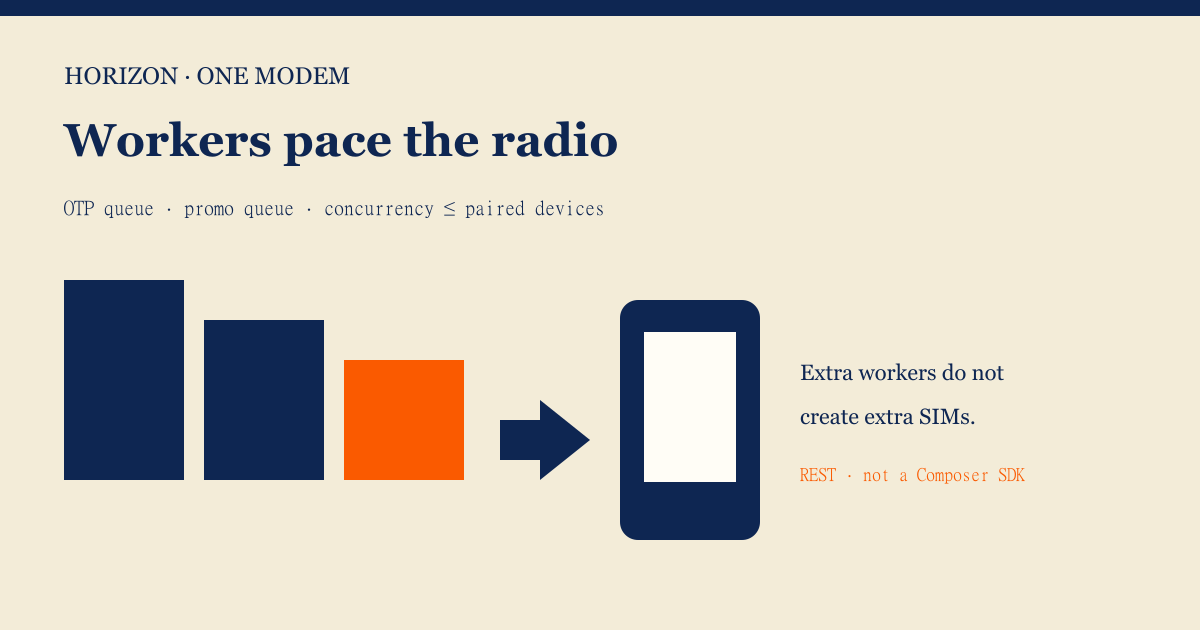
- Enqueue work (Rabbit/Kafka/Spring @Async) so request threads do not wait on radio latency; pace consumers to handset reality.
- HTTP accept is not delivery — persist message IDs and verify with DLR or webhooks.
- Priced by devices and SMS send volume. You use your own phone and operator SMS credit. Free is 300 SMS lifetime; paid from $19/month.
- Keep OTP on an isolated queue and device pool from promotional blasts.
- Confirm live fields in Developer Center; this guide teaches patterns only.
Summary
Spring Boot teams usually want queue workers that call an Android device gateway without blocking Tomcat threads. Integration is REST HTTPS/JSON — not a fake Complete SDK. Start from Android SMS Gateway API and confirm live parameters in the SMS API documentation. Priced by devices and SMS send volume. You use your own phone and operator SMS credit.
If your consumer pool can enqueue faster than one SIM can transmit, you built a backlog, not a throughput win. Pace workers to OEM ceilings and carrier fair-use.
Design: queue + REST client
One Spring bean wraps WebClient/RestClient. Consumers call that bean — never put API keys in message payloads. Cap concurrency below sustainable SMS/min on the OTP device pool. Prefer separate queues for OTP vs bulk.
Worker pattern table
| Pattern | Use when | Watch for |
|---|---|---|
| Controller sync send | Never for production OTP | Thread pool exhaustion |
| Queue + REST | Default OTP and alerts | Retry storms without idempotency |
| Paced bulk consumers | Consented campaigns | Starving OTP queue |
| Webhook controller | DLR correlation | Unsigned callbacks |
Implementation shape
- Read API key from ENV / Spring Config.
- POST send with idempotency for OTP.
- Persist gateway message ID.
- Retry transport failures with backoff; fail permanent rejects.
- Update status from DLR — accept ≠ delivered.
Failure modes
- Phone offline while broker backlog grows.
- Consumer concurrency above OEM/carrier ceiling.
- Blind retries duplicate OTP.
Security
Keys in ENV only. Verify webhook signatures. Avoid logging full OTP bodies. No Complete SDK download claims.
Operations
Free is 300 SMS lifetime; paid from $19/month. Monitor queue depth, last-seen, and airtime together. See pricing.
Checklist
- REST only — no Complete Spring SDK claims.
- OTP/bulk queues separated; concurrency capped.
- Idempotency + DLR tested on staff numbers.
Next steps
Return to the API hub, open setup, and confirm the SMS API documentation.
Related product pages
Jump to the live product docs for this topic—not another long-form article.
- SMS API documentationLive endpoint reference
- device and SMS volume pricingPlans and allowances
- Android SMS gateway product guideDefinition, product, and how to buy
- download the Android gateway appGet the APK