Key Takeaways
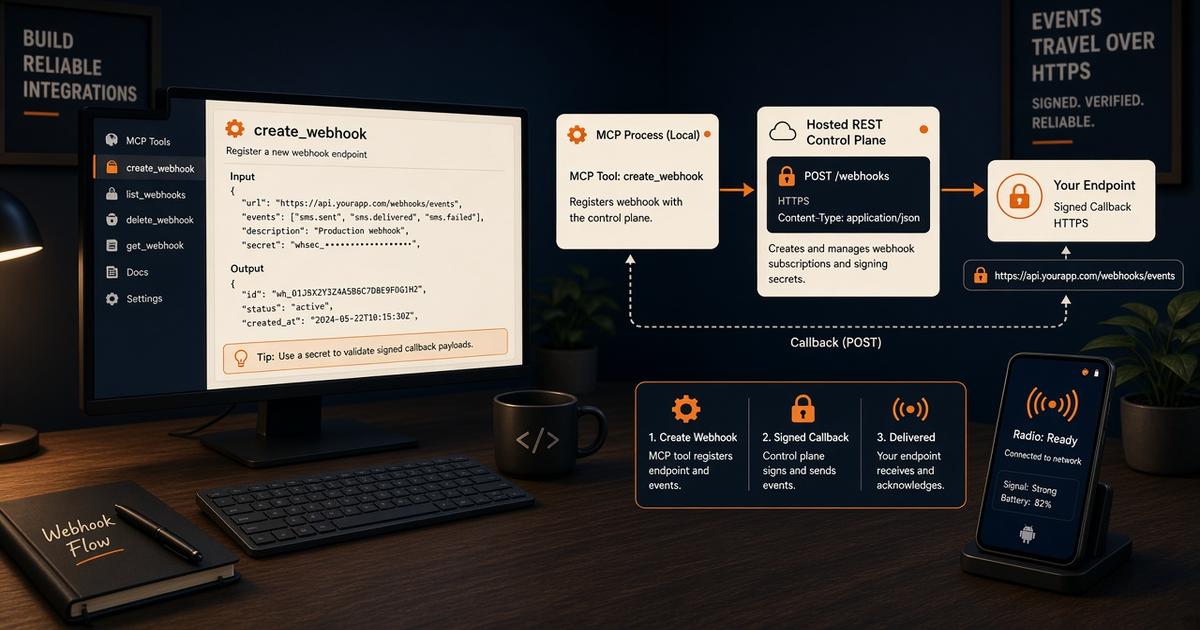
- Designing a send_sms MCP tool for an Android SMS gateway means wrapping HTTPS/JSON — not inventing a first-party Cursor plugin.
- Required: destination, text, client_ref, optional device_id. Confirm live names in Developer Center.
- Failure modes are ops (timeouts, missing args, retry storms) — not exploit PoCs.
- You bring the Android and operator credit. Platform pricing is devices plus send volume.
- Return message id and accepted state — never the plaintext OTP to the model.
send_sms MCP tool design for an Android SMS gateway is schema discipline. Concepts: What is MCP for SMS. Failure twin: send_sms failure modes. Spec: MCP. Live JSON: Developer Center.
Pricing: devices and send volume. App: Downloads.
to · text · client_ref · device_id
Optional client_ref is how agents double-send.
send_sms is REST in a costume
MCP does not replace pairing or the radio. MCP overview. curl.
A tool that returns the OTP “so the agent can confirm” is a logger with a SIM attached. Return ids, not secrets.
Tool design table
| Design choice | Risk | Prefer |
|---|---|---|
| Optional to | Hallucinated MSISDN | Required + allowlist in staging |
| No client_ref | Timeout → duplicate SMS | Required idempotency key |
| No device_id | OTP on promo SIM | Pin quiet device |
| Echo body | Codes in traces | id + accepted only |
| Blind retries | Airtime drain | Map errors to your store |
Require client_ref
Same key on retry. OTP. MCP auth failures.
Do not echo OTP text
Securing tools. DLR. Messaging practices.
Next steps
Make client_ref required in the schema. Fail closed if missing. Spend 300 lifetime SMS proving one send — then a funded SIM.
Related product pages
Jump to the live product docs for this topic—not another long-form article.
- SMS API documentationLive endpoint reference
- device and SMS volume pricingPlans and allowances
- Android SMS gateway product guideDefinition, product, and how to buy
- download the Android gateway appGet the APK