
Key Takeaways
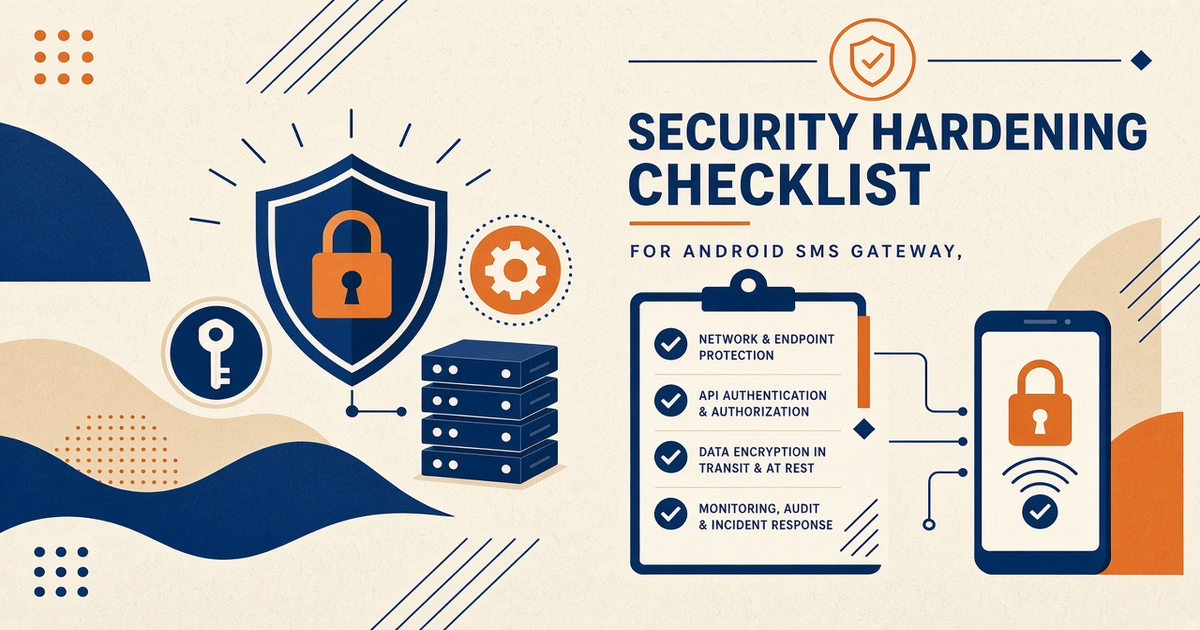
- Security hardening for a core Android SMS gateway is a go/no-go gate list: secrets, device posture, webhooks, and OTP logging — not marketing copy.
- API keys live in ENV/secret managers; never in tickets, APKs, or public repos.
- Physical handset access is part of the threat model — pairing, lock screen, and spare inventory matter.
- Verify webhook signatures; treat unsigned callbacks as hostile.
- Do not log full OTP bodies into shared chat or SIEM without redaction.
- Priced by devices and SMS send volume. You use your own phone and operator SMS credit. Free is 300 SMS lifetime; Developer is 25,000 SMS per year — abuse burns both meters.
Summary
This checklist covers security hardening for a core Android SMS gateway before production OTP. Primary intent is operational gates — secrets, handset posture, webhooks, and data handling — translated for SIM fleets rather than aggregator number pools. Priced by devices and SMS send volume. You use your own phone and operator SMS credit.
Related: contacts and lists, bulk SMS consent, SMS API documentation, OWASP API Security.
A paired phone with a key in Slack is not a hardened gateway. It is a prepaid SIM waiting for someone else’s OTP campaign.
Why a security hardening checklist
Aggregator hardening often stops at account 2FA and IP allowlists. Handset gateways add physical access, OEM debug menus, and SIM theft. Write owners before you tick boxes.
Hardening gate table
| Gate | Pass | Fail | Owner |
|---|---|---|---|
| Secrets | ENV/vault; rotated; least privilege | Keys in chat, git, or APK | Backend |
| Device | Lock screen, inventory tag, spare offline policy | Unlocked desk phone, no asset ID | Ops |
| Webhooks | Signature verified; HTTPS only | Open callback URL | Backend |
| OTP logs | Redacted codes; short retention | Full bodies in Slack | Eng + Sec |
| Traffic class | OTP pool ≠ promo pool | One key, one phone, everything | Product |
Secrets and API access
Server-side sends only. Rotate keys when staff leave. Prefer separate keys for staging vs production. Confirm auth headers in the SMS API documentation.
Device and SIM posture
- Pair via Setup using APK from Downloads.
- Screen lock, unknown-sources policy, and USB debugging off on production units.
- Label ICCID/MSISDN; document who can physically remove the SIM.
- Spare devices stay charged but access-controlled.
Network and webhook hygiene
TLS everywhere. Verify webhook signatures. Rate-limit inbound admin APIs. Do not expose the control plane to the public internet without auth.
OTP and PII handling
Redact OTP in logs. Limit who can export contact lists. Honor STOP on promotional lanes — see bulk SMS consent.
Cost abuse controls
Caps and alerts on send volume and airtime drain. Free is 300 SMS lifetime; Developer is 25,000 SMS per year. Compromised keys can empty prepaid SIMs overnight — treat burn rate as a security signal.
Full checklist
- Secrets, device, webhook, OTP-log, and isolation gates owned.
- Canary after key rotation.
- No unmetered-carrier claims in security marketing copy.
- Incident path: revoke key, pause promo, preserve OTP spare.
Next steps
Review pricing, harden setup, and confirm API auth in the SMS API documentation.
Related product pages
Jump to the live product docs for this topic—not another long-form article.
- SMS API documentationLive endpoint reference
- device and SMS volume pricingPlans and allowances
- Security and Trust CenterCompliance and posture
- Android SMS gateway product guideDefinition, product, and how to buy


