Key Takeaways
- Ruby parse DLR on an Android SMS gateway API means mapping message.status from GET /messages/{id} or webhooks — not treating HTTP accept as delivered.
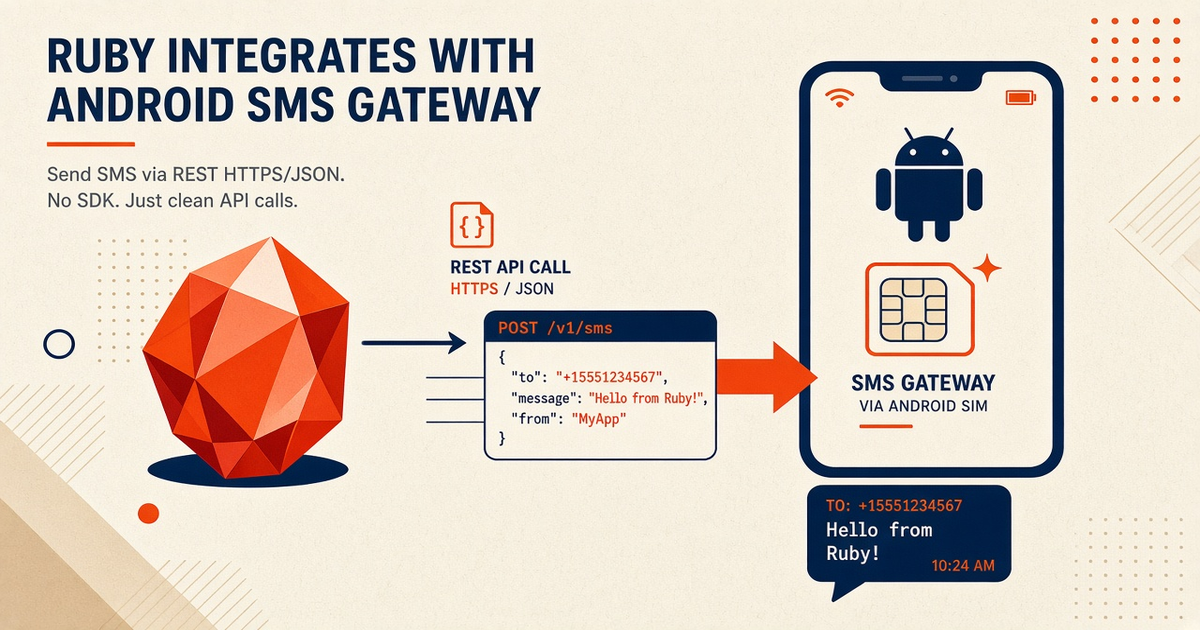
- Use Net::HTTP or Faraday over HTTPS/JSON. This is not a packaged Ruby SMS SDK or gem product.
- Deduplicate webhook event ids before updating rows. Confirm live enums in Developer Center.
- You bring phone and operator airtime. Failed DLR does not cash out carrier credit.
- Free/Developer pause at the platform SMS allowance. We meter devices + send volume.
Ruby parse DLR on an android sms gateway api is mapping delivery state after the SIM transmitted — or failed to. Product: delivery reports. API corner: Android SMS Gateway API. Docs: Developer Center.
REST HTTPS/JSON only — not a Complete Ruby SDK. Devices and send volume. You fund the SIM.
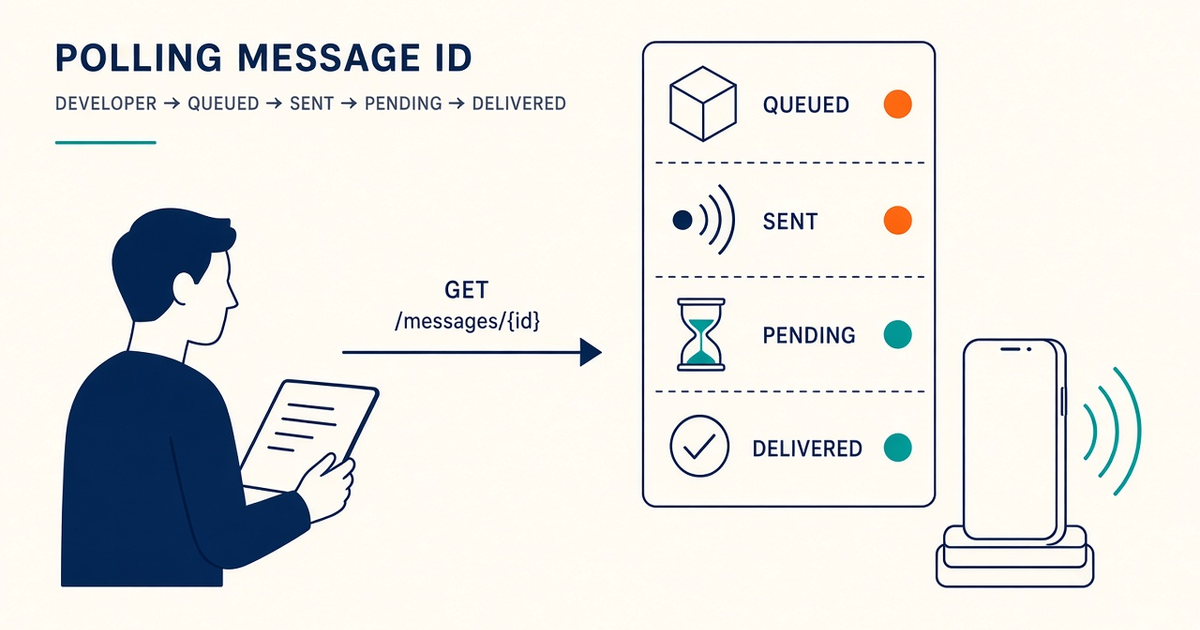
Pending → Delivered (when the carrier says so)
Accepted is not delivered
Send returns a batch with Pending:
{
  "campaignId": 17,
  "accepted": 1,
  "scheduledAt": null,
  "messages": [
    {
      "id": 41822,
      "number": "+14155552671",
      "text": "Your verification code is 481920",
      "type": "sms",
      "status": "Pending",
      "campaignId": 17,
      "deviceId": 3
    }
  ]
}
If Sidekiq marks the user “notified” on HTTP 200/202, you will debug OTPs that never left the docked phone.
How to parse DLR in Ruby
- Persist
messages[].id. - GET that id or wait for webhook.
- Map
status/deliveredAt. - Do not treat DLR as login success.
GET /messages/{id}
curl -X GET "https://app.sms-gateway.app/api/v1/messages/41822" \
  -H "Authorization: Bearer $SMS_GATEWAY_API_KEY"
Confirm the GET body in docs. Match OpenAPI — do not invent properties from this sketch.
Status map
| You see | Means | Your row |
|---|---|---|
| Pending | Queued / not yet radio | sent_pending |
| Delivered | Carrier DLR when provided | delivered |
| Failed | Radio or SMSC gave up | failed — inspect; don’t auto-resend without a new key |
Sibling: C# parse DLR. JSON: Ruby JSON.
Prefer webhooks
{
  "id": "evt_01K2F8QW3N4RXB7M",
  "type": "message.delivered",
  "createdAt": "2026-08-12T14:04:09Z",
  "apiVersion": "2026-08-12",
  "data": {
    "message": {
      "id": 41823,
      "number": "+14155552671",
      "text": "Your verification code is 481920",
      "status": "Delivered",
      "campaignId": 17,
      "deviceId": 3,
      "metadata": { "orderId": "1234" },
      "sentAt": "2026-08-12T14:04:02Z",
      "deliveredAt": "2026-08-12T14:04:09Z"
    }
  }
}
HMAC + event-id unique. Server webhook · /webhook.
Net::HTTP sketch
# Sketch only — confirm JSON shape in Developer Center
require "net/http"
require "json"
require "uri"

def get_dlr(api_key, id)
  uri = URI("#{API_DLR_URL}/#{id}")
  req = Net::HTTP::Get.new(uri)
  req["Authorization"] = "Bearer #{api_key}"
  res = Net::HTTP.start(uri.hostname, uri.port, use_ssl: true) { |h| h.request(req) }
  raise "dlr_http_#{res.code}" unless res.is_a?(Net::HTTPSuccess)
  JSON.parse(res.body)
end
OTP path: OTP verification. Keep keys server-side — never in a mobile client.
DLR is not a refund
Failed after the SIM fired still cost airtime. Free: 300 SMS lifetime. We meter devices + volume; carrier fair-use remains. No “Unlimited SMS” titles for this tutorial.
Next steps
Send one staff SMS, GET the id, then fire a webhook into a Rack endpoint. Downloads.
Related product pages
Jump to the live product docs for this topic—not another long-form article.
- SMS delivery reports (DLR)Delivery status tracking
- SMS API documentationLive endpoint reference
- device and SMS volume pricingPlans and allowances
- Android SMS gateway product guideDefinition, product, and how to buy