Key Takeaways
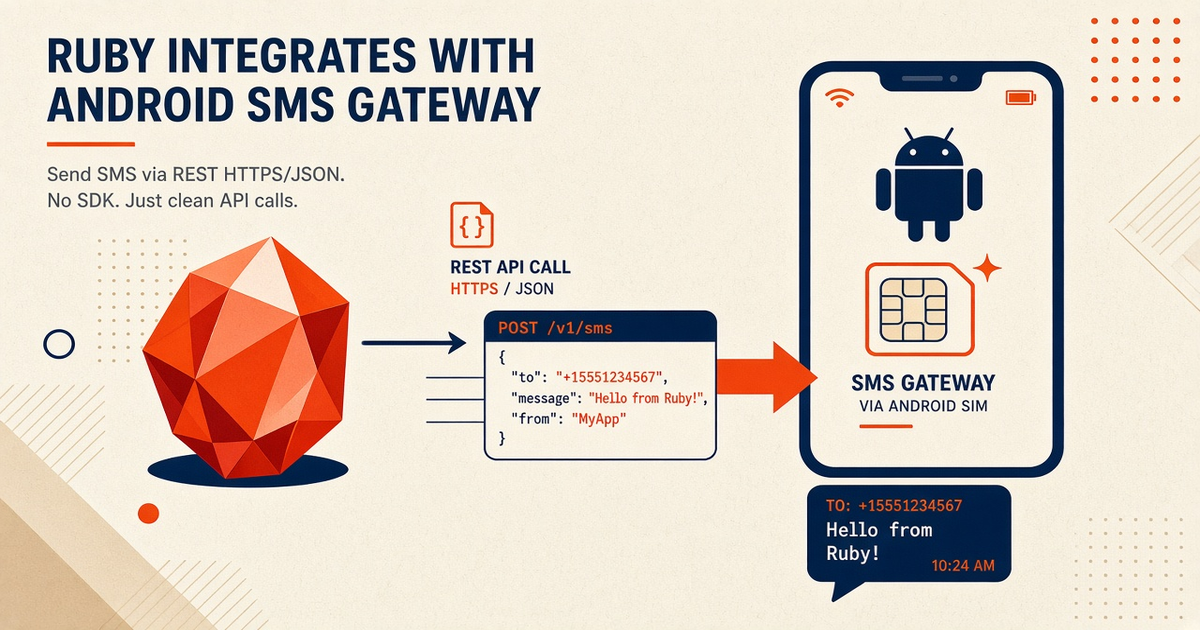
- Ruby integrates with an Android SMS gateway over HTTPS/JSON (REST) using Net::HTTP, Faraday, or similar — not a productized Complete Ruby SDK.
- Confirm live request fields in Developer Center; this guide teaches patterns and failure modes only.
- HTTP accept is not delivery — persist message IDs and verify with DLR or webhooks.
- Priced by devices and SMS send volume. You use your own phone and operator SMS credit. Free is 300 SMS lifetime; paid from $19/month.
- Isolate OTP from marketing device pools; pace workers to radio reality.
- Keys stay in ENV/credentials — never in the frontend or public gems demos.
Summary
Teams searching ruby android sms gateway api usually want a server-side HTTP client that talks to a paired Android handset — not another gem that pretends to own the SMSC. This in-depth guide covers REST patterns, async workers, and radio-aware failure modes. Start from the Android SMS Gateway API hub. Priced by devices and SMS send volume. You use your own phone and operator SMS credit.
If your README markets a “Complete Ruby SDK download,” you are branding theatre. Production path is ENV secrets, HTTPS JSON, and a phone that is still paired at 2 a.m.
REST HTTPS/JSON — not a Ruby SDK
Call the gateway like any other internal HTTPS service. Prefer Faraday or Net::HTTP on the server. Do not ship API keys in mobile apps or public sample repos. C# teams have REST samples on /codebase-csharp — those are language samples, not multi-language Complete SDK products. Same rule for Ruby: samples, not gem theatre.
Client shape in Ruby
One service object posts JSON, attaches auth headers from ENV, returns the gateway message ID, and never logs full OTP bodies. Controllers enqueue work; workers call the client. Confirm live fields in the SMS API documentation.
Call pattern table
| Pattern | Use | Avoid |
|---|---|---|
| Sync in request | Rare admin tools only | Production OTP in Puma/Unicorn threads |
| ActiveJob / Sidekiq | Default OTP and alerts | Unbounded concurrency vs one SIM |
| Idempotent send | Always for login codes | Blind retries without keys |
| Webhook / DLR | Delivery truth | Treating HTTP 200 as delivered |
Async and workers
Pace job concurrency to OEM SMS rate ceilings and carrier fair-use. Separate OTP and bulk queues. Alert on device last-seen, not only failed_jobs count. Related: multi-device and dual SIM.
Cost and ownership
Free is 300 SMS lifetime; paid from $19/month meters devices and platform volume. Operator airtime is separate — retries still burn prepaid. See device and SMS volume pricing.
Failure modes
- Phone offline while Redis jobs succeed — green queue, silent OTP.
- Retry storms without idempotency — duplicate codes.
- Promo jobs sharing OTP workers — login latency spikes.
Security
Secrets in credentials/ENV. Verify webhook signatures when enabled. Consent and STOP still apply on promotional lanes. Canary on staff numbers before customer OTP.
Checklist
- REST client only — no Complete SDK claims.
- Live fields checked in Developer Center.
- OTP isolated; workers paced; DLR wired.
- Airtime + platform volume budgeted including retries.
Next steps
Return to the API hub, open setup, and confirm the SMS API documentation.
Related product pages
Jump to the live product docs for this topic—not another long-form article.
- SMS API documentationLive endpoint reference
- device and SMS volume pricingPlans and allowances
- Android SMS gateway product guideDefinition, product, and how to buy
- download the Android gateway appGet the APK