Key Takeaways
- Ruby talks to the Android SMS gateway with Net::HTTP, Faraday, or similar — plain REST HTTPS/JSON, not a packaged Ruby SDK product.
- Bulk loops must pace for OEM ceilings and carrier fair-use; a tight foreach can starve OTP and burn prepaid airtime.
- Prefer a queue worker (Sidekiq/GoodJob) over synchronous web requests for campaigns.
- Persist message ids; HTTP accept is not delivery. Use DLR or webhooks for terminal status.
- You need a working Android phone with a SIM and SMS credit from your mobile operator. Operator message costs are yours—we do not sell carrier SMS balance. Service pricing is based on device count and total SMS sent through the gateway. Free includes 300 SMS lifetime for canaries.
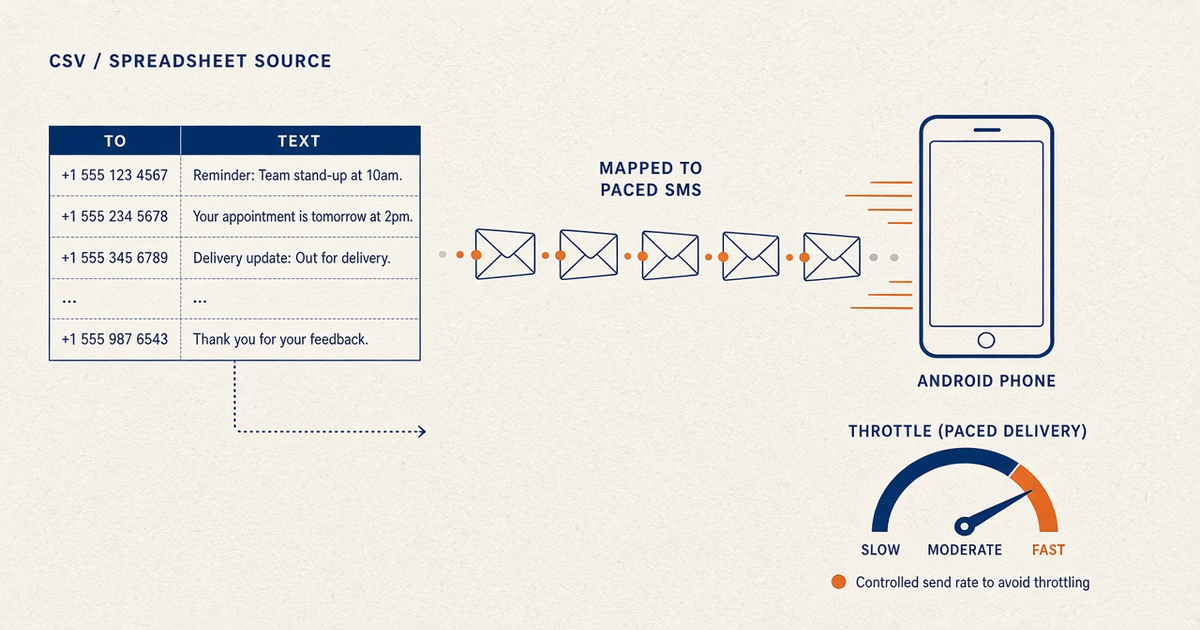
This Hub C guide covers a Ruby android sms gateway api bulk send loop: how to pace HTTPS sends through your own Android SIM without pretending Ruby has a vendor SDK. Hub: Android SMS Gateway API. Live params: SMS API documentation.
You need a working Android phone with a SIM and SMS credit from your mobile operator. Operator message costs are yours—we do not sell carrier SMS balance. Service pricing is based on device count and total SMS sent through the gateway. Device and SMS volume pricing. Do not market bulk loops as Unlimited SMS — OEM ceilings and carrier fair-use still apply.
What a Ruby loop is
A worker reads consented recipients, builds to / text, calls the control plane, stores the message id, then waits according to your throttle. Panel CSV bulk is fine for ops; this page is for application-owned loops. Feature: bulk SMS from Excel/CSV.
Ruby is just another HTTPS client. Net::HTTP or Faraday plus ENV for the Bearer token — not a gem that “is” the SMS product.
REST HTTPS/JSON only
Confirm path and JSON in Developer Center. Do not invent gem method names as if they were the API. Keys stay server-side — never in a mobile app or committed credentials.yml. Samples elsewhere: PHP HTTPS samples.
Pace to the radio
One handset is bounded by OEM SMS rate ceilings and carrier fair-use. Raise ceilings where Android allows; still plan devices for peak, not average. Isolate OTP: OTP verification.
Loop design choices
| Approach | Use when | Risk |
|---|---|---|
| Sync foreach in a web action | Never for real campaigns | Timeouts, no backoff, OTP starvation |
| Sidekiq/GoodJob with concurrency=1–N | Production bulk | Needs broker ops; still pace sleeps |
| Multi-device + deviceIds | Higher peak on paid plans | More phones, SIMs, and airtime owners |
| Blind retry on every error | Never | Duplicate SMS and burned credit |
Ids and retries
Send an Idempotency-Key per logical recipient job. Retry transport failures with backoff; do not blindly resend permanent rejects. DLR: delivery reports, webhooks.
Checklist
- Bearer from ENV; staging key in CI.
- Queue worker, not request thread.
- Throttle aligned to measured handset rate.
- OTP queue separate from bulk.
- Ids persisted; webhook handler idempotent.
- Consent / STOP honored before enqueue.
Next steps
Pair a phone via setup, canary fifty staff numbers, then raise concurrency carefully. Multi-device: multi-device and dual SIM.
Related product pages
Jump to the live product docs for this topic—not another long-form article.
- bulk SMS from Excel and CSVSpreadsheet campaigns
- bulk SMS with consent best practicesHigh-volume outreach
- SMS API documentationLive endpoint reference
- device and SMS volume pricingPlans and allowances