Key Takeaways
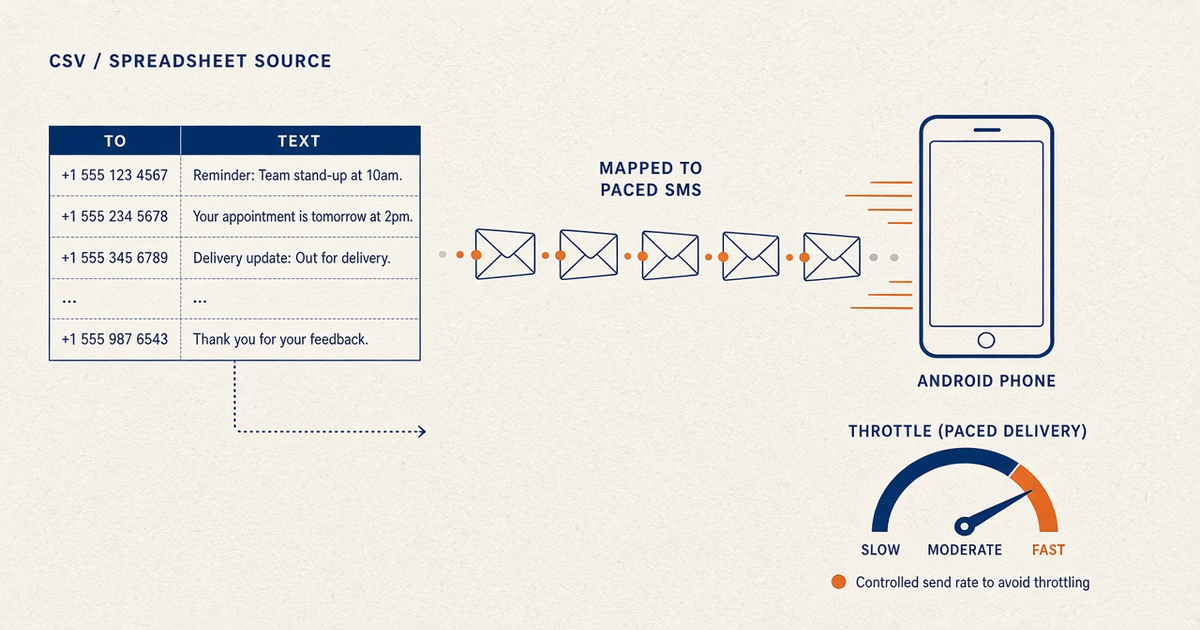
- Python bulk needs workers (Celery/RQ/arq), not a long Flask request.
- Compare sync scripts vs queues in a table.
- SMS Retriever is end-user OTP UX — not bulk send.
- USA geo canaries for campaign quality.
- Questions hub for customer FAQs; engineers use this recipe.
- Developer Center for live send schema.
- Cap rate per device.
This Hub C guide covers android sms gateway api integration for bulk send loops using Python. Start from Android SMS Gateway API and confirm live parameters in SMS API documentation. Service pricing is devices + send volume (free tier 300 SMS lifetime; paid from $19/month); you supply phone and operator SMS credit — see device and SMS volume pricing.
USA, SMS gateway FAQ and definitions, SMS API documentation, SMS Retriever.
“A Flask request that loops ten thousand recipients is not a bulk system. A paced worker that respects radio ceilings and plan volume is.”
| Mode | Fit | Risk |
|---|---|---|
| Sync script | Tiny internal lists | Timeouts, no ops controls |
| Celery/RQ/arq workers | Production campaigns | Needs broker + pacing |
| Unbounded asyncio gather | Lab demos only | OEM rate ceilings + airtime burn |
Context
Bulk and OTP should not share unbounded senders. A campaign loop can starve login codes and burn prepaid balance. Separate queues, quotas, and pacing policies even if both call the same android sms gateway api. Write this into your team checklist explicitly.
Encoding matters. Accidental Unicode in templates can turn a short OTP into multi-segment SMS and inflate operator cost. Prefer simple GSM-7 friendly templates for authentication messages. Make it part of definition of done for the integration.
Webhooks arrive at-least-once. Your handler must be idempotent. Return 2xx quickly after durable persistence; do slow work in a background worker so the gateway does not mark you unhealthy. Treat it as a release gate, not a backlog idea.
Signature verification on webhooks is mandatory. Compute MACs over the raw body. Use constant-time comparison. Reject before you mutate business state. Review it again after every major Android OEM update on the gateway phone.
DLR precedence matters when events reorder. Delivered should not be overwritten by a late Pending. Encode precedence in one mapper used by both webhook and poll paths. Revisit the assumption whenever you add a second device.
Testing should use canary numbers and staging keys. CI should not empty production prepaid wallets. Contract-test your JSON mappers against frozen fixtures when the API evolves. Write this into your team checklist explicitly.
Design
Encoding matters. Accidental Unicode in templates can turn a short OTP into multi-segment SMS and inflate operator cost. Prefer simple GSM-7 friendly templates for authentication messages. Write this into your team checklist explicitly.
Webhooks arrive at-least-once. Your handler must be idempotent. Return 2xx quickly after durable persistence; do slow work in a background worker so the gateway does not mark you unhealthy. Make it part of definition of done for the integration.
Signature verification on webhooks is mandatory. Compute MACs over the raw body. Use constant-time comparison. Reject before you mutate business state. Treat it as a release gate, not a backlog idea.
DLR precedence matters when events reorder. Delivered should not be overwritten by a late Pending. Encode precedence in one mapper used by both webhook and poll paths. Review it again after every major Android OEM update on the gateway phone.
Testing should use canary numbers and staging keys. CI should not empty production prepaid wallets. Contract-test your JSON mappers against frozen fixtures when the API evolves. Revisit the assumption whenever you add a second device.
Support staff need a runbook: check device online, balance, API auth errors, Pending age, and template issues in that order. Most API bugs are phones asleep or SIMs empty. Write this into your team checklist explicitly.
Implementation
Webhooks arrive at-least-once. Your handler must be idempotent. Return 2xx quickly after durable persistence; do slow work in a background worker so the gateway does not mark you unhealthy. Write this into your team checklist explicitly.
Signature verification on webhooks is mandatory. Compute MACs over the raw body. Use constant-time comparison. Reject before you mutate business state. Make it part of definition of done for the integration.
DLR precedence matters when events reorder. Delivered should not be overwritten by a late Pending. Encode precedence in one mapper used by both webhook and poll paths. Treat it as a release gate, not a backlog idea.
Testing should use canary numbers and staging keys. CI should not empty production prepaid wallets. Contract-test your JSON mappers against frozen fixtures when the API evolves. Review it again after every major Android OEM update on the gateway phone.
Support staff need a runbook: check device online, balance, API auth errors, Pending age, and template issues in that order. Most API bugs are phones asleep or SIMs empty. Revisit the assumption whenever you add a second device.
Framework choice changes how you structure workers, not the radio physics. Queues and retries are mandatory patterns in Node, Python, and C# alike. Write this into your team checklist explicitly.
Failure modes
Signature verification on webhooks is mandatory. Compute MACs over the raw body. Use constant-time comparison. Reject before you mutate business state. Write this into your team checklist explicitly.
DLR precedence matters when events reorder. Delivered should not be overwritten by a late Pending. Encode precedence in one mapper used by both webhook and poll paths. Make it part of definition of done for the integration.
Testing should use canary numbers and staging keys. CI should not empty production prepaid wallets. Contract-test your JSON mappers against frozen fixtures when the API evolves. Treat it as a release gate, not a backlog idea.
Support staff need a runbook: check device online, balance, API auth errors, Pending age, and template issues in that order. Most API bugs are phones asleep or SIMs empty. Review it again after every major Android OEM update on the gateway phone.
Framework choice changes how you structure workers, not the radio physics. Queues and retries are mandatory patterns in Node, Python, and C# alike. Revisit the assumption whenever you add a second device.
Security
DLR precedence matters when events reorder. Delivered should not be overwritten by a late Pending. Encode precedence in one mapper used by both webhook and poll paths. Write this into your team checklist explicitly.
Testing should use canary numbers and staging keys. CI should not empty production prepaid wallets. Contract-test your JSON mappers against frozen fixtures when the API evolves. Make it part of definition of done for the integration.
Support staff need a runbook: check device online, balance, API auth errors, Pending age, and template issues in that order. Most API bugs are phones asleep or SIMs empty. Treat it as a release gate, not a backlog idea.
Framework choice changes how you structure workers, not the radio physics. Queues and retries are mandatory patterns in Node, Python, and C# alike. Review it again after every major Android OEM update on the gateway phone.
Security reviews should ask where keys live, who can pair devices, how webhooks authenticate, and whether admin panels are locked down. A paired phone is a privileged actor on your account. Revisit the assumption whenever you add a second device.
Operations
Testing should use canary numbers and staging keys. CI should not empty production prepaid wallets. Contract-test your JSON mappers against frozen fixtures when the API evolves. Write this into your team checklist explicitly.
Support staff need a runbook: check device online, balance, API auth errors, Pending age, and template issues in that order. Most API bugs are phones asleep or SIMs empty. Make it part of definition of done for the integration.
Framework choice changes how you structure workers, not the radio physics. Queues and retries are mandatory patterns in Node, Python, and C# alike. Treat it as a release gate, not a backlog idea.
Security reviews should ask where keys live, who can pair devices, how webhooks authenticate, and whether admin panels are locked down. A paired phone is a privileged actor on your account. Review it again after every major Android OEM update on the gateway phone.
Geo and carrier behavior vary. What works on one prepaid SIM may throttle on another. Measure deliverability with canaries in the countries you serve before promising SLAs. Revisit the assumption whenever you add a second device.
Checklist
Support staff need a runbook: check device online, balance, API auth errors, Pending age, and template issues in that order. Most API bugs are phones asleep or SIMs empty. Write this into your team checklist explicitly.
Framework choice changes how you structure workers, not the radio physics. Queues and retries are mandatory patterns in Node, Python, and C# alike. Make it part of definition of done for the integration.
Security reviews should ask where keys live, who can pair devices, how webhooks authenticate, and whether admin panels are locked down. A paired phone is a privileged actor on your account. Treat it as a release gate, not a backlog idea.
Geo and carrier behavior vary. What works on one prepaid SIM may throttle on another. Measure deliverability with canaries in the countries you serve before promising SLAs. Review it again after every major Android OEM update on the gateway phone.
Next steps
Framework choice changes how you structure workers, not the radio physics. Queues and retries are mandatory patterns in Node, Python, and C# alike. Write this into your team checklist explicitly.
Security reviews should ask where keys live, who can pair devices, how webhooks authenticate, and whether admin panels are locked down. A paired phone is a privileged actor on your account. Make it part of definition of done for the integration.
Geo and carrier behavior vary. What works on one prepaid SIM may throttle on another. Measure deliverability with canaries in the countries you serve before promising SLAs. Treat it as a release gate, not a backlog idea.
Observability without action is decoration. Tie alerts to pages that on-call can actually fix: restart app, top up SIM, rotate key, fail over device. Review it again after every major Android OEM update on the gateway phone.
Deep dive: production hardening
Geo and carrier behavior vary. What works on one prepaid SIM may throttle on another. Measure deliverability with canaries in the countries you serve before promising SLAs. Write this into your team checklist explicitly.
Observability without action is decoration. Tie alerts to pages that on-call can actually fix: restart app, top up SIM, rotate key, fail over device. Make it part of definition of done for the integration.
Migration from aggregator SDKs requires rewriting assumptions about numbers, pricing, and delivery callbacks. Keep an interface in your code so drivers can swap without rewriting controllers. Treat it as a release gate, not a backlog idea.
Compliance tone differs for OTP versus marketing. Do not append promotional footers to authentication messages. Honor STOP on promotional traffic with suppression lists. Review it again after every major Android OEM update on the gateway phone.
Partial outages are common: one device dies, another lives. Prefer explicit routing for critical OTP when the API allows device selection. Revisit the assumption whenever you add a second device.
Clock skew breaks signature checks. Allow a small skew window and reject large ones. Monitor for sudden verification failure spikes after deploys. Write this into your team checklist explicitly.
Empty rendered templates should fail closed before the HTTP call. Defensive checks beat sending blank SMS that still consume volume quota. Make it part of definition of done for the integration.
Rate limits exist to protect you from yourself. When you hit 429, back off with jitter. Treating 429 without delay creates thundering herds. Treat it as a release gate, not a backlog idea.
Documentation debt kills weekends. If pairing, battery exemptions, and webhook URLs are not in the runbook, the next hire will learn during an incident. Review it again after every major Android OEM update on the gateway phone.
Feature flags let you ramp traffic. Start with staff accounts, then a percentage of OTP, then full cutover. Watch DLR fail rates at each gate. Revisit the assumption whenever you add a second device.
Cost control means capping daily sends, separating OTP and bulk budgets, and alerting on unusual accept rates. Airtime surprise bills are preventable. Write this into your team checklist explicitly.
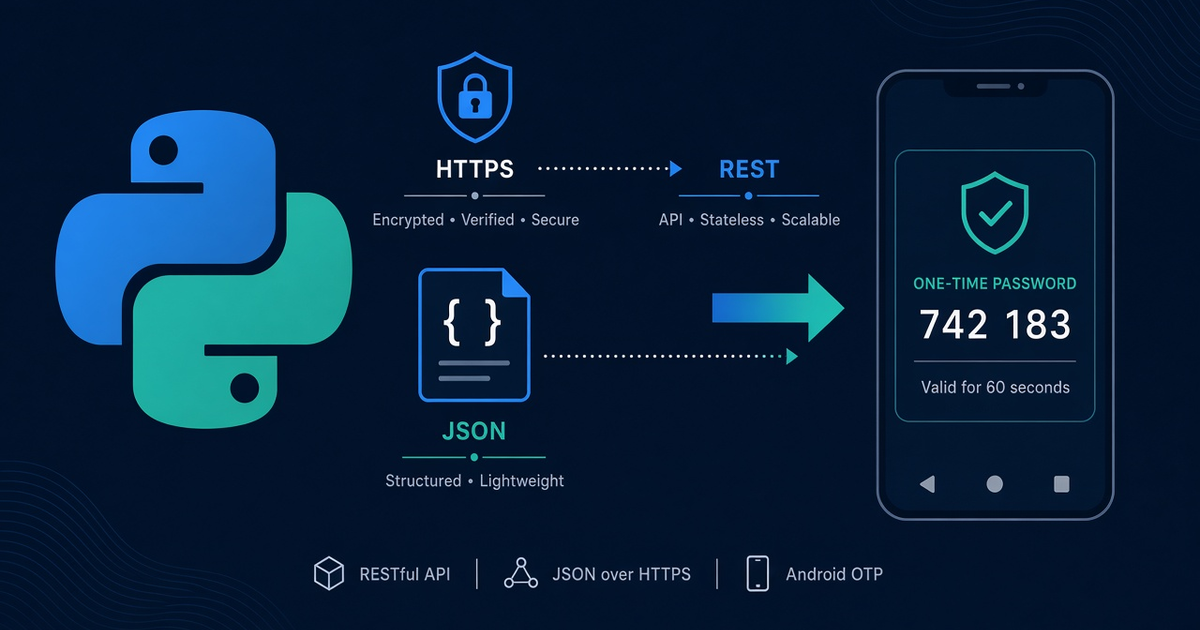
An android sms gateway api sits between your application and a physical Android handset. Your code never talks to AT commands or SmsManager directly. It authenticates over HTTPS, submits a job, and learns later whether the radio path finished. That delay is why status handling is not optional in production systems. Make it part of definition of done for the integration.
Operator airtime is separate from the gateway service fee. You bring a working phone and SMS credit from your mobile operator. The service bills on device count and total SMS volume through the gateway. Confusing those layers leads to broken cost models and angry finance reviews. Treat it as a release gate, not a backlog idea.
Confirm every path, header, and JSON field in the Developer Center before you ship. Blog examples use conceptual shapes so they do not drift from the live reference. When docs and a blog disagree, trust Developer Center. Review it again after every major Android OEM update on the gateway phone.
Idempotency is the difference between a clean OTP flow and a support queue full of duplicate codes. Use a stable client reference or challenge id for each logical send. Retries should converge on one message, not multiply them. Revisit the assumption whenever you add a second device.
HTTP 200 on send usually means accepted by the control plane, not delivered to the handset user. Delivery reports and webhooks close the loop. If you only log the HTTP response, you are flying without instruments. Write this into your team checklist explicitly.
Device offline is an application problem as much as an ops problem. Queues will happily accept work that cannot transmit. Alert on device last-seen and Pending age, not only on framework exceptions. Make it part of definition of done for the integration.
Throughput is bounded by SIM, handset, and carrier policy. Adding more app servers without more devices only accelerates failure. Cap concurrency to a function of healthy devices and a safe messages-per-minute budget. Treat it as a release gate, not a backlog idea.
Secrets belong in environment variables or a secret manager. Never commit API keys. Never ship them to mobile apps or browser JavaScript. Rotate when people leave the team and after any suspected leak. Review it again after every major Android OEM update on the gateway phone.
Logging should include correlation ids, gateway message ids, masked MSISDNs, and latency. Do not log OTP codes or full Authorization headers. Redaction is part of the feature, not a nice-to-have. Revisit the assumption whenever you add a second device.
Failover means a second phone, a documented SIM swap, or a temporary provider fallback practiced before an outage. Untested failover is fiction. Schedule drills the same way you schedule database backups. Write this into your team checklist explicitly.
Bulk and OTP should not share unbounded senders. A campaign loop can starve login codes and burn prepaid balance. Separate queues, quotas, and pacing policies even if both call the same android sms gateway api. Make it part of definition of done for the integration.
Encoding matters. Accidental Unicode in templates can turn a short OTP into multi-segment SMS and inflate operator cost. Prefer simple GSM-7 friendly templates for authentication messages. Treat it as a release gate, not a backlog idea.
Webhooks arrive at-least-once. Your handler must be idempotent. Return 2xx quickly after durable persistence; do slow work in a background worker so the gateway does not mark you unhealthy. Review it again after every major Android OEM update on the gateway phone.
Signature verification on webhooks is mandatory. Compute MACs over the raw body. Use constant-time comparison. Reject before you mutate business state. Revisit the assumption whenever you add a second device.
DLR precedence matters when events reorder. Delivered should not be overwritten by a late Pending. Encode precedence in one mapper used by both webhook and poll paths. Write this into your team checklist explicitly.
Testing should use canary numbers and staging keys. CI should not empty production prepaid wallets. Contract-test your JSON mappers against frozen fixtures when the API evolves. Make it part of definition of done for the integration.
Support staff need a runbook: check device online, balance, API auth errors, Pending age, and template issues in that order. Most API bugs are phones asleep or SIMs empty. Treat it as a release gate, not a backlog idea.
Framework choice changes how you structure workers, not the radio physics. Queues and retries are mandatory patterns in Node, Python, and C# alike. Review it again after every major Android OEM update on the gateway phone.
Deep dive: scaling and failure modes
Logging should include correlation ids, gateway message ids, masked MSISDNs, and latency. Do not log OTP codes or full Authorization headers. Redaction is part of the feature, not a nice-to-have. Write this into your team checklist explicitly.
Failover means a second phone, a documented SIM swap, or a temporary provider fallback practiced before an outage. Untested failover is fiction. Schedule drills the same way you schedule database backups. Make it part of definition of done for the integration.
Bulk and OTP should not share unbounded senders. A campaign loop can starve login codes and burn prepaid balance. Separate queues, quotas, and pacing policies even if both call the same android sms gateway api. Treat it as a release gate, not a backlog idea.
Encoding matters. Accidental Unicode in templates can turn a short OTP into multi-segment SMS and inflate operator cost. Prefer simple GSM-7 friendly templates for authentication messages. Review it again after every major Android OEM update on the gateway phone.
Webhooks arrive at-least-once. Your handler must be idempotent. Return 2xx quickly after durable persistence; do slow work in a background worker so the gateway does not mark you unhealthy. Revisit the assumption whenever you add a second device.
Signature verification on webhooks is mandatory. Compute MACs over the raw body. Use constant-time comparison. Reject before you mutate business state. Write this into your team checklist explicitly.
DLR precedence matters when events reorder. Delivered should not be overwritten by a late Pending. Encode precedence in one mapper used by both webhook and poll paths. Make it part of definition of done for the integration.
Testing should use canary numbers and staging keys. CI should not empty production prepaid wallets. Contract-test your JSON mappers against frozen fixtures when the API evolves. Treat it as a release gate, not a backlog idea.
Support staff need a runbook: check device online, balance, API auth errors, Pending age, and template issues in that order. Most API bugs are phones asleep or SIMs empty. Review it again after every major Android OEM update on the gateway phone.
Framework choice changes how you structure workers, not the radio physics. Queues and retries are mandatory patterns in Node, Python, and C# alike. Revisit the assumption whenever you add a second device.
Security reviews should ask where keys live, who can pair devices, how webhooks authenticate, and whether admin panels are locked down. A paired phone is a privileged actor on your account. Write this into your team checklist explicitly.
Geo and carrier behavior vary. What works on one prepaid SIM may throttle on another. Measure deliverability with canaries in the countries you serve before promising SLAs. Make it part of definition of done for the integration.
Observability without action is decoration. Tie alerts to pages that on-call can actually fix: restart app, top up SIM, rotate key, fail over device. Treat it as a release gate, not a backlog idea.
Migration from aggregator SDKs requires rewriting assumptions about numbers, pricing, and delivery callbacks. Keep an interface in your code so drivers can swap without rewriting controllers. Review it again after every major Android OEM update on the gateway phone.
Compliance tone differs for OTP versus marketing. Do not append promotional footers to authentication messages. Honor STOP on promotional traffic with suppression lists. Revisit the assumption whenever you add a second device.
Partial outages are common: one device dies, another lives. Prefer explicit routing for critical OTP when the API allows device selection. Write this into your team checklist explicitly.
Clock skew breaks signature checks. Allow a small skew window and reject large ones. Monitor for sudden verification failure spikes after deploys. Make it part of definition of done for the integration.
Empty rendered templates should fail closed before the HTTP call. Defensive checks beat sending blank SMS that still consume volume quota. Treat it as a release gate, not a backlog idea.
Rate limits exist to protect you from yourself. When you hit 429, back off with jitter. Treating 429 without delay creates thundering herds. Review it again after every major Android OEM update on the gateway phone.
Documentation debt kills weekends. If pairing, battery exemptions, and webhook URLs are not in the runbook, the next hire will learn during an incident. Revisit the assumption whenever you add a second device.
Feature flags let you ramp traffic. Start with staff accounts, then a percentage of OTP, then full cutover. Watch DLR fail rates at each gate. Write this into your team checklist explicitly.
Cost control means capping daily sends, separating OTP and bulk budgets, and alerting on unusual accept rates. Airtime surprise bills are preventable. Make it part of definition of done for the integration.
An android sms gateway api sits between your application and a physical Android handset. Your code never talks to AT commands or SmsManager directly. It authenticates over HTTPS, submits a job, and learns later whether the radio path finished. That delay is why status handling is not optional in production systems. Treat it as a release gate, not a backlog idea.
Operator airtime is separate from the gateway service fee. You bring a working phone and SMS credit from your mobile operator. The service bills on device count and total SMS volume through the gateway. Confusing those layers leads to broken cost models and angry finance reviews. Review it again after every major Android OEM update on the gateway phone.
Confirm every path, header, and JSON field in the Developer Center before you ship. Blog examples use conceptual shapes so they do not drift from the live reference. When docs and a blog disagree, trust Developer Center. Revisit the assumption whenever you add a second device.
Idempotency is the difference between a clean OTP flow and a support queue full of duplicate codes. Use a stable client reference or challenge id for each logical send. Retries should converge on one message, not multiply them. Write this into your team checklist explicitly.
HTTP 200 on send usually means accepted by the control plane, not delivered to the handset user. Delivery reports and webhooks close the loop. If you only log the HTTP response, you are flying without instruments. Make it part of definition of done for the integration.
Device offline is an application problem as much as an ops problem. Queues will happily accept work that cannot transmit. Alert on device last-seen and Pending age, not only on framework exceptions. Treat it as a release gate, not a backlog idea.
Throughput is bounded by SIM, handset, and carrier policy. Adding more app servers without more devices only accelerates failure. Cap concurrency to a function of healthy devices and a safe messages-per-minute budget. Review it again after every major Android OEM update on the gateway phone.
Related product pages
Jump to the live product docs for this topic—not another long-form article.
- bulk SMS from Excel and CSVSpreadsheet campaigns
- bulk SMS with consent best practicesHigh-volume outreach
- SMS API documentationLive endpoint reference
- device and SMS volume pricingPlans and allowances