Key Takeaways
- Kotlin talks to android sms gateway api over REST HTTPS/JSON using server-side secrets — not a Kotlin SDK product.
- This guide focuses on receive webhook patterns — confirm live fields in Developer Center.
- Accept is not delivered; use DLR or webhooks for terminal status.
- Devices + SMS volume pricing; you bring phone and operator airtime.
- Idempotency and timeouts belong in every production client.
- Keep OTP and promotional templates on separate lanes.
- Cross-link Hub C stack guides; physics stays the same across languages.
This Hub C guide covers android sms gateway api integration for receive webhook using Kotlin. Start from Android SMS Gateway API and confirm live parameters in SMS API documentation. Samples are REST HTTPS/JSON on the JVM — not a Kotlin SDK product, not a Maven artifact we ship as “the official SDK.” Service pricing is devices + send volume (free tier 300 SMS lifetime; paid from $19/month); you supply phone and operator SMS credit — see device and SMS volume pricing.
If your route parses JSON before it verifies the signature, you built a public enqueue button with extra syntax.
Multi-device dual SIM, Scheduled SMS, Bulk SMS, GSMA.
Context
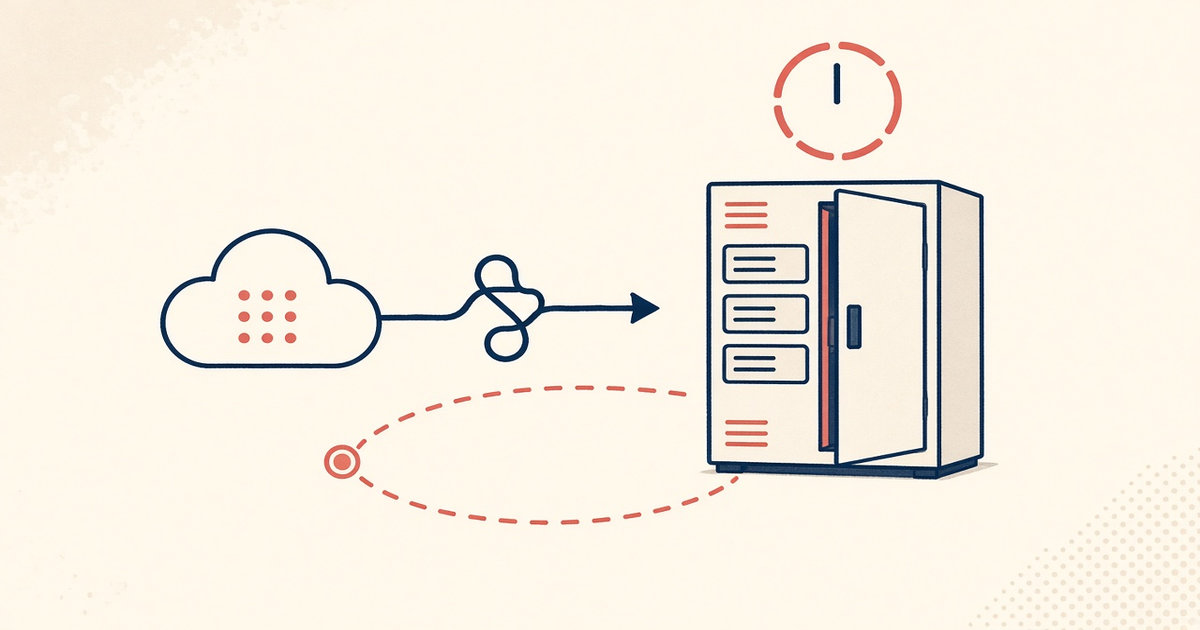
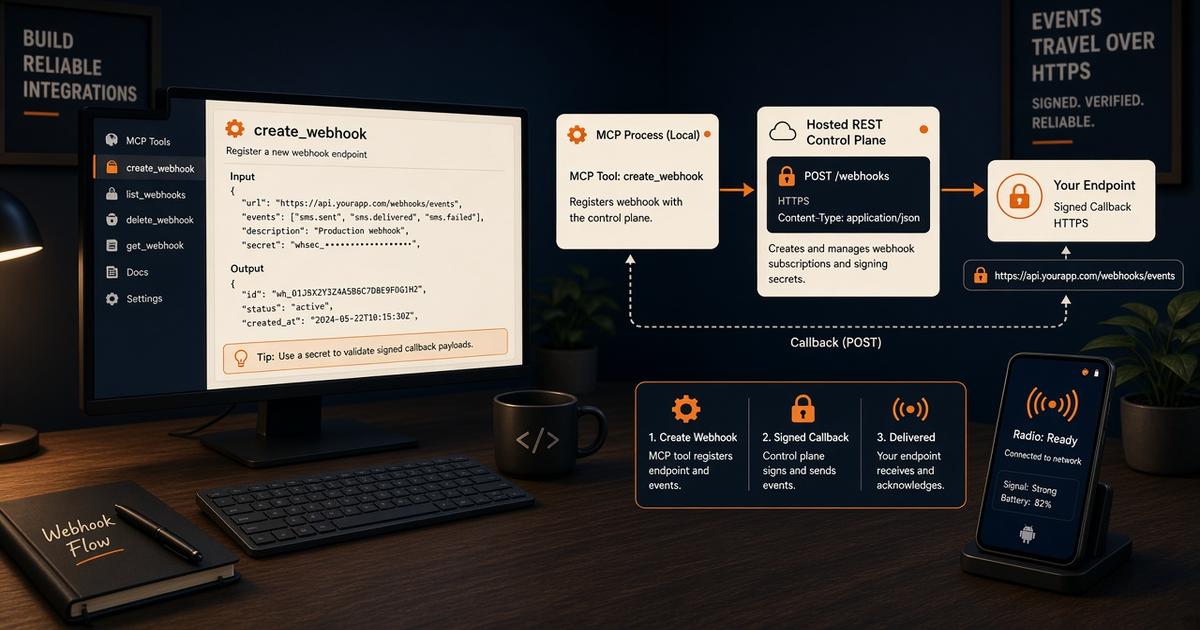
Inbound webhooks reverse the control flow: the gateway calls you when events happen. Your job is verify, ack fast, and process later. Review it again after every major Android OEM update on the gateway phone.
Signature verification stops forged events. Reject missing or stale signatures with clear metrics. Revisit the assumption whenever you add a second device.
Deduplicate on event id. Providers retry; your side effects must not. Write this into your team checklist explicitly.
Ack fast from a suspending handler, then process on a dedicated dispatcher. Verify signatures before parsing business fields. Make it part of definition of done for the integration.
Teams choosing Kotlin for receive webhook usually want fast iteration without rewriting the rest of their stack. Keep the gateway client behind a narrow interface so you can add another language later. Treat it as a release gate, not a backlog idea.
Hub C articles share the primary keyword android sms gateway api as spokes under the cornerstone API guide. Differentiate by stack and subtopic, and link back to the hub. Review it again after every major Android OEM update on the gateway phone.
Glossary
Accept means the control plane took the job. Delivered is terminal success via DLR. A webhook is an inbound event your app must verify and process idempotently. Kotlin tooling for receive webhook still obeys those physics.
Observability without action is decoration. Tie alerts to pages that on-call can actually fix: restart app, top up SIM, rotate key, fail over device. Review it again after every major Android OEM update on the gateway phone.
Migration from aggregator SDKs requires rewriting assumptions about numbers, pricing, and delivery callbacks. Keep an interface in your code so drivers can swap without rewriting controllers. Revisit the assumption whenever you add a second device.
Compliance tone differs for OTP versus marketing. Do not append promotional footers to authentication messages. Honor STOP on promotional traffic with suppression lists. Write this into your team checklist explicitly.
Partial outages are common: one device dies, another lives. Prefer explicit routing for critical OTP when the API allows device selection. Make it part of definition of done for the integration.
Design
Design receive webhook as an explicit workflow with named states, owners, and alerts — not a one-off script buried in a ticket. Make it part of definition of done for the integration.
| Layer | Kotlin job | Not this |
|---|---|---|
| HTTPS ingress | Verify signature, ack fast | A branded Kotlin SDK SKU |
| Queue | Deduplicate event id | Inline DB writes in the route |
| DLR / inbound SMS | Map fields from Developer Center | Treat 2xx as delivered |
| Phone + SIM | Last-seen + operator airtime | Assume JVM health equals radio health |
Separate configuration (base URL, key, device routing) from business templates so ops can rotate secrets without redeploying copy. Treat it as a release gate, not a backlog idea.
Prefer structured logging with message ids over dumping full SMS bodies into shared log drains. Review it again after every major Android OEM update on the gateway phone.
Plan failure modes: offline device, 429, invalid destination, signature mismatch, and delayed DLR. Revisit the assumption whenever you add a second device.
Budget for both service fees (devices + volume) and operator airtime so finance sees the full picture. Write this into your team checklist explicitly.
Document who may pause bulk jobs and who may rotate API keys during an incident. Make it part of definition of done for the integration.
Implementation
Implementation for Kotlin starts with environment-based credentials and explicit timeouts on every outbound call. Revisit the assumption whenever you add a second device.
Persist the gateway message id next to your domain object before you consider the send accepted. Write this into your team checklist explicitly.
Add a smoke test destination owned by engineering so CI or a release checklist can prove the path after deploys. Make it part of definition of done for the integration.
When using CLIs or scripts, wrap secrets carefully and avoid pasting keys into chat transcripts. Treat it as a release gate, not a backlog idea.
For app stacks, push heavy work to a background job so web requests stay snappy. Review it again after every major Android OEM update on the gateway phone.
Rehearse the runbook once: pair device, send canary, confirm DLR, rotate key, fail over device. Revisit the assumption whenever you add a second device.
// Conceptual Ktor route
post("/webhooks/sms") {
 val raw = call.receive<ByteArray>()
 if (!validSignature(call.request.headers, raw)) {
 call.respond(HttpStatusCode.Unauthorized)
 return@post
  }
 webhookQueue.enqueue(raw)
 call.respond(HttpStatusCode.NoContent)
}
The snippet above is conceptual. Paths, headers, and field names must match Developer Center. Prefer the live reference over any blog example when they diverge.
Failure modes
Hung clients without timeouts hold workers forever. Set open and read deadlines and surface timeout metrics. Treat it as a release gate, not a backlog idea.
Duplicate accepts without idempotency keys create double OTPs and double airtime spend. Review it again after every major Android OEM update on the gateway phone.
Ignoring device last-seen yields silent failures that look like application bugs. Revisit the assumption whenever you add a second device.
Webhook handlers that do business work inline invite provider retries and duplicate side effects. Write this into your team checklist explicitly.
Treating marketing STOP replies as noise violates consent expectations and burns trust. Make it part of definition of done for the integration.
Missing cost alerts on volume spikes turn a misconfigured loop into a surprise bill. Treat it as a release gate, not a backlog idea.
Security
API keys are production secrets. Rotate on schedule and after any paste into an insecure channel. Write this into your team checklist explicitly.
Prefer network allowlists and short-lived tokens when the product supports them. Make it part of definition of done for the integration.
Never embed keys in mobile clients or public repos. Automation hosts still need least privilege. Treat it as a release gate, not a backlog idea.
Redact OTP bodies in logs and support screenshots. Review it again after every major Android OEM update on the gateway phone.
Verify webhook signatures with a skew window; reject outliers loudly. Revisit the assumption whenever you add a second device.
Separate staging and production keys so engineer experiments cannot drain live SIMs. Write this into your team checklist explicitly.
Operations
On-call needs a one-page runbook: pairing, battery exemptions, SIM top-up, pause bulk, fail over device. Review it again after every major Android OEM update on the gateway phone.
Track Pending age and DLR fail rate as primary SLOs for messaging, not just HTTP latency. Revisit the assumption whenever you add a second device.
Schedule bulk windows away from peak OTP if you share devices. Write this into your team checklist explicitly.
After OEM Android updates, re-verify background permissions and Doze exemptions on gateway phones. Make it part of definition of done for the integration.
Keep a spare paired device for critical OTP when uptime matters. Treat it as a release gate, not a backlog idea.
Train support to distinguish accept failures from delivery failures using message ids. Review it again after every major Android OEM update on the gateway phone.
Checklist
- Credentials only in env/vault; not in git.
- Timeouts and retries with jitter configured.
- Idempotency reference on sends.
- DLR or webhook status wired to UI/tickets.
- Device last-seen alerting live.
- Canary destination verified this week.
- OTP vs marketing lanes separated.
- Developer Center fields confirmed against this pattern.
- Pricing model understood: devices + volume + BYO airtime.
- Runbook linked from the on-call doc.
Next steps
Pair a dedicated Android phone, confirm Developer Center credentials, ship a canary receive webhook path in Kotlin, then expand with DLR and webhook reconciliation. Cross-read sibling Hub C guides for other stacks when your team is polyglot.
When you outgrow a single SIM, add devices deliberately and keep OTP capacity ring-fenced. Revisit device and SMS volume pricing so device count and volume caps match real traffic — still with your own operator SMS credit on each handset.
Deep dive: production hardening
Retries should distinguish transport errors from business rejects. Blindly retrying a bad destination burns airtime and quota. Revisit the assumption whenever you add a second device.
Staging environments should use a dedicated low-volume device so production SIMs are not polluted by engineer experiments. Write this into your team checklist explicitly.
Contract tests against recorded fixtures catch schema drift when Developer Center fields evolve. Make it part of definition of done for the integration.
Queue depth alerts matter more than CPU for messaging workers. A calm machine with a growing pending SMS pile is still an incident. Treat it as a release gate, not a backlog idea.
Human-readable error catalogs help support resolve tickets without opening source code during peak hours. Review it again after every major Android OEM update on the gateway phone.
Keep OTP and marketing on separate mental lanes even if they share one API. Mixing templates in one worker invites compliance mistakes. Revisit the assumption whenever you add a second device.
Typed clients reduce foot-guns: validate destinations and body length before the network hop when your language supports it. Write this into your team checklist explicitly.
Coroutine or async workers still need backpressure. Unbounded fan-out against a single SIM is not parallelism — it is a queue bomb. Make it part of definition of done for the integration.
Windows automation hosts running PowerShell need the same secret hygiene as Linux workers: least privilege, no plaintext keys in transcripts. Treat it as a release gate, not a backlog idea.
Kotlin JVM services calling the gateway should treat OkHttp timeouts as mandatory, not optional polish. Review it again after every major Android OEM update on the gateway phone.
TypeScript fetch wrappers should centralize auth headers so rotating a key is one config change, not a grep across routes. Revisit the assumption whenever you add a second device.
Observability without action is decoration. Tie alerts to pages that on-call can actually fix: restart app, top up SIM, rotate key, fail over device. Write this into your team checklist explicitly.
Migration from aggregator SDKs requires rewriting assumptions about numbers, pricing, and delivery callbacks. Keep an interface in your code so drivers can swap without rewriting controllers. Make it part of definition of done for the integration.
Compliance tone differs for OTP versus marketing. Do not append promotional footers to authentication messages. Honor STOP on promotional traffic with suppression lists. Treat it as a release gate, not a backlog idea.
Partial outages are common: one device dies, another lives. Prefer explicit routing for critical OTP when the API allows device selection. Review it again after every major Android OEM update on the gateway phone.
Clock skew breaks signature checks. Allow a small skew window and reject large ones. Monitor for sudden verification failure spikes after deploys. Revisit the assumption whenever you add a second device.
Empty rendered templates should fail closed before the HTTP call. Defensive checks beat sending blank SMS that still consume volume quota. Write this into your team checklist explicitly.
Rate limits exist to protect you from yourself. When you hit 429, back off with jitter. Treating 429 without delay creates thundering herds. Make it part of definition of done for the integration.
Documentation debt kills weekends. If pairing, battery exemptions, and webhook URLs are not in the runbook, the next hire will learn during an incident. Treat it as a release gate, not a backlog idea.
Feature flags let you ramp traffic. Start with staff accounts, then a percentage of OTP, then full cutover. Watch DLR fail rates at each gate. Review it again after every major Android OEM update on the gateway phone.
Cost control means capping daily sends, separating OTP and bulk budgets, and alerting on unusual accept rates. Airtime surprise bills are preventable. Revisit the assumption whenever you add a second device.
An android sms gateway api sits between your application and a physical Android handset. Your code never talks to AT commands or SmsManager directly. It authenticates over HTTPS, submits a job, and learns later whether the radio path finished. That delay is why status handling is not optional in production systems. Write this into your team checklist explicitly.
Operator airtime is separate from the gateway service fee. You bring a working phone and SMS credit from your mobile operator. The service bills on device count and total SMS volume through the gateway. Confusing those layers leads to broken cost models and angry finance reviews. Make it part of definition of done for the integration.
Confirm every path, header, and JSON field in the Developer Center before you ship. Blog examples use conceptual shapes so they do not drift from the live reference. When docs and a blog disagree, trust Developer Center. Treat it as a release gate, not a backlog idea.
Idempotency is not optional for OTP or bulk. A retried HTTP client without a stable reference can double-charge airtime and confuse users with duplicate codes. Review it again after every major Android OEM update on the gateway phone.
Device last-seen freshness is a first-class health signal. A green HTTP path with a stale radio is how silent OTP failures begin. Revisit the assumption whenever you add a second device.
Deep dive: scaling and failure modes
Rate limits exist to protect you from yourself. When you hit 429, back off with jitter. Treating 429 without delay creates thundering herds. Make it part of definition of done for the integration.
Documentation debt kills weekends. If pairing, battery exemptions, and webhook URLs are not in the runbook, the next hire will learn during an incident. Treat it as a release gate, not a backlog idea.
Feature flags let you ramp traffic. Start with staff accounts, then a percentage of OTP, then full cutover. Watch DLR fail rates at each gate. Review it again after every major Android OEM update on the gateway phone.
Cost control means capping daily sends, separating OTP and bulk budgets, and alerting on unusual accept rates. Airtime surprise bills are preventable. Revisit the assumption whenever you add a second device.
An android sms gateway api sits between your application and a physical Android handset. Your code never talks to AT commands or SmsManager directly. It authenticates over HTTPS, submits a job, and learns later whether the radio path finished. That delay is why status handling is not optional in production systems. Write this into your team checklist explicitly.
Operator airtime is separate from the gateway service fee. You bring a working phone and SMS credit from your mobile operator. The service bills on device count and total SMS volume through the gateway. Confusing those layers leads to broken cost models and angry finance reviews. Make it part of definition of done for the integration.
Confirm every path, header, and JSON field in the Developer Center before you ship. Blog examples use conceptual shapes so they do not drift from the live reference. When docs and a blog disagree, trust Developer Center. Treat it as a release gate, not a backlog idea.
Idempotency is not optional for OTP or bulk. A retried HTTP client without a stable reference can double-charge airtime and confuse users with duplicate codes. Review it again after every major Android OEM update on the gateway phone.
Device last-seen freshness is a first-class health signal. A green HTTP path with a stale radio is how silent OTP failures begin. Revisit the assumption whenever you add a second device.
Webhook receivers must acknowledge quickly and process asynchronously. Spending seconds inside the request handler invites retries and duplicate side effects. Write this into your team checklist explicitly.
DLR states are terminal truths for delivery questions. Treat accept responses as promises, not proof the handset radio finished. Make it part of definition of done for the integration.
Bulk loops need pacing that matches real SIM throughput. Bursting faster than the radio can drain creates backlog and carrier friction. Treat it as a release gate, not a backlog idea.
Secrets belong in environment variables or a vault, never in shell history dumps committed to git or shared Slack snippets. Review it again after every major Android OEM update on the gateway phone.
Canary sends to staff numbers before production cutover catch template bugs that unit tests will never see. Revisit the assumption whenever you add a second device.
Timezone mistakes show up as midnight surprise campaigns. Store schedule intent in UTC and render local time only for operators. Write this into your team checklist explicitly.
Support runbooks should include SIM swap steps, pairing QR recovery, and how to pause a noisy bulk job without killing OTP. Make it part of definition of done for the integration.
Multi-device fleets need naming conventions and ownership tags so on-call knows which desk drawer holds the failing handset. Treat it as a release gate, not a backlog idea.
Logging should redact message bodies that contain OTPs or PII while still retaining message ids for reconciliation. Review it again after every major Android OEM update on the gateway phone.
Retries should distinguish transport errors from business rejects. Blindly retrying a bad destination burns airtime and quota. Revisit the assumption whenever you add a second device.
Staging environments should use a dedicated low-volume device so production SIMs are not polluted by engineer experiments. Write this into your team checklist explicitly.
Contract tests against recorded fixtures catch schema drift when Developer Center fields evolve. Make it part of definition of done for the integration.
Queue depth alerts matter more than CPU for messaging workers. A calm machine with a growing pending SMS pile is still an incident. Treat it as a release gate, not a backlog idea.
Human-readable error catalogs help support resolve tickets without opening source code during peak hours. Review it again after every major Android OEM update on the gateway phone.
Keep OTP and marketing on separate mental lanes even if they share one API. Mixing templates in one worker invites compliance mistakes. Revisit the assumption whenever you add a second device.
Typed clients reduce foot-guns: validate destinations and body length before the network hop when your language supports it. Write this into your team checklist explicitly.
Coroutine or async workers still need backpressure. Unbounded fan-out against a single SIM is not parallelism — it is a queue bomb. Make it part of definition of done for the integration.
Deep dive: integration discipline
An android sms gateway api sits between your application and a physical Android handset. Your code never talks to AT commands or SmsManager directly. It authenticates over HTTPS, submits a job, and learns later whether the radio path finished. That delay is why status handling is not optional in production systems. Write this into your team checklist explicitly.
Operator airtime is separate from the gateway service fee. You bring a working phone and SMS credit from your mobile operator. The service bills on device count and total SMS volume through the gateway. Confusing those layers leads to broken cost models and angry finance reviews. Make it part of definition of done for the integration.
Confirm every path, header, and JSON field in the Developer Center before you ship. Blog examples use conceptual shapes so they do not drift from the live reference. When docs and a blog disagree, trust Developer Center. Treat it as a release gate, not a backlog idea.
Idempotency is not optional for OTP or bulk. A retried HTTP client without a stable reference can double-charge airtime and confuse users with duplicate codes. Review it again after every major Android OEM update on the gateway phone.
Device last-seen freshness is a first-class health signal. A green HTTP path with a stale radio is how silent OTP failures begin. Revisit the assumption whenever you add a second device.
Webhook receivers must acknowledge quickly and process asynchronously. Spending seconds inside the request handler invites retries and duplicate side effects. Write this into your team checklist explicitly.
DLR states are terminal truths for delivery questions. Treat accept responses as promises, not proof the handset radio finished. Make it part of definition of done for the integration.
Bulk loops need pacing that matches real SIM throughput. Bursting faster than the radio can drain creates backlog and carrier friction. Treat it as a release gate, not a backlog idea.
Secrets belong in environment variables or a vault, never in shell history dumps committed to git or shared Slack snippets. Review it again after every major Android OEM update on the gateway phone.
Canary sends to staff numbers before production cutover catch template bugs that unit tests will never see. Revisit the assumption whenever you add a second device.
Timezone mistakes show up as midnight surprise campaigns. Store schedule intent in UTC and render local time only for operators. Write this into your team checklist explicitly.
Support runbooks should include SIM swap steps, pairing QR recovery, and how to pause a noisy bulk job without killing OTP. Make it part of definition of done for the integration.
Multi-device fleets need naming conventions and ownership tags so on-call knows which desk drawer holds the failing handset. Treat it as a release gate, not a backlog idea.
Logging should redact message bodies that contain OTPs or PII while still retaining message ids for reconciliation. Review it again after every major Android OEM update on the gateway phone.
Retries should distinguish transport errors from business rejects. Blindly retrying a bad destination burns airtime and quota. Revisit the assumption whenever you add a second device.
Staging environments should use a dedicated low-volume device so production SIMs are not polluted by engineer experiments. Write this into your team checklist explicitly.
Contract tests against recorded fixtures catch schema drift when Developer Center fields evolve. Make it part of definition of done for the integration.
Queue depth alerts matter more than CPU for messaging workers. A calm machine with a growing pending SMS pile is still an incident. Treat it as a release gate, not a backlog idea.
Human-readable error catalogs help support resolve tickets without opening source code during peak hours. Review it again after every major Android OEM update on the gateway phone.
Keep OTP and marketing on separate mental lanes even if they share one API. Mixing templates in one worker invites compliance mistakes. Revisit the assumption whenever you add a second device.
Typed clients reduce foot-guns: validate destinations and body length before the network hop when your language supports it. Write this into your team checklist explicitly.
Coroutine or async workers still need backpressure. Unbounded fan-out against a single SIM is not parallelism — it is a queue bomb. Make it part of definition of done for the integration.
Windows automation hosts running PowerShell need the same secret hygiene as Linux workers: least privilege, no plaintext keys in transcripts. Treat it as a release gate, not a backlog idea.
Kotlin JVM services calling the gateway should treat OkHttp timeouts as mandatory, not optional polish. Review it again after every major Android OEM update on the gateway phone.
Related product pages
Jump to the live product docs for this topic—not another long-form article.
- SMS webhook integrationInbound and status events
- SMS API documentationLive endpoint reference
- device and SMS volume pricingPlans and allowances
- Android SMS gateway product guideDefinition, product, and how to buy