Key Takeaways
- Carrier plan choice for OTP on an android phone as sms gateway determines whether login codes arrive in seconds or vanish behind throttling, zero-balance cutoffs, and A2P filters — not the gateway app alone.
- Budget three separate line items: gateway service fee (devices + send volume), operator SMS airtime on your SIM plan, and optional mobile data for the control plane — we do not sell carrier SMS balance.
- Prepaid plans work for low-volume OTP if you automate balance alerts; postpaid or business lines scale better when nightly batch jobs or password-reset storms spike send volume.
- Consumer “unlimited SMS” marketing often excludes automated or high-rate application traffic — read fair-use and A2P clauses before you route production OTP through a personal line.
- Model OTP monthly volume as peak-day sends × safety factor (1.5–2×), not average traffic — Black Friday login spikes exhaust prepaid buckets faster than spreadsheets predict.
- Gateway service pricing (Priced by devices and SMS send volume. You use your own phone and operator SMS credit.) meters devices and platform send volume separately from what you pay your mobile operator for each SMS bearer.
- USA teams must pair plan choice with A2P 10DLC registration and sender reputation work — the wrong consumer plan plus unregistered traffic is a deliverability failure, not a gateway bug.
- Dual-SIM spares need two documented plan profiles: primary OTP slot with tested throughput, secondary failover slot with its own airtime balance and expiry calendar.
Picking the wrong mobile plan is one of the quietest ways to break OTP verification on an android phone as sms gateway. The dashboard shows green, your API returns 200, and users still never receive login codes — because prepaid credit hit zero, because a consumer “unlimited SMS” fair-use clause throttled application traffic, or because US carriers filtered unregistered A2P on a long code. The gateway app sends what the SIM and carrier allow; it cannot manufacture airtime or bypass operator policy.
A prepaid SIM that dies at 02:14 is not an API outage. It is an airtime runbook you never wrote, on a phone you still own.
This guide walks carrier plan choice for OTP workloads: how to model volume, compare prepaid vs postpaid vs business lines, read throttling and A2P rules, budget operator cost beside gateway service fees, and build runbooks that survive midnight balance expiry. Companion reads: the Android phone as SMS gateway hub, SMS Gateway USA for market-specific compliance, SMS Gateway questions, and SMS API documentation for API and webhook patterns. Service pricing is based on device count and total SMS sent through the gateway. Priced by devices and SMS send volume. You use your own phone and operator SMS credit.
Why carrier plan choice matters for OTP
OTP is the most latency-sensitive SMS workload most teams run. Users stare at a screen; every second of delay feels like a bug. Marketing bulk can tolerate five-minute skew; login codes cannot. That urgency exposes plan weaknesses consumer texting never triggers: burst sends when a thousand users request reset at once, retry loops when codes expire in sixty seconds, and twenty-four-hour uptime expectation on a SIM you forgot to top up.
An Android gateway phone sits at an unusual intersection. It is a consumer handset running a production automation workload through a consumer or small-business carrier contract. Operators designed those plans for people messaging friends and family, not for Laravel apps firing verification codes every three seconds. When behavior looks like A2P traffic, filters activate — sometimes silently, sometimes as hard bounces with opaque error codes on the modem path.
Plan choice also determines operational toil. Prepaid saves monthly commitment but adds balance babysitting. Postpaid smooths billing but may require credit checks and business registration. M2M lines simplify IoT branding yet sometimes omit SMS entirely. Your job is to match plan mechanics to OTP volume, geography, and how much midnight top-up drama your team will tolerate.
Industry groups publish messaging best-practice guidance worth reading alongside carrier contracts — for example resources from CTIA on responsible messaging. Those frameworks assume you know what your plan allows before you scale OTP through a phone on a shelf.
Two cost layers: gateway service vs operator airtime
New teams conflate two bills. Separating them prevents budget surprises and support tickets aimed at the wrong vendor.
Gateway service fee. You need a working Android phone with a SIM and SMS credit from your mobile operator. Operator message costs are yours—we do not sell carrier SMS balance. We charge based on device count and total SMS sent through the platform — see device and SMS volume pricing for tiers. The free plan includes 300 SMS lifetime on one device; paid production OTP commonly starts at $19/month for Starter (Unlimited SMS). That fee buys dashboard, API, webhooks, routing, and support — not carrier transmission.
Operator SMS airtime. Each OTP SMS consumes credit on your SIM plan according to your mobile operator's tariff. Prepaid: deduct from bundle or wallet. Postpaid: per-message charge or included pool. If this balance is empty, sends fail regardless of gateway tier headroom. You pay the operator directly; we do not resell their SMS buckets.
Mobile data (optional third line item). The gateway app needs IP connectivity for queue sync and delivery reports. Wi-Fi or cellular data carries that control plane. Data charges belong to your operator data plan — unrelated to SMS bundles except on odd combined tariffs you should verify in writing.
Total cost of OTP ownership ≈ gateway tier + operator SMS at your volume + data + handset amortization. Comparing only gateway pricing to Twilio per-message rates ignores that you still buy operator airtime on the Android path while gaining control of your own SIM and MSISDN.
Glossary: plans and OTP terms
- Operator SMS airtime
- Credit or allowance on your mobile plan that pays the carrier for each SMS PDU transmitted over the radio network. Distinct from gateway platform fees and from mobile data megabytes.
- OTP burst
- Short window where login or reset traffic spikes — product launch, password breach news, or Monday morning peak. Plans must survive burst TPS, not just monthly averages.
- A2P (application-to-person)
- SMS originated by software rather than human thumb-typing. Carriers apply different filtering, registration, and fair-use rules to A2P on long codes and short codes.
- 10DLC (US)
- Ten-digit long code registration scheme for US A2P SMS. Brands and campaigns register with The Campaign Registry; carriers enforce throughput tiers and filtering on unregistered traffic.
- Throughput tier
- Carrier limit on messages per minute or day from a sender ID. Low tiers cause OTP delay during bursts even when monthly bundle headroom remains.
- DLR (delivery report)
- Carrier acknowledgment that SMS reached the handset or was rejected. OTP SLAs should monitor DLR latency, not only API 200 responses from your backend.
- MSISDN
- The phone number associated with your SIM — what recipients see as sender on OTP texts. Plan changes that swap numbers break user trust and 10DLC mappings.
- M2M / IoT plan
- Machine-to-machine tariff intended for devices, sometimes with SMS buckets and stricter data-only variants. Verify SMS is included before assuming OTP will send.
- Fair-use policy (FUP)
- Carrier clause limiting "unlimited" SMS when usage looks automated or excessive. Gateway OTP traffic often triggers FUP on consumer plans.
- Control plane
- HTTPS connection between gateway app and cloud service for queue sync. Requires Wi-Fi or mobile data; independent of SMS airtime balance unless the carrier bundles oddly.
Share this glossary with finance and support — OTP incidents go faster when everyone uses the same words for airtime, throughput, and registration status.
OTP volume math before you choose a plan
Do not pick a 500-SMS prepaid bundle because “we're small.” Model from peak day, retries, and clock skew.
Step 1 — count OTP events. How many logins, signups, or password resets request SMS per day at peak? Use analytics, not guesses. Include staging sends during QA if they hit the same production SIM.
Step 2 — multiply retry factor. Users mistype codes; apps auto-resend; bots trigger floods. Factor 1.2–1.5 for healthy apps; 2× if UX encourages instant resend buttons without cooldown.
Step 3 — monthly projection. Peak daily sends × retry factor × 30. Example: 800 peak OTP requests × 1.35 × 30 ≈ 32,400 SMS/month on that SIM.
Step 4 — compare to plan and platform caps. Operator bundle must cover step 3 with headroom. Gateway tiers meter devices plus platform send volume: Free is 300 SMS lifetime; Developer is 25,000 SMS per year; Starter / Professional / Business uncap platform send volume while still metering 2 / 5 / 15 devices. Carrier fair-use still applies. Misalignment either blocks sends at the platform or at the carrier first.
Step 5 — burst rate. Monthly totals lie. Ask: how many OTP SMS in the worst minute? Carriers throttle on short windows. A plan with generous monthly pool but low throughput tier still queues codes during incident traffic.
Document assumptions in the same wiki page as your SMS API documentation integration notes so finance renewals reuse the same math.
Plan types compared for gateway OTP
Labels vary by country; the mechanics below repeat often enough to use as a workshop table with your carrier account rep.
| Plan type | Typical OTP fit | Watch-outs |
|---|---|---|
| Prepaid consumer | Low volume, dev/staging, single-market pilots | Balance zero outages; bundle expiry; no invoice trail |
| Postpaid consumer | Moderate OTP with auto top-up via billing | FUP on automated sends; personal liability |
| Postpaid business | Production OTP, higher burst, support SLAs | Contract term; may need business ID registration |
| M2M / IoT | Dedicated shelf device, predictable SMS bucket | Some variants are data-only; SMS add-on required |
| Dual-SIM hybrid | Primary OTP + failover secondary market | Two plans to monitor; slot routing mistakes |
None of these labels guarantees A2P compliance. Always request written confirmation that application-originated OTP is permitted at your projected rate on the specific tariff code you will activate.
Prepaid vs postpaid for OTP
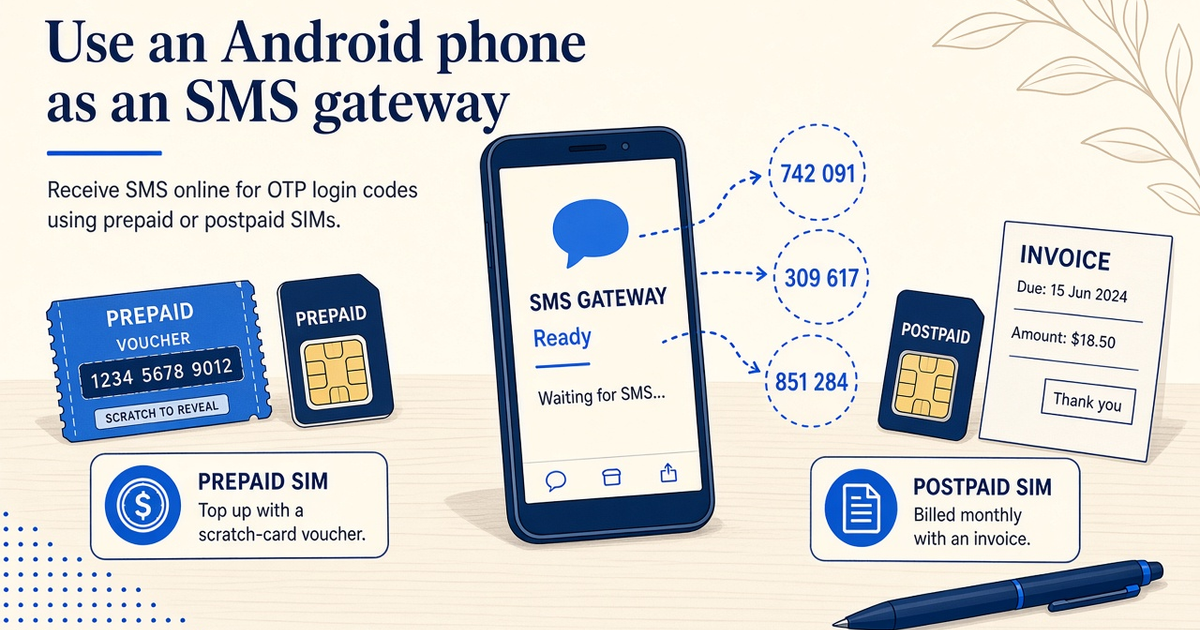
Prepaid strengths. No credit check; easy spare SIM for Bangladesh, Philippines, or US testing; hard spending cap when you load only what you need. Teams prototyping on the 300 SMS lifetime free tier often pair a cheap prepaid SIM for operator airtime during burn-in.
Prepaid failure modes. Balance hits zero silently overnight. Bundle expires calendar-day while dashboard heartbeats stay green. Retail top-up friction during holidays. Harder to get carrier support to escalate filtering issues without business account status.
Postpaid strengths. Invoiced usage smooths accounting; business accounts get named reps; higher default throughput on some carriers. Automatic billing continues through month-end OTP spikes you forgot to forecast.
Postpaid failure modes. Spend caps and parental-style controls still exist on consumer postpaid. Roaming surprises if SIM travels. Contract minimums hurt when you decommission a pilot gateway phone.
Rule of thumb: prepaid until OTP volume stabilizes and you have automated balance monitoring; migrate to business postpaid before production SLAs depend on the SIM. Document the migration as a change ticket — MSISDN changes break user recognition of sender ID.
Business and M2M plans
When OTP underpins revenue — checkout login, wallet transfer confirm, healthcare portal access — consumer plans become liability. Business mobile lines or M2M tariffs typically offer:
- SMS buckets sized for machine traffic, not thumb texting averages
- Named support channels that understand A2P questions
- Central billing for multi-device fleets matching Silver or Gold gateway tiers
- Clearer acceptable-use language for automated sends
Verify SMS is in-bundle. IoT data SIMs marketed for GPS trackers sometimes block MO/MT SMS entirely or charge punitive per-message rates. Ask the rep: “Android device sending OTP via API gateway at X messages per day — which SKU?”
Business plans do not replace regulatory work. US 10DLC, opt-in/consent, and SHAFT content rules still apply. Business status helps with carrier relationship; it is not a compliance shortcut.
Throttling, fair-use, and A2P filters
Carriers protect networks and subscribers with rate limits invisible on marketing brochures. OTP teams feel them first during launches.
Throughput caps. Messages per second or minute from one sender ID. Exceed the cap and OTP queues delay — users request resend, doubling load. Fix: registered 10DLC campaign with higher tier (US), business plan upgrade, or traffic spread across multiple registered senders (multi-device Silver tier).
Fair-use on “unlimited.” Consumer marketing unlimited SMS rarely means unlimited application OTP. Patterns that trigger review: identical template to many recipients, 24/7 symmetric traffic, short-code-like velocity from a long code. Symptoms: sudden DLR failures, error classes in modem logs, carrier SMS without delivery.
Content filtering. SHAFT (sex, hate, alcohol, firearms, tobacco) and spam heuristics affect OTP if templates include URLs on blocklists or suspicious domains. Keep OTP copy boring: code, expiry, support line. Link to FAQ pages sparingly in the OTP body itself.
International routes. Sending US OTP from a foreign roaming SIM — or the reverse — hits different filters and rates. Match SIM registration country to primary user base when possible; see geo notes below.
USA geo note: plans plus 10DLC
US OTP through your own Android phone uses a ten-digit long code (your SIM's MSISDN). Carriers expect A2P 10DLC registration: business brand, campaign use case, throughput tier assignment. Unregistered or misclassified traffic faces filtering regardless of plan generosity.
Plan choice interacts with 10DLC in three ways. First, business postpaid lines often smooth carrier support when registration stalls. Second, throughput tier caps bind to campaign approval — a unlimited consumer SMS marketing claim does not raise tier. Third, number porting or SIM swap changes the sender ID and invalidates prior registration bindings until updated.
Deep market context — pricing comparisons, compliance checklists, operator cost framing — lives on SMS Gateway USA. Pair that page with this plan guide before US production cutover.
Non-US teams sending mostly local OTP should still read US rules if any traffic terminates on US handsets — roaming users, US expats, global apps. One US recipient with unregistered traffic can trigger reputation hits affecting broader routes.
Dual-SIM plan strategy
Dual-SIM gateway phones appear in Silver-tier fleets and failover designs. Two slots mean two carrier relationships — not one plan with backup magic.
Primary OTP slot. Plan chosen for lowest latency to your main user geography, registered sender, highest throughput tier you can justify. Document ICCID, MSISDN, plan name, renewal date, and low-balance threshold.
Secondary slot. Failover when primary carrier has regional outage or primary balance exhausted; or separate market (SIM2 for Bangladesh local, SIM1 for US 10DLC). Secondary must receive its own burn-in OTP tests — inactive failover SIMs expire quietly.
Routing. Dashboard device settings map sends to slot. Wrong slot with empty balance mirrors single-SIM failure. After any plan change, run canary OTP to both slots and verify DLR on SMS API documentation webhook endpoints.
Monthly cost model (operator + platform)
Build a spreadsheet row per production SIM. Example US-ish illustration — replace rates with your operator quote:
| Line item | Example | Notes |
|---|---|---|
| Gateway Starter tier | $19/month | 10,000 platform SMS/month, 1 device |
| Operator plan fee | $15–$45/month | Business line or M2M; varies widely |
| Operator SMS at 10k OTP | $0–$80 | Included bundle vs $0.008 × 10k |
| Mobile data | $5–$15/month | If not on unmetered Wi-Fi primary |
| Handset amortization | $3–$8/month | Dedicated spare over 24 months |
At 10,000 OTP/month, total Android-path cost often lands near aggregator list pricing on message count alone — advantage comes from owning MSISDN, avoiding per-number rental, and controlling SIM in your jurisdiction. Re-run the model at 50k and 300k to pick Silver vs Gold gateway tiers honestly.
Failure modes by plan type
Map symptoms to plan causes before opening gateway support tickets.
- All sends fail, heartbeats green, prepaid SIM: zero SMS balance or expired bundle — top up or renew plan.
- Intermittent delays, no hard failure: throughput tier saturation — spread devices, upgrade campaign tier, or reduce resend spam in app UX.
- Sudden block after months of OK traffic: FUP triggered on consumer plan — migrate to business SKU or register A2P properly.
- Works domestic, fails US roaming users: international SMS not enabled or filtered — check plan add-on or use in-country SIM for that market.
- Dual-SIM wrong slot: primary empty, secondary full — fix routing and asset labels.
- Platform 429 or quota errors with healthy SIM: gateway tier cap — upgrade plan on device and SMS volume pricing, distinct from carrier issue.
More diagnostic flows live in SMS Gateway questions — search OTP delivery and DLR topics before assuming app regression.
Decision matrix: which plan for your OTP stage
Score honestly; staging pretends are cheaper than production outages.
| Your situation | Recommended plan direction |
|---|---|
| Dev/test on free gateway tier, <100 OTP/day | Cheapest prepaid with manual weekly balance check |
| Production <5k OTP/month, single country | Postpaid business or generous prepaid with auto-alert |
| Production >10k OTP/month or burst-sensitive | Business/M2M with documented SMS bucket + Starter/Silver gateway |
| US users, long-code OTP | Business line + completed 10DLC; read USA geo page |
| Multi-market, one phone dual-SIM | Two plans, two registrations, Silver routing |
| OTP plus heavy marketing same number | Split SIMs or accept reputation risk with monitoring |
Developer integration context
Plan limits surface in API behavior your backend must handle gracefully.
Return clear UX when sends fail at carrier: “Unable to send code, try email fallback” beats infinite spinner. Log gateway error payloads and DLR webhooks separately — SMS API documentation documents retry policy; do not hammer resend on hard carrier block (creates retry storm).
Rate-limit resend buttons in your app to protect both user experience and SIM throughput. A sixty-second cooldown reduces duplicate OTP charges on prepaid airtime during carrier delay windows.
Align environment separation: staging SIM on prepaid, production on business postpaid — never share SIM between staging load tests and live users. Volume math includes QA if it hits production ICCID.
For OTP-specific product patterns — code length, expiry, fallback channels — see OTP verification use case. Plan choice sits underneath those patterns as infrastructure assumption.
Monitoring and balance alerts
OTP reliability on a gateway phone is as much about observability as plan SKU. Treat SIM airtime like disk space on a database server — invisible until critical, then catastrophic. Build alerts that fire before users notice.
Carrier-native alerts. Most operators offer SMS or email when prepaid balance crosses a threshold. Enable the lowest threshold they allow (often 10–20% remaining) and add a second alert at fixed currency amount. Postpaid accounts may support spend-cap notifications — turn them on even if you trust invoicing; caps still block sends.
Gateway-side signals. Rising send failure rate in dashboard analytics, missing DLR webhooks within SLA, or API error codes referencing modem failure often precede total outage. Wire SMS API documentation webhooks to the same on-call channel as application errors. OTP teams should page on DLR timeout percent, not only on HTTP 500 from auth service.
Calendar alerts. Prepaid bundle expiry dates, contract renewal, and annual plan migrations belong in shared ops calendar with owner names. SIMs do not fail gracefully at expiry — they fail completely. Seven-day and one-day reminders prevent weekend surprises.
Synthetic canaries. Scheduled OTP to an internal test handset every six hours validates end-to-end path including operator delivery. Canary failure with green heartbeats strongly implicates airtime or filtering; canary failure with offline device implicates network or power path from companion hub articles.
Reconciliation cadence. Monthly: compare platform send counter, operator invoice or usage portal, and application OTP analytics. Drift indicates misconfigured routing, dual-SIM slot bleed, or staging traffic on production ICCID. Finance should see one row explaining gateway platform fee separate from carrier SMS line item — Priced by devices and SMS send volume. You use your own phone and operator SMS credit.
Consent, compliance, and plan language
Carrier plan choice does not remove legal obligations around OTP. Even purely transactional one-time passwords require accurate sender identification, honest template content, and respect for local telecom rules. Plans that forbid commercial messaging may still allow transactional OTP — but only if your contract says so explicitly.
Opt-in scope. OTP for login to an account the user created is typically transactional. OTP sent to purchased lead lists is not — and will violate both law and carrier AUP on any plan type. If marketing and auth share infrastructure, separate SIMs and separate compliance packets.
Sender ID stability. Users learn “codes come from this number.” Swapping SIM to chase a cheaper prepaid deal changes MSISDN and erodes trust — plan migrations should prefer keeping the number and changing tariff in place via carrier port or plan change workflow.
Record retention. Business postpaid lines simplify invoice retention for audits. Prepaid top-up receipts scattered across personal cards frustrate SOC-style reviews. Centralize carrier billing ownership under ops or finance, not individual engineer expense reports.
External messaging standards bodies emphasize lawful, consent-based use — review industry guidance from CTIA when drafting internal acceptable-use policy for OTP templates and volume growth. Pair policy with SMS Gateway questions for product-specific limits.
Negotiating with carrier account reps
Walk into carrier conversations with OTP math printed, not vague “we send automated texts.” Reps route unknown A2P questions to specialized teams when you sound like revenue, not hobbyists.
Bring these numbers: peak daily OTP, peak minute burst, primary destination countries, one example template (code-only), Android device type (gateway phone on shelf), expected growth over twelve months. Ask which product code supports MT SMS at that profile and whether MO replies are needed for STOP handling on other products sharing the fleet.
Ask explicitly: Is application-originated OTP permitted? What throughput tier applies day one? What registration (US 10DLC, local equivalent) is required before full speed? What happens on fair-use review — warning, throttle, or terminate? Is SMS included on quoted M2M SKU or billed per PDU?
Get email confirmation. Verbal yes from retail store staff fails audits and incident postmortems. Save PDF tariff sheets and acceptable-use excerpts in asset folder beside ICCID.
Multi-device fleets. If you plan Silver-tier ten-phone rollout, ask about pooled SMS buckets or consolidated billing — ten separate prepaid top-ups invite human error. Carriers vary wildly; some enterprise programs excel here, some have no Android gateway concept at all. Persistence plus switching carriers is valid when incumbent offers only consumer unlimited with hostile AUP.
Case narrative: prepaid midnight outage
A fintech pilot ran OTP through one Android gateway phone on a $30 prepaid bundle advertised as “5,000 SMS.” Launch week exceeded forecast; legitimate retries exhausted the bundle at 23:47 local time on Friday. Heartbeats stayed green over Wi-Fi. Send API returned success from app queue dequeue; DLRs never arrived. Support assumed gateway bug until someone opened carrier portal and saw zero SMS remaining.
Top-up via retail app failed — payment gateway maintenance until 06:00. Users could not log in for six hours. Postmortem actions: lower alert threshold to 500 SMS remaining; migrate to postpaid business line with invoice billing; add email OTP fallback in auth service; schedule canary every four hours hitting real carrier path; document that platform Starter quota and prepaid bundle are independent counters — they had 4,000 platform SMS left while carrier showed empty.
Lesson: prepaid works until volume variance and retry UX convert headroom into outage. Plan choice plus alerting plus fallback channel beats blaming the gateway phone.
International market notes (beyond USA)
OTP plan shopping is local even when your app is global. A SIM perfect in Jakarta may filter London-terminating traffic; EU roaming rules change effective rates overnight.
South and Southeast Asia. Prepaid dominance makes balance alerts mandatory. Many markets offer cheap SMS buckets ideally suited to Android gateway pilots — verify automated send permission because regulators tightened spam while keeping transactional carve-outs. Dual-SIM phones with local SIM plus backup are common ops pattern.
Europe. GDPR shapes retention of phone numbers in logs, not SMS plan choice directly — but business contracts simplify DPA conversations with carrier as processor where applicable. Roaming within EU may still change SMS tariffs; production gateway SIMs should stay stationary in registered country when possible.
Middle East and Africa. Operator quality varies by route; test DLR latency to local handsets during burn-in, not only to foreign test numbers. Some markets require sender registration akin to lightweight 10DLC — ask rep before scaling.
Cross-border OTP. Sending from SIM registered in country A to users in country B often costs more and filters harder than local termination. Multi-geo teams combine USA geo guidance with local SIM procurement per market rather than one heroic roaming plan.
When unsure, start OTP on local prepaid with tight monitoring, promote to business postpaid after thirty days of measured peak rate, and align gateway tier upgrade (300 free lifetime → $19/mo Starter for two devices, then Professional / Business as the device pool grows) with proven numbers not roadmap slides.
Carrier plan checklist for OTP gateway phones
Walk at commissioning, after any carrier call, and quarterly. Copy into your ops wiki.
- Peak OTP volume modeled with retry factor and seasonal headroom documented
- Operator plan type labeled: prepaid, postpaid consumer, business, or M2M
- SMS bundle size or per-message rate recorded in ops wiki with currency
- Low-balance alert configured at carrier portal or third-party monitor
- Prepaid expiry date on calendar with 7-day and 1-day reminders
- Terms reviewed for automated / commercial / A2P restrictions
- USA: 10DLC brand and campaign status verified if sending to US handsets
- Dual-SIM: both slot ICCIDs, plans, and balances on asset sheet
- Separate OTP SIM from marketing SIM when reputation isolation required
- Gateway tier SMS allowance matches projected platform volume
- Canary OTP send scheduled after any plan change or SIM swap
- Incident runbook: top-up steps, carrier support number, expected restore time
- Monthly reconciliation: platform send count vs operator bill vs OTP analytics
- Starter ($19/mo, 2 devices) or higher selected before exceeding free lifetime quota
- Developer Center webhook alerts wired for send failures and DLR timeouts
Common mistakes
- Treating gateway subscription as including operator SMS — sends fail with full platform quota.
- Choosing plan from monthly average, ignoring burst minute — throttling during incident.
- Personal unlimited plan for production OTP — FUP termination risk.
- No low-balance alert on prepaid — 02:00 login outage until retail opens.
- US OTP without 10DLC registration — filtered despite paid plan.
- M2M data SIM without SMS enabled — discovery at go-live.
- Marketing and OTP on one MSISDN — reputation bleed blocks auth codes.
- Dual-SIM failover never tested — secondary expired unused.
- MSISDN change without updating user docs and registration — trust collapse.
- Ignoring DLR webhooks — API success without handset delivery.
- Roaming SIM for local OTP — higher latency and filter risk.
- Skipping carrier written confirmation on A2P allowance — account rep verbal yes insufficient.
Next steps
Run volume math, pick plan type from the decision matrix, confirm A2P rules in writing, and wire balance alerts before promoting OTP to production on your gateway phone. Continue the hub series: Android phone as SMS gateway cornerstone, dedicated spare phone setup, install from download the Android gateway app, and align platform tiers on device and SMS volume pricing (Priced by devices and SMS send volume. You use your own phone and operator SMS credit.). US teams: complete USA geo guidance alongside carrier contract review. Integrators: SMS API documentation and OTP verification.
Carrier plan choice is not a one-time shopping task — it is living ops tied to OTP volume growth, registration status, and prepaid calendars. Pick deliberately, monitor balances like uptime, and users get codes in seconds instead of tickets about codes that never arrived.
Related product pages
Jump to the live product docs for this topic—not another long-form article.
- OTP and 2FA SMS on AndroidAuthentication flows
- device and SMS volume pricingPlans and allowances
- Android SMS gateway product guideDefinition, product, and how to buy
- SMS API documentationLive endpoint reference