Key Takeaways
- “Free SMS server” usually means free or freemium software that drives a phone SIM — not free carrier messages to the world.
- You always pay operator airtime (or a prepaid SMS bundle) when the radio path is a real Android SIM.
- A free tier that includes limited lifetime sends is for proving OTP and webhooks; production volume needs a clear device + volume plan.
- Bulk on one free handset is throttled by physics and carriers, not by marketing adjectives.
- Score any “free” offer on: who hosts the control plane, what happens after the free quota, and who is on-call when the phone sleeps.
Search free sms server and you will find GitHub READMEs, marketplace “unlimited after install” claims, freemium SaaS tiers, and forum threads promising SMS with zero cost forever. Some of those paths are honest freemium products. Some are software that is free while the carrier bill is not. This guide unpacks what “free” actually includes when the server is an Android phone with a SIM — and how to set up a path that works for OTP and careful bulk without walking into a trap.
Related context: open source vs maintained, android phone as SMS gateway, and device and SMS volume pricing.
“Free software is not free airtime. On this product Free is 300 SMS lifetime on one device — then you upgrade or pause.”
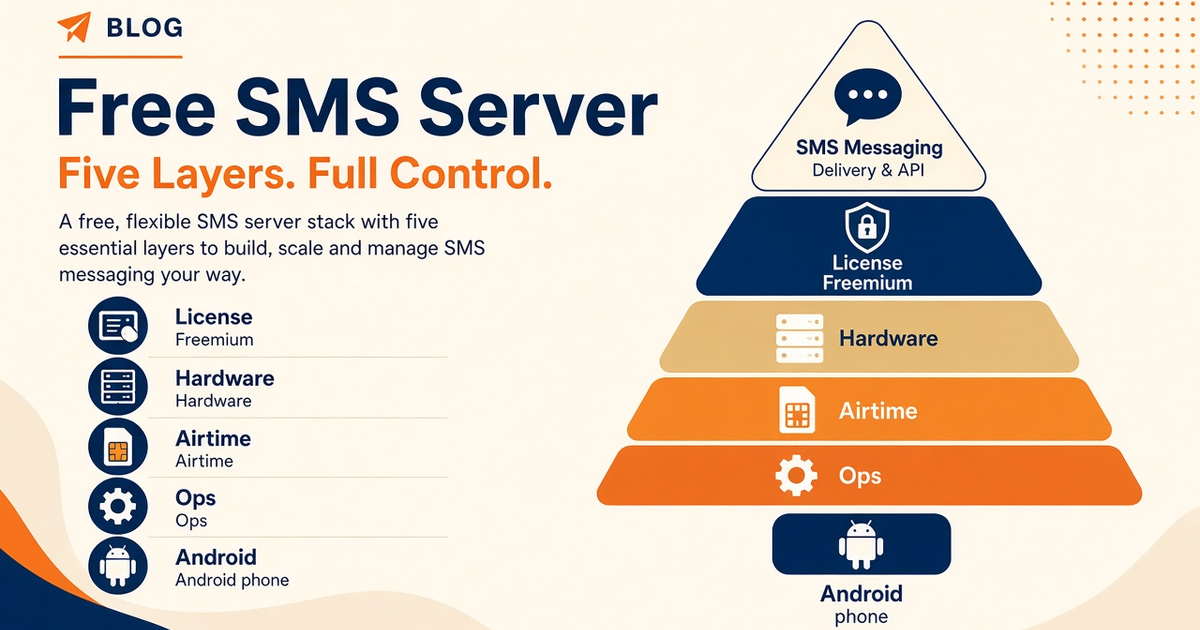
License
Freemium
Hardware
Airtime
Ops
| Claim layer | Honest meaning | Myth |
|---|---|---|
| License free | OSS or $0 download | Includes hosting forever |
| Freemium | 300 SMS lifetime / 1 device here | Unlimited cloud SMS |
| Hardware | You bring Android | No phone required |
| Airtime | You pay operator | Worldwide free texts |
| Ops | Someone on-call | Set and forget |
What people mean by “free SMS server”
Intent splits four ways. One camp wants software with a $0 license. One wants a cloud account with a free allowance. One wants literally zero cost to recipients worldwide. One wants “free” as in no per-message aggregator fee because they already pay a mobile plan. Only the last group is thinking clearly about Android SIM economics.
An Android free SMS server is almost always: a phone you own, a SIM with operator credit, and software that exposes HTTP so your app can send. The software may be free forever, free to start, or free with limits. The radio is never free in the marketing sense.
Search logs also show students looking for classroom demos, indie hackers looking for OTP without a card, and agencies hoping to resell “free SMS” to clients. Those audiences need different answers. Students can stay on freemium forever if volume stays tiny. Indie hackers should calendar the upgrade day. Agencies that promise clients free SMS are selling a fantasy — unless they eat the operator cost themselves and price it into retainers.
The five layers of “free”
- License free: open source or $0 download. You still host and operate.
- Freemium service: capped sends or devices, then paid plans by devices and volume.
- Hardware free: mythical. You need a handset or you rent someone else’s.
- Airtime free: mythical for meaningful volume. Operators bill SMS or bundles.
- Ops free: mythical. Someone reboots phones, watches batteries, and rotates keys.
When a landing page says “free SMS server,” map the claim to these layers out loud. If the page only addresses layer one and pretends layers four and five do not exist, keep shopping.
A useful meeting trick: write the five layers on a whiteboard and ask the vendor which cells they cover. Honest vendors point to license or freemium and openly say airtime is yours. Dishonest vendors change the subject to screenshots. Believe the whiteboard, not the carousel.
Android free SMS server shape
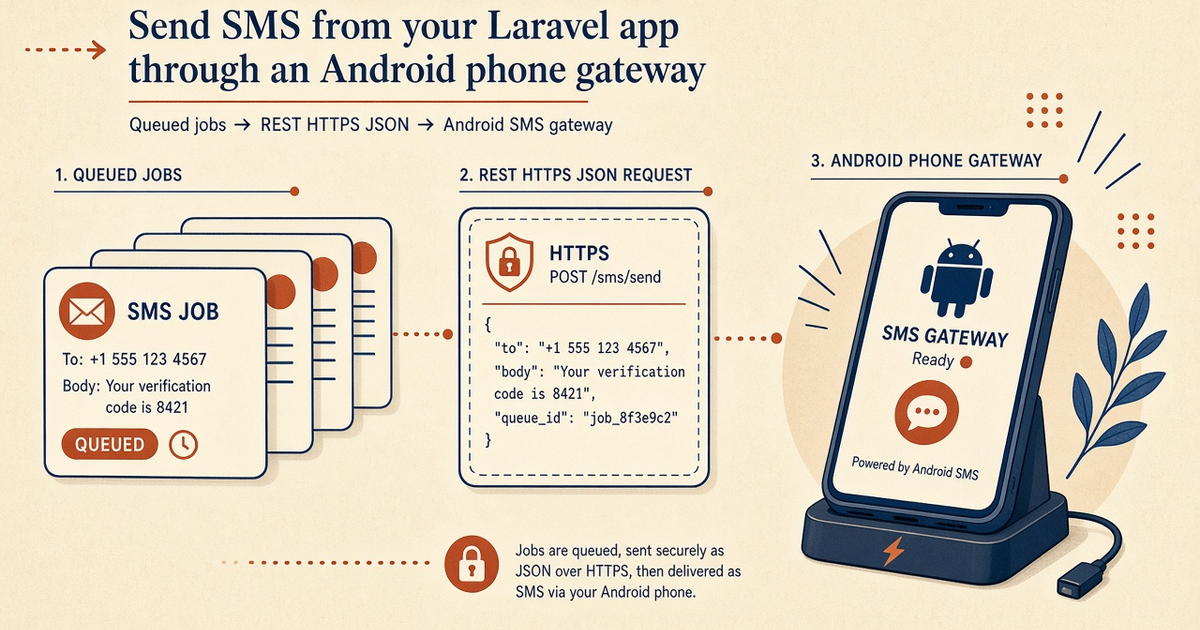
Architecture stays simple. Your backend calls HTTPS. A control plane (cloud or local) queues the job. An Android app on a paired phone asks the modem to send. Delivery reports and inbound SMS can return as webhooks. That is the same shape whether you paid $0 or $100 for the panel.
What changes with “free” is usually: footer branding on demo messages, lifetime or monthly caps, single-device limits, and slower support. Those constraints are acceptable for learning and staging. They become painful when login SMS is a revenue path.
On this site, free means 300 SMS lifetime on one device to prove functionality — not unlimited production traffic. Paid plans from $19/month follow device count and SMS send volume. You bring the phone and operator credit either way. See download the Android gateway app to start the app path.
Self-hosted “free forever” scripts shift cost from subscription to your time. That can be rational for engineers who enjoy ops and need air-gapped control. It is irrational for product teams who only wanted OTP. Match the free shape to the team you have, not the team you wish you hired.
How to set up a free SMS server path
Practical sequence that works for freemium Android gateways:
- Get a dedicated Android phone and a SIM with known SMS pricing in your country.
- Install the gateway APK from a trusted source; grant SMS and phone permissions deliberately.
- Disable battery optimizations for the gateway app; keep the phone charged and awake policies sane.
- Create an account, pair the device (QR or credentials), confirm it shows online.
- Store the API key in server env — never in a mobile app or public repo.
- Send one test message to your own number; confirm body, timing, and status.
- Wire a webhook or DLR check; confirm failure states are visible.
- Only then connect OTP or transactional events from staging.
Deeper handset habits live in Android SMS gateway app and gateway server guides. Free software does not erase OEM battery quirks.
Add a staging gate before production. Maintain an allowlist of numbers that may receive SMS outside production. Refuse all other recipients when APP_ENV is not production. Free tiers make it easy to “just test” against real customers by accident — especially when a founder dumps a CSV into the panel. Gate early.
Document the pair of clocks you care about: time from API accept to handset vibrate, and time from vibrate to DLR webhook. Free paths that cannot show both are incomplete for OTP. Write the numbers on the runbook after your first successful evening test, then re-measure after every OS update.
Free SMS server for OTP verification
OTP is the best first job for a free tier. Volume is bursty but countable. You can measure latency with a stopwatch. You learn whether the phone stays online overnight. You learn whether webhooks arrive before users rage-quit.
Design rules that do not depend on price:
- Hash codes server-side; short TTL; attempt caps; resend cooldowns.
- Queue sends off the request path.
- Store provider message ids next to challenge ids.
- Plan a second device before marketing “SMS login” as a feature.
Use free allowance to prove the loop. Move to paid when volume or branding constraints bite — not when a blog post shames you for starting free. For product framing see OTP verification and transactional SMS.
A free OTP path fails when the only phone is also a daily driver, when the SIM runs out mid-campaign, or when demo footers make codes look like phishing. Fix those before you blame the framework.
Resend UX matters on free tiers because users mash the button when radios are slow. Cap resends, rotate codes, and show a cooldown. Each resend still spends free quota and operator credit — treat both as finite. If your free lifetime pool is 300 messages, a leaky resend loop can burn the educational runway in a single load test. Put rate limits in the application, not only in hope.
Free SMS server for bulk SMS
Bulk is where “free” marketing gets dangerous. One Android radio is not a marketing cloud. Carriers filter bursts. Quiet hours and consent still apply. Spreadsheet import features — see contacts and lists and two-way expectations on two-way SMS — help operators, but they do not multiply SIMs.
If your free SMS server plan is “blast 50,000 leads this weekend,” stop. Either buy aggregator capacity for that job or build a multi-device farm with real ops budget. Free software on one phone will either trickle or get your SIM throttled.
Sensible free-tier bulk: small transactional-adjacent lists, staff alerts, internal canaries, consented local audiences measured in hundreds not hundreds of thousands. Grow devices as metrics demand.
Separate transactional and bulk queues in your app even when both hit the same free gateway. A newsletter chunk should never delay login codes. If the free product UI only offers “send to list,” still originate critical OTP from your backend API so you control priority. Panels are convenience; your domain rules are law.
Honest free-tier checklist
- Is free about software, service quota, or both?
- What is the exact send/device cap and reset rule (lifetime vs monthly)?
- Do demo messages append branding footers?
- Can I use my own SIM and see real operator costs?
- Are API docs complete enough for OTP without guesswork?
- Is there a webhook/DLR path, or only a pretty UI?
- What happens the day after free quota ends — hard stop or paid upgrade?
- Who patches the control plane — me or the vendor?
- Can I add a second device without rewriting my client?
- Is support available when free, or only on paid?
- Does the license allow commercial use of my product that sends SMS?
- Have I written the operator cost per OTP in my currency?
Check every box before you tell stakeholders “SMS is free now.” Ambiguity here becomes a finance argument later.
Scams and dead ends to avoid
- Sites promising unlimited free SMS to any country with no SIM and no card.
- APKs from random mirrors with “cracked” gateway panels.
- Services that harvest your contacts then disappear.
- “Free server” that is just a web form posting into someone else’s Twilio trial.
- Listings that hide after-install fees for SMS credits sold as if they were operator traffic.
If the pitch requires ignoring physics, ignore the pitch. Real Android paths always show a phone and a SIM somewhere in the story.
Ops reality when the software is free
Free software still needs: power, Wi-Fi or stable mobile data, OEM battery exceptions, SIM balance monitoring, and a reboot runbook. Free tiers still need API key rotation and staging allowlists. The difference is you may not get a human on chat when the phone dies at 1am.
Budget engineer hours even at $0 license. A weekend install plus two hours a month of babysitting is normal. If nobody owns that, paid SaaS with clearer uptime habits may cost less than “free” chaos.
Keep a one-page runbook: where the phone lives, which SIM, how to re-pair, who has the dashboard login, what the free quota remaining is. Folklore is not a free-tier feature.
Schedule two drills on the free path before you announce SMS login. First, airplane-mode the gateway for ten minutes during a fake signup spike and confirm the app shows a safe error. Second, deplete a test prepaid SIM to empty and confirm your monitoring notices before users do. Free tiers that cannot survive those drills will not survive a holiday weekend either.
Physical placement is underrated. A phone in a hot drawer under a router will thermal-throttle and drop Wi-Fi. A phone on a public retail counter will grow legs. Put the free SMS server handset somewhere boring, labeled, and access-controlled — the same standard you would use if the software cost real money.
Compliance still applies
Consent, sender identity, STOP handling, and content rules do not care that your software was free. US messaging best-practice discussions often point to industry resources such as the CTIA — use them as orientation, then follow your local regulator and carrier rules. Auto-reply and STOP patterns are product features, not optional polish, once you message people at scale.
Free bulk that skips consent is not a clever growth hack. It is how SIMs get blocked and brands get fined.
Keep a suppression list in your database even if the free panel has contacts built in. Application-owned suppression survives vendor switches. When a user texts STOP, record it with timestamp and source message id, then make every future send path check that flag. Free software will not argue with your lawyer — your logs will.
Ninety-day cost math
Build a simple sheet:
- Handset cost amortized over a year (or $0 if spare device).
- SIM plan / prepaid top-ups for expected OTP + transactional volume.
- Software: $0 free tier until cap, then devices + volume pricing.
- Engineer hours for install and monthly checks (honest hourly rate).
- Failure cost: support tickets when login SMS fails for an hour.
Compare that to aggregator per-message quotes for the same geography. Android free servers win when local SIM rates are low and volume is moderate. They lose when you need global reach without handsets in every market.
Example sketch: 3,000 OTP/month, one phone, free software tier still inside allowance, prepaid bundle $X, two engineer hours/month. If free allowance ends at 300 lifetime, plot the month you cross it and pre-approve the paid plan from $19/month so finance is not surprised.
When paid tiers are the cheaper choice
Pay when you need: multiple devices, no demo footer, higher volume, clearer support, or simply less time fighting quotas. Paying for devices and send volume on a maintained gateway is often cheaper than “free” self-hosted panels that consume weekends — see the CodeCanyon buyer guide and RBSoft / Ozeki alternatives for ownership tradeoffs.
Paid is also cheaper when your opportunity cost is high. Founders who bill $150/hour and spend ten hours on a free panel have not saved money.
Case narrative: “free forever” that was not
A two-person SaaS team installed a “free unlimited” Android gateway script on shared hosting. Day one: OTP worked. Week two: host killed long-running PHP workers; messages queued forever. Week three: the personal phone used as gateway got an OS update that revived battery optimizations; overnight OTPs died. Month two: prepaid SIM empty during a launch; nobody had balance alerts. The software license was still $0. The launch cost was a week of firefighting and lost signups.
Lessons they wrote down afterward: dedicated handset, balance alerts, staging allowlist, free-tier cap calendar, and a maintained control plane once OTP became load-bearing. Free got them learning. Free did not get them reliability. That distinction is the whole point of this article.
A second team took the freemium SaaS path instead. They burned through a few hundred of the free lifetime messages proving webhooks, then upgraded one device before public launch. Their “surprise” was boring: a calendar invite to enter a payment method when 80% of the free pool was gone. Boring is the goal. If your free SMS server story ends with adrenaline, you optimized the wrong layer.
Carry those lessons into vendor demos. Ask where quota lives, who alerts on SIM balance (hint: usually you), and what a second device costs. Write answers in the ninety-day sheet before you celebrate $0 on a price tag.
Common mistakes
- Equating free software with free SMS.
- Running production OTP on a free quota without a paid upgrade plan.
- Using one daily-driver phone as the “server.”
- Ignoring demo footers until users report phishing fears.
- Bulk blasting from a free single SIM.
- No webhook verification because “it’s just a test account.”
- Skipping STOP handling on the first campaign.
- Never measuring p95 OTP latency on the free path.
- Promising clients “free SMS” as a line item you cannot sustain.
- Choosing cracked APKs to avoid freemium caps — and inheriting malware instead.
Fix secrets, devices, and quotas first. Marketing adjectives last. Free is a phase, not a personality.
Next steps
Decide which layer of free you actually need. Pair a phone from download the Android gateway app, spend the free allowance on OTP proofs, read the SMS API documentation, and calendar the day you will outgrow 300 lifetime sends. Keep operator costs visible. When you are ready for architecture depth, continue with the API guide and Laravel SMS gateway patterns.
Free SMS servers are real — as freemium software and capped learning tiers. They are not magic free telephony. Treat them as a runway to a measured production setup priced by devices and SMS volume, with your phone and your operator credit doing the honest work.
If a vendor cannot explain in one paragraph what remains billable after “free,” do not hand them your login traffic. Clarity is the feature. Everything else is decoration. Ship the checklist, run the drills, and upgrade before the runway ends — not after users are stuck on a spinner waiting for a code that will never arrive on a dead free quota.
Keep a shared document titled Free tier runway with remaining quota, upgrade owner, and the prepaid SIM top-up contact. Review it in the same meeting where you review error budgets. Free SMS servers fail socially before they fail technically — somebody assumed somebody else was watching the counter.
Related product pages
Jump to the live product docs for this topic—not another long-form article.
- OTP and 2FA SMS on AndroidAuthentication flows
- bulk SMS from Excel and CSVSpreadsheet campaigns
- bulk SMS with consent best practicesHigh-volume outreach
- device and SMS volume pricingPlans and allowances