Key Takeaways
- Flask integrates with an Android SMS gateway for queue workers over HTTPS using server-side secrets.
- Primary focus: android sms gateway api. Confirm live fields in Developer Center.
- Accept is not delivered — use DLR or webhooks.
- Devices + SMS volume pricing; BYO phone and operator airtime.
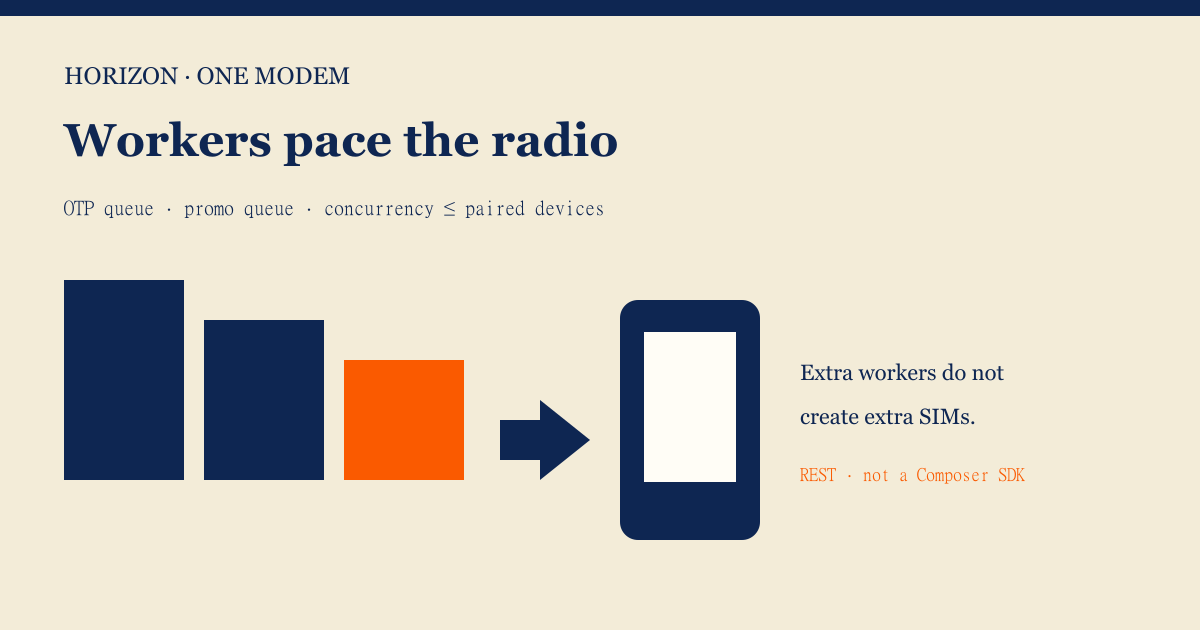
- Queue/async workers should pace to radio reality.
- Keep OTP isolated from promotional templates.
- Hub I frameworks share API physics with Hub C language guides.
This Hub I guide covers android sms gateway api patterns for queue workers using Flask against an Android device gateway. Start from Android SMS Gateway API and confirm live parameters in SMS API documentation. Related samples: SMS API documentation. Service pricing is devices + send volume (free tier 300 SMS lifetime; paid from $19/month); you supply phone and operator SMS credit — see device and SMS volume pricing. REST samples are HTTPS/JSON — not a packaged SDK.
gunicorn timeout is not a delivery SLO. If the worker dies after HTTP accept, you still owe the recipient a DLR story.
Bulk SMS, India, SMS gateway FAQ and definitions, Shopify API.
Context
Flask teams usually want queue workers without rewriting their domain model. Keep a narrow gateway client interface. Make it part of definition of done before production OTP.
The phone still sends SMS on a SIM you fund. The framework only schedules and records work. Treat it as a release gate, not a backlog spike.
Prefer async workers so user requests do not wait on radio latency.
Cross-read Hub C language recipes when you need HTTP-client detail outside the framework.
Design
Design queue workers with explicit states: queued, accepted, delivered, failed.
| Layer | Flask owns | Phone owns |
|---|---|---|
| View | Enqueue only | Not in the request |
| Worker | HTTPS + timeout | SMSC attempt |
| Webhook | Signature + idempotency | Operator DLR |
| OTP vs promo | Queue name / nickname | Which SIM is awake |
Separate OTP templates from marketing notifications even inside one framework app. Make it part of definition of done before production OTP.
Model idempotency for orders and OTP challenges before the first HTTP call. Treat it as a release gate, not a backlog spike.
Plan pacing when bulk notifications share devices with authentication.
Implementation
Implementation in Flask starts with env-based credentials and timeouts on every outbound call.
Persist gateway message ids on your notification or order records.
Add a staff canary destination to the release checklist. Make it part of definition of done before production OTP.
Use framework queues — do not invent a second job system without cause. Treat it as a release gate, not a backlog spike.
from redis import Redis
from rq import Queue
q = Queue(connection=Redis())
q.enqueue(send_sms, msisdn, body)
Conceptual only. Paths and fields must match Developer Center.
Failure modes
Hung HTTP without timeouts stalls workers.
Blind retries duplicate OTPs and order texts.
Ignoring device last-seen creates silent OTP outages.
Inline webhook processing causes provider retry storms. Make it part of definition of done before production OTP.
Security
Keep API keys out of git and frontend bundles. Treat it as a release gate, not a backlog spike.
Hash OTP codes at rest; redact bodies in logs.
Verify webhook signatures with a skew window.
Separate staging and production gateway credentials.
Operations
Watch queue depth and device last-seen together. Make it part of definition of done before production OTP.
Pause notification workers without killing OTP when needed. Treat it as a release gate, not a backlog spike.
Document SIM top-up and spare device steps for on-call.
Re-verify after OEM updates on gateway phones.
Checklist
- Env credentials + timeouts configured.
- Async worker path for sends.
- Idempotency for queue workers.
- DLR/webhook status wired.
- Canary destination tested.
- OTP vs promo templates separated.
- Developer Center fields confirmed.
- Pricing model understood: devices + volume + BYO airtime.
- On-call runbook linked.
- Hub C sibling language guide reviewed if useful.
Next steps
Pair a phone via download the Android gateway app, confirm SMS API documentation, ship a canary queue workers flow in Flask, then expand retries and DLR. Keep API nearby.
Deep dive: production hardening
Service pricing is devices plus SMS send volume. Operator airtime is separate and always yours.
OTP workers must hash codes, enforce TTL, and stay isolated from marketing notification templates.
Order alerts should include idempotent order ids so retries do not double-text customers.
Retry policies must distinguish transport errors from permanent destination rejects. Make it part of definition of done before production OTP.
Webhook receivers need fast 2xx and async jobs. Inline side effects invite duplicate deliveries. Treat it as a release gate, not a backlog spike.
Confirm DLR or status webhooks before calling a notification flow production-ready.
Staging should use a dedicated low-volume device so production SIMs stay clean.
Secrets belong in env and vaults — never in committed config repositories.
Feature flags let you ramp OTP after a gateway client change. Make it part of definition of done before production OTP.
Monitor device last-seen alongside queue depth; a calm app server with a dead phone is still an incident. Treat it as a release gate, not a backlog spike.
Keep STOP handling for promotional lanes even when transactional OTP shares the same API.
An android sms gateway api call accepts work; delivery truth arrives later via DLR.
Django Celery and Flask RQ/Celery patterns should pace below radio capacity.
Express and NestJS should keep gateway clients injectable so tests do not hit live devices. Make it part of definition of done before production OTP.
CodeIgniter services should centralize base URL and key so rotation is one change. Treat it as a release gate, not a backlog spike.
Rate limits and backoff with jitter prevent thundering herds after gateway 429s.
Empty rendered templates must fail closed before the HTTP call.
Multi-device routing needs health awareness when OTP and bulk share an account.
Clock skew breaks signature windows on webhooks — allow small skew, reject large. Make it part of definition of done before production OTP.
Document who may pause notification workers during incidents. Treat it as a release gate, not a backlog spike.
Compare cost honestly: aggregator per-message fees versus SIM airtime plus device/volume service fees.
Contract tests against fixtures catch schema drift when Developer Center fields evolve.
Support needs message ids in tickets, not pasted OTP bodies.
Queue workers should pace bulk below radio capacity. Make it part of definition of done before production OTP.
Retry budgets belong next to business SLAs for OTP expiry windows. Treat it as a release gate, not a backlog spike.
When blog examples and Developer Center disagree, trust Developer Center.
Hub C language recipes and Hub I framework spokes share physics; differentiate by framework lifecycle and workers.
Framework SMS integrations against an Android gateway still send through a phone SIM you own. The framework only orchestrates HTTPS jobs and status handling.
Queues and workers exist to absorb radio latency. Do not block HTTP requests on SIM throughput. Make it part of definition of done before production OTP.
Developer Center owns live paths and schemas. /codebase-php and /codebase-csharp own samples where relevant. This blog teaches architecture patterns. Treat it as a release gate, not a backlog spike.
Service pricing is devices plus SMS send volume. Operator airtime is separate and always yours.
OTP workers must hash codes, enforce TTL, and stay isolated from marketing notification templates.
Order alerts should include idempotent order ids so retries do not double-text customers.
Retry policies must distinguish transport errors from permanent destination rejects. Make it part of definition of done before production OTP.
Webhook receivers need fast 2xx and async jobs. Inline side effects invite duplicate deliveries. Treat it as a release gate, not a backlog spike.
Confirm DLR or status webhooks before calling a notification flow production-ready.
Staging should use a dedicated low-volume device so production SIMs stay clean.
Secrets belong in env and vaults — never in committed config repositories.
Feature flags let you ramp OTP after a gateway client change. Make it part of definition of done before production OTP.
Monitor device last-seen alongside queue depth; a calm app server with a dead phone is still an incident. Treat it as a release gate, not a backlog spike.
Keep STOP handling for promotional lanes even when transactional OTP shares the same API.
An android sms gateway api call accepts work; delivery truth arrives later via DLR.
Deep dive: scaling and failure modes
Rate limits and backoff with jitter prevent thundering herds after gateway 429s.
Empty rendered templates must fail closed before the HTTP call.
Multi-device routing needs health awareness when OTP and bulk share an account.
Clock skew breaks signature windows on webhooks — allow small skew, reject large. Make it part of definition of done before production OTP.
Document who may pause notification workers during incidents. Treat it as a release gate, not a backlog spike.
Compare cost honestly: aggregator per-message fees versus SIM airtime plus device/volume service fees.
Contract tests against fixtures catch schema drift when Developer Center fields evolve.
Support needs message ids in tickets, not pasted OTP bodies.
Queue workers should pace bulk below radio capacity. Make it part of definition of done before production OTP.
Retry budgets belong next to business SLAs for OTP expiry windows. Treat it as a release gate, not a backlog spike.
When blog examples and Developer Center disagree, trust Developer Center.
Hub C language recipes and Hub I framework spokes share physics; differentiate by framework lifecycle and workers.
Framework SMS integrations against an Android gateway still send through a phone SIM you own. The framework only orchestrates HTTPS jobs and status handling.
Queues and workers exist to absorb radio latency. Do not block HTTP requests on SIM throughput. Make it part of definition of done before production OTP.
Developer Center owns live paths and schemas. /codebase-php and /codebase-csharp own samples where relevant. This blog teaches architecture patterns. Treat it as a release gate, not a backlog spike.
Service pricing is devices plus SMS send volume. Operator airtime is separate and always yours.
OTP workers must hash codes, enforce TTL, and stay isolated from marketing notification templates.
Order alerts should include idempotent order ids so retries do not double-text customers.
Retry policies must distinguish transport errors from permanent destination rejects. Make it part of definition of done before production OTP.
Webhook receivers need fast 2xx and async jobs. Inline side effects invite duplicate deliveries. Treat it as a release gate, not a backlog spike.
Confirm DLR or status webhooks before calling a notification flow production-ready.
Staging should use a dedicated low-volume device so production SIMs stay clean.
Secrets belong in env and vaults — never in committed config repositories.
Feature flags let you ramp OTP after a gateway client change. Make it part of definition of done before production OTP.
Monitor device last-seen alongside queue depth; a calm app server with a dead phone is still an incident. Treat it as a release gate, not a backlog spike.
Keep STOP handling for promotional lanes even when transactional OTP shares the same API.
An android sms gateway api call accepts work; delivery truth arrives later via DLR.
Django Celery and Flask RQ/Celery patterns should pace below radio capacity.
Express and NestJS should keep gateway clients injectable so tests do not hit live devices. Make it part of definition of done before production OTP.
CodeIgniter services should centralize base URL and key so rotation is one change. Treat it as a release gate, not a backlog spike.
Rate limits and backoff with jitter prevent thundering herds after gateway 429s.
Empty rendered templates must fail closed before the HTTP call.
Multi-device routing needs health awareness when OTP and bulk share an account.
Clock skew breaks signature windows on webhooks — allow small skew, reject large. Make it part of definition of done before production OTP.
Document who may pause notification workers during incidents. Treat it as a release gate, not a backlog spike.
Compare cost honestly: aggregator per-message fees versus SIM airtime plus device/volume service fees.
Contract tests against fixtures catch schema drift when Developer Center fields evolve.
Support needs message ids in tickets, not pasted OTP bodies.
Queue workers should pace bulk below radio capacity. Make it part of definition of done before production OTP.
Retry budgets belong next to business SLAs for OTP expiry windows. Treat it as a release gate, not a backlog spike.
When blog examples and Developer Center disagree, trust Developer Center.
Hub C language recipes and Hub I framework spokes share physics; differentiate by framework lifecycle and workers.
Deep dive: integration discipline
Order alerts should include idempotent order ids so retries do not double-text customers.
Retry policies must distinguish transport errors from permanent destination rejects. Make it part of definition of done before production OTP.
Webhook receivers need fast 2xx and async jobs. Inline side effects invite duplicate deliveries. Treat it as a release gate, not a backlog spike.
Confirm DLR or status webhooks before calling a notification flow production-ready.
Staging should use a dedicated low-volume device so production SIMs stay clean.
Secrets belong in env and vaults — never in committed config repositories.
Feature flags let you ramp OTP after a gateway client change. Make it part of definition of done before production OTP.
Monitor device last-seen alongside queue depth; a calm app server with a dead phone is still an incident. Treat it as a release gate, not a backlog spike.
Keep STOP handling for promotional lanes even when transactional OTP shares the same API.
An android sms gateway api call accepts work; delivery truth arrives later via DLR.
Django Celery and Flask RQ/Celery patterns should pace below radio capacity.
Express and NestJS should keep gateway clients injectable so tests do not hit live devices. Make it part of definition of done before production OTP.
CodeIgniter services should centralize base URL and key so rotation is one change. Treat it as a release gate, not a backlog spike.
Rate limits and backoff with jitter prevent thundering herds after gateway 429s.
Empty rendered templates must fail closed before the HTTP call.
Multi-device routing needs health awareness when OTP and bulk share an account.
Clock skew breaks signature windows on webhooks — allow small skew, reject large. Make it part of definition of done before production OTP.
Document who may pause notification workers during incidents. Treat it as a release gate, not a backlog spike.
Compare cost honestly: aggregator per-message fees versus SIM airtime plus device/volume service fees.
Contract tests against fixtures catch schema drift when Developer Center fields evolve.
Support needs message ids in tickets, not pasted OTP bodies.
Queue workers should pace bulk below radio capacity. Make it part of definition of done before production OTP.
Retry budgets belong next to business SLAs for OTP expiry windows. Treat it as a release gate, not a backlog spike.
When blog examples and Developer Center disagree, trust Developer Center.
Hub C language recipes and Hub I framework spokes share physics; differentiate by framework lifecycle and workers.
Framework SMS integrations against an Android gateway still send through a phone SIM you own. The framework only orchestrates HTTPS jobs and status handling.
Queues and workers exist to absorb radio latency. Do not block HTTP requests on SIM throughput. Make it part of definition of done before production OTP.
Developer Center owns live paths and schemas. /codebase-php and /codebase-csharp own samples where relevant. This blog teaches architecture patterns. Treat it as a release gate, not a backlog spike.
Service pricing is devices plus SMS send volume. Operator airtime is separate and always yours.
OTP workers must hash codes, enforce TTL, and stay isolated from marketing notification templates.
Order alerts should include idempotent order ids so retries do not double-text customers.
Retry policies must distinguish transport errors from permanent destination rejects. Make it part of definition of done before production OTP.
Webhook receivers need fast 2xx and async jobs. Inline side effects invite duplicate deliveries. Treat it as a release gate, not a backlog spike.
Confirm DLR or status webhooks before calling a notification flow production-ready.
Staging should use a dedicated low-volume device so production SIMs stay clean.
Secrets belong in env and vaults — never in committed config repositories.
Feature flags let you ramp OTP after a gateway client change. Make it part of definition of done before production OTP.
Monitor device last-seen alongside queue depth; a calm app server with a dead phone is still an incident. Treat it as a release gate, not a backlog spike.
Keep STOP handling for promotional lanes even when transactional OTP shares the same API.
An android sms gateway api call accepts work; delivery truth arrives later via DLR.
Related product pages
Jump to the live product docs for this topic—not another long-form article.
- SMS API documentationLive endpoint reference
- device and SMS volume pricingPlans and allowances
- Android SMS gateway product guideDefinition, product, and how to buy
- download the Android gateway appGet the APK