Key Takeaways
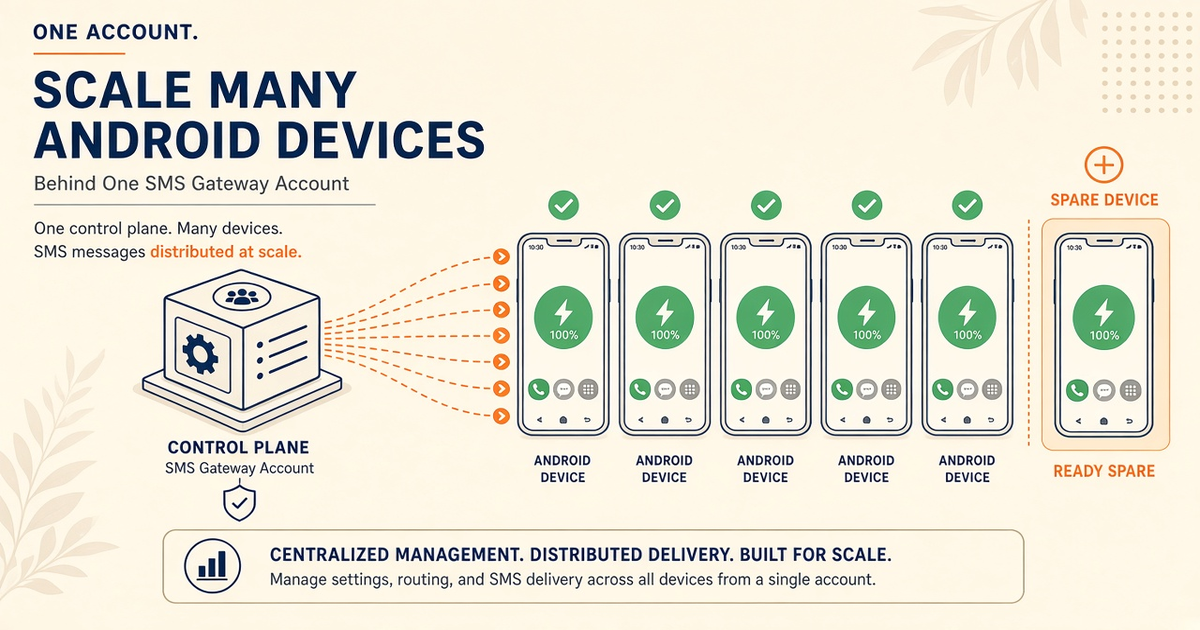
- One SMS Gateway account can front many Androids. Each phone is still a battery, a SIM, and an OEM exception list.
- Catalog caps: Free 1, Developer 1, Starter 2, Professional 5, Business 15.
- Throughput is peak GSM plus operator fair-use, not “add phones until unlimited.” Dual SIM is not a second device.
- Shared USB power and one Wi-Fi AP are correlated failure domains. Spread chargers and networks.
- Priced by devices and SMS send volume. You use your own phone and operator SMS credit. Extra radios still need extra airtime.
One account is not one radio
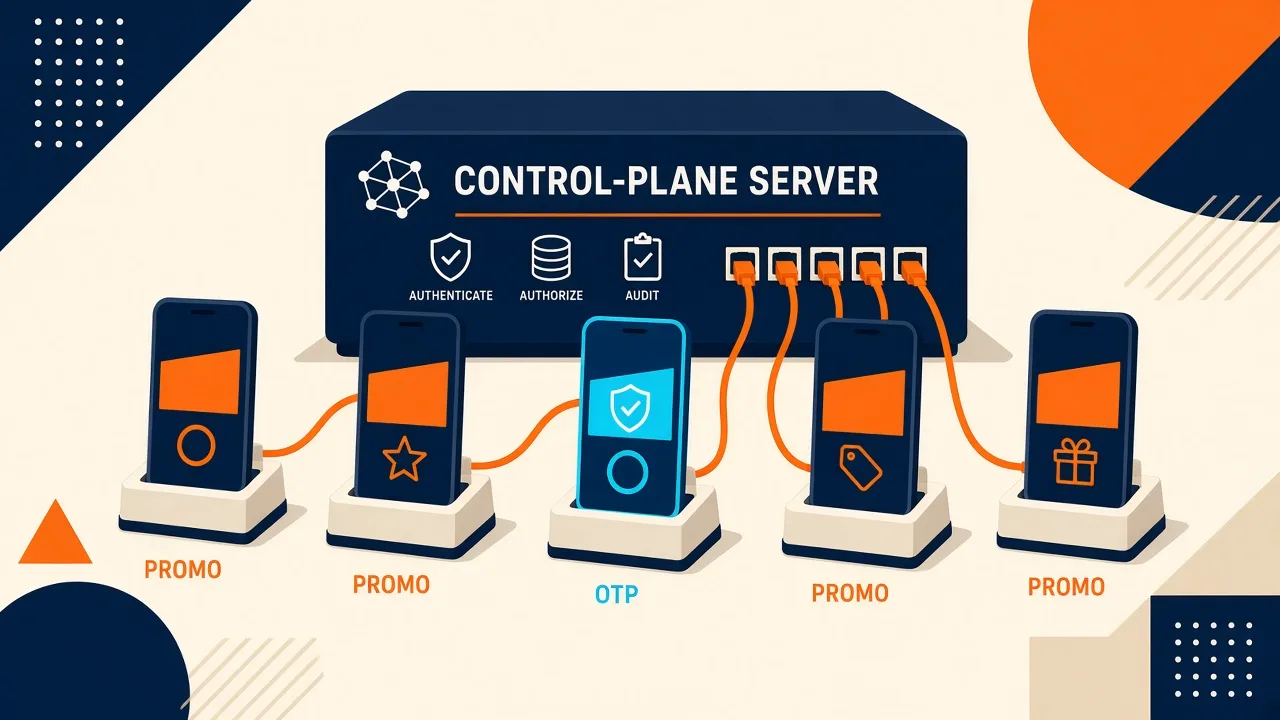
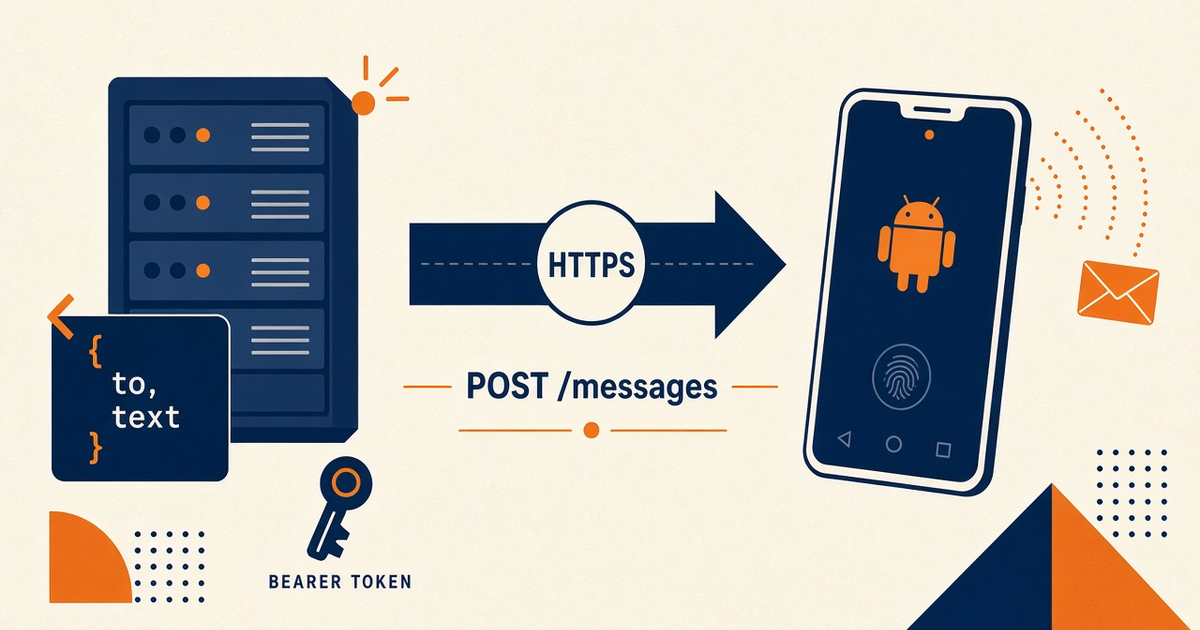
Server model: Android SMS gateway server. One login, one API key namespace, many paired handsets. Feature mechanics: multi-device and dual SIM. In-depth fleet design: multi-device in-depth. This spoke is what breaks when you add the third through fifteenth phone behind the same account.
Fifteen phones on one power strip is not scale. It is a single circuit breaker with extra screens.
Device caps on the catalog
Free 1 device and 300 SMS lifetime. Developer 1 device. Starter 2 from $19/month. Professional 5. Business 15. Platform send volume on the last three is not capped like Developer — devices still are. Operator fair-use still is.
Scale the fleet, not the myth
| Move | Helps | Does not |
|---|---|---|
| Add a charged spare | OTP failover | Fix a throttled operator |
| Second site Wi-Fi | Correlated AP failure | Replace OEM exemptions |
| Dual SIM | On-net mix | Count as two plan devices |
| USB hub of ten | Cable aesthetics | Survive a brown-out |
| Any-device routing | Promo overflow, maybe | Protect login codes |
USB hubs and brown-outs
Consumer hubs starve charge current. Phones reboot, pairing drops, Monday OTP dies. Independent chargers, UPS if the site blinks, and a spare that lives on a different strip. Setup ritual on every unit: device setup.
Scale without a silent OTP lane
- Name lanes, then count phones. Auth, reminders, promo, geo, spare. Map the count onto the plan cap with a spare included.
- Upgrade the device meter first. Starter 2, Professional 5, Business 15. Do not pirate a fifteenth pairing on a two-device plan.
- Independent power and data. No single USB hub, no single consumer router as the only path. Chargers that stay seated.
- Pin OTP to a named deviceId. Promo workers never steal the auth radio. Dual SIM still one battery.
- Health per IMEI. Pairing, battery, queue depth, DLR silence. A fleet average hides the dead OTP phone.
- Stagger OEM updates. One handset per night. The spare must have sent a canary this week.
API: SMS API documentation. DLR per device: delivery reports. Health sibling: monitoring device health.
Pin jobs; health-check each IMEI
Live deviceIds in Developer Center. Webhooks: SMS webhooks. A fleet that looks “mostly online” still fails if the OTP IMEI is the one in battery saver.
TCO
Service pricing is based on device count and total SMS sent through the gateway. You need a working Android phone with a SIM and SMS credit from your mobile operator. Operator message costs are yours—we do not sell carrier SMS balance. Handsets, SIMs, electricity, and a human who notices a red light are the rest. Device and SMS volume pricing. Not a turnkey white-label SMS reseller.
Next steps
Count lanes including spare, buy power that is not one hub, pin OTP, stagger updates. Then add phones only when a named radio has a named job.
Related product pages
Jump to the live product docs for this topic—not another long-form article.
- multi-device and dual SIM routingCapacity and failover
- device and SMS volume pricingPlans and allowances
- Android SMS gateway product guideDefinition, product, and how to buy
- SMS API documentationLive endpoint reference