Key Takeaways
- Field MMS is proof-of-work on a carrier APN, not a cloud file drop. Size and MIME limits are operator rules.
- Keep job-photo SIMs off the OTP pool. A dispatch blast must never share the authentication radio.
- A technician photo that never leaves the handset is an open ticket. Monitor send + DLR + inbound ACK separately.
- Service pricing is devices plus SMS/MMS send volume. You bring the Android phone and operator credit.
- Free is 1 device, 300 SMS lifetime, and 300 contacts — enough to canary a crew, not a national fleet.
- Name who owns SIM top-ups, charger discipline, and the spare tablet before unattended weekend jobs.
Summary
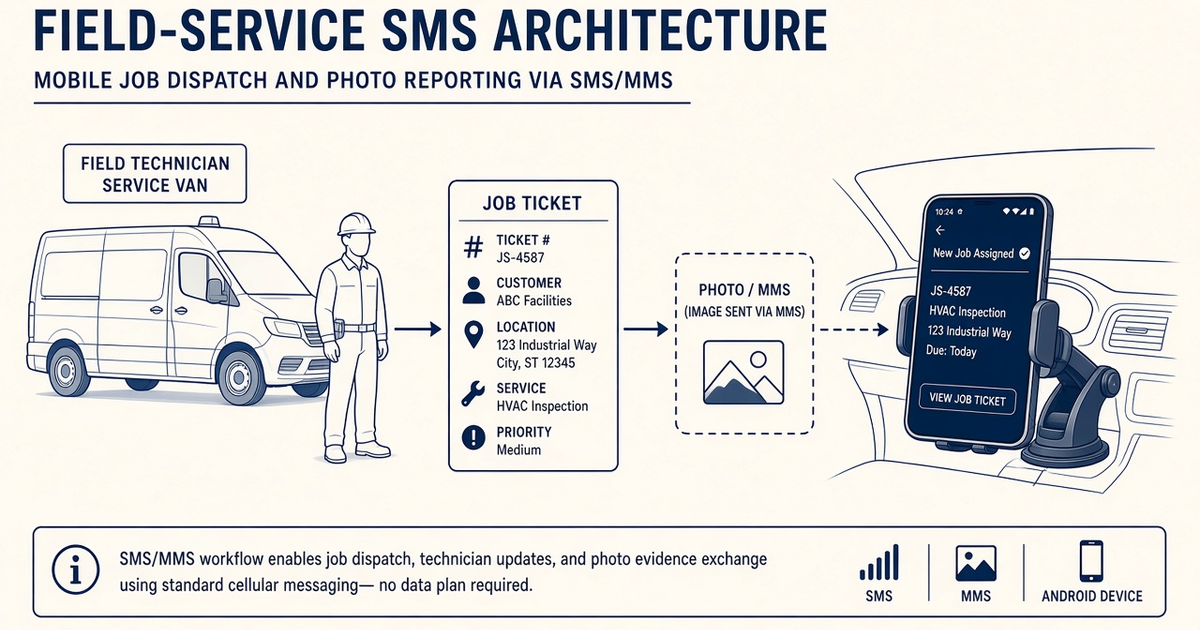
Field-service MMS on an Android phone as SMS gateway is a proof-of-work lane: a tech photographs a meter, a signed sheet, or a completed repair, and the picture has to leave that SIM before the van rolls. Scenario 9 is not a generic “attachments” overview. It is the moment the dispatcher learns the job is done because multimedia actually traversed the operator, not because someone tapped Send on a gallery thumbnail.
Service pricing is devices plus SMS send volume. You bring the Android phone and operator SMS credit. Free stays 1 device, 300 SMS lifetime, and 300 contacts. Do not title this path “Unlimited SMS.” Starter through Business uncap platform send volume; devices still meter, and the carrier still bills every picture.
A photo that never left the technician phone is not proof of work. It is a ticket that reopens at 08:00 with a customer already on site.
Key takeaways
- Field MMS is proof-of-work on a carrier APN, not a cloud file drop. Size and MIME limits are operator rules.
- Keep job-photo SIMs off the OTP pool. A dispatch blast must never share the authentication radio.
- A technician photo that never leaves the handset is an open ticket. Monitor send + DLR + inbound ACK separately.
- Service pricing is devices plus SMS/MMS send volume. You bring the Android phone and operator credit.
- Free is 1 device, 300 SMS lifetime, and 300 contacts — enough to canary a crew, not a national fleet.
- Name who owns SIM top-ups, charger discipline, and the spare tablet before unattended weekend jobs.
Related reading
Start from how an Android SMS gateway works, pair devices in the device setup guide, confirm live fields in SMS API documentation, and review GSMA messaging programmes when carrier multimedia policy is in question.
Context
Crews land on this scenario after a “sent” photo never appears in the job system. The usual miss is treating MMS like a HTTPS upload. The radio uses the operator MMS APN, a size ceiling, and sometimes a separate billing counter. Offline vans, OEM battery killers, and dual-SIM slot drift all look like “the API failed” when the handset simply never handed the payload to the carrier.
Dispatch SMS (next job, ETA, parts delay) can share a promotional-adjacent device pool. Customer login OTPs cannot. If your field app also verifies the homeowner, put those codes on a dedicated authentication SIM so a Saturday photo burst cannot stall sign-in.
Core scenario guidance
Map each job moment to a device: outbound dispatch text, inbound tech reply, MMS close-out, and optional customer satisfaction ping. Write acceptance criteria as “dispatcher sees the photo hash in the ticket within N minutes of completion,” not “HTTP 200 from send.”
| Field moment | What must be true | Common miss |
|---|---|---|
| Job photo | APN present, size under carrier cap, app exempt from OEM sleep | Assuming SMS DLR means the JPEG arrived |
| Signed sheet | MIME allowed; store a copy in the FSM, not only on the SIM | Leaving PII only on a shared crew phone |
| Parts photo | Roaming APN tested on the actual depot route | Lab Wi-Fi success, highway LTE failure |
| Customer OTP | Separate device pool and airtime wallet | Same SIM as Saturday MMS burst |
Canary on staff numbers with a real 400–800 KB image before the first live close-out. If the carrier silently downgrades to SMS-only, your “proof” is a broken thumbnail and a charge you still owe.
Cost and ownership
Model cost as connected devices + gateway send volume + operator MMS airtime. Retries of a 1 MB attachment burn faster than OTP retries. Assign who tops up the crew SIM and who holds the spare charged tablet. Keep marketing blast spend off these handsets.
Free (1 / 300 / 300) is a pairing lab. A three-van Saturday needs a paid device-and-volume plan plus prepaid or postpaid MMS that will not pause mid-route. Platform send volume on Starter, Professional, and Business is not capped like Developer; devices still meter and the carrier still invoices pictures.
Operations
Daily: pairing last-seen, battery, queue depth, and failed MMS vs failed SMS. After OEM updates or SIM reseats, send one staff photo end to end. Keep a spare charged device paired. Name an on-call owner before unattended overnight close-outs.
When a photo stalls, separate “app process dead,” “APN missing after roam,” and “attachment over cap.” Do not restart the whole dispatch stack for a single Doze-killed tablet.
Security and compliance
Job photos are personal data: houses, faces, meter IDs. Encrypt at rest in the FSM, rotate API keys per environment, and never paste full media URLs into a public Slack. STOP and consent still apply if you later text a promo from a field number. Verify webhook signatures if close-out SMS is automated.
Decision guide
Ship this lane when owners, APN tests, size budgets, and a spare handset exist. Delay if you cannot explain what happens when the van is underground for forty minutes. If zero phone ops is mandatory, evaluate CPaaS for that slice and keep Android for local SIM economics.
Checklist
- Job moments listed with owners (dispatch, photo, OTP).
- OTP isolated from MMS devices.
- Carrier size and APN proven on the real route.
- Spare device funded, charged, and paired.
- Staff canary photo passed.
- Airtime budget includes MMS retries.
- On-call named for weekend jobs.
- PII retention documented in the FSM.
Next steps
Return to Android phone as SMS gateway, compare device and SMS volume pricing, open device setup, and confirm APIs in SMS API documentation.
Deep dive: production hardening
Field MMS inherits carrier size and APN limits that SMS never hits. Treat a successful text as unrelated evidence. Pin the APN name in the runbook, including the roaming variant your vans actually use between depots.
Battery exemptions and OEM killers dominate overnight tablet closets. A “charged” device that Doze-kills the gateway app will queue photos until Monday. Exempt the package, pin it, and prove an inbound plus outbound after eight hours idle.
Dual-SIM crew phones fail closed-out jobs when the MMS slot silently swaps after reboot. Re-pair and re-test the multimedia path after every OS update. Multi-device failover only helps if the spare stays charged and already knows the APN.
Document who owns SIM top-ups for multi-site rollouts. A regional manager who “assumes finance handles airtime” is how Friday photos die at 16:40. Prefer honest latency over brochure SLAs: a photo can sit behind radio congestion even when the gateway accepted the job.
Deep dive: scaling and failure modes
Scaling field MMS is van count times pictures per job, not a cloud concurrency slider. Add devices when queues grow; raising a platform allowance does not add radios. Developer is 25,000 SMS per year on one device — the wrong SKU for a photo-heavy fleet.
Airtime surprise bills happen when a retry loop resends a 1 MB close-out on a flaky APN. Cap retries, alert on repeated MIME failures, and keep marketing CSV imports off these SIMs. Bulk blasts and job photos starve each other.
Logistics-style ETA texts can sit on a sibling device. Do not fold them onto the MMS SIM “to save a handset” unless you have measured Saturday peak. Spare charged devices beat brochure SLAs when phones send the media.
Deep dive: integration discipline
Developer Center owns live API parameters. This blog teaches process: persist the job ID, store your own media copy, and treat gateway callbacks as signals, not the system of record. Webhook signature verification is non-negotiable if a completion event triggers customer SMS.
Never claim unlimited free cloud SMS credits with no device or volume meter. Scenario playbooks still bill by devices and send volume. You bring the Android phone and operator credit. If zero phone ops is mandatory, evaluate CPaaS for that lane instead of pretending a tablet closet is a carrier backbone.
Cross-link Setup, Pricing, Downloads, and Developer Center with keyword-rich anchors. Canary on staff numbers before customer-facing close-outs. Name an on-call owner before unattended schedules go live.
Related product pages
Jump to the live product docs for this topic—not another long-form article.
- MMS gateway on your own SIMMultimedia where supported
- two-way SMS inboxReplies on your SIM
- SMS API documentationLive endpoint reference
- device and SMS volume pricingPlans and allowances