Key Takeaways
- Scenario 828 is after-hours booking OTP: the 21:00 self-serve code must beat the next-morning reminder file.
- A phone-as-gateway still needs a dedicated OTP Android. Ranking inside one CSV does not free the radio.
- No-show win-back promo never shares the night booking SIM.
- Service pricing is based on device count and total SMS sent through the gateway. You need a working Android phone with a SIM and SMS credit from your mobile operator. Operator message costs are yours—we do not sell carrier SMS balance.
- Developer is $50/year with a published SMS cap. Night retries still spend carrier credit.
- Canary 21:00 booking codes on staff SIMs before you open the after-hours form.
Summary
Appointment scenario 828 is after-hours booking OTP at 21:00 that must beat the 07:30 reminder file. One phone cannot be both. Service pricing is based on device count and total SMS sent through the gateway. You need a working Android phone with a SIM and SMS credit from your mobile operator. Operator message costs are yours—we do not sell carrier SMS balance.
21:00 booking OTP first. 07:30 reminders wait. Win-back promo off this SIM.
Ranking OTP as row 1 in tomorrow’s reminder CSV is not a night queue. The morning dump still owns the radio.
After-hours rank
| Rank | Job | Radio | Shares with |
|---|---|---|---|
| 1 | 21:00 booking OTP | Dedicated Android | Nothing |
| 2 | 07:30 reminders | Second pool | Reschedule YES/NO |
| 3 | No-show win-back | Consented MSISDN | STOP only |
Key takeaways
- Scenario success needs owners for phones, SIMs, templates, and on-call.
- Isolate OTP from marketing on separate device pools.
- Spare charged devices beat brochure SLAs.
- Verify webhooks and DLR habits before customer traffic.
- Developer Center owns live API parameters.
- Canary on staff numbers before production OTP.
Related reading
transactional SMS for orders and alerts, SMS gateway for the USA, how an Android SMS gateway works, Twilio SMS docs for comparison
Context
After-hours studios use scenario 828 when 21:00 self-serve booking codes must beat the 07:30 reminder dump. The phone is the radio, not a CPaaS short code.
Radio reality still wins: offline phones and OEM killers break scenarios overnight.
Cross-link hub cornerstones instead of rewriting the product overview.
Keep examples conceptual until Developer Center confirms live request shapes.
Budget airtime for retries — failed loops still cost operator credit.
Core scenario guidance
Split pools: night OTP alone, morning reminders plus YES/NO on a second radio, win-back on a consented MSISDN. Developer Center owns live send fields.
Separate configuration mistakes from radio failures during incidents.
Write acceptance criteria before seasonal or clinic-hour traffic.
Prefer gradual rollout with feature flags when automation is involved.
Cost and ownership
Plans are billed as device + SMS volume tiers—not aggregator-style $0.0x-per-message platform charging. Starter, Professional, and Business include unlimited platform send volume; Developer and Free have published SMS caps. Operator airtime remains separate, and carrier fair-use still applies. Morning reminder batches still spend prepaid credit even when night OTP is ranked first.
Failed retries still burn credit during scenario experiments.
Assign who owns SIM top-ups and spare handsets.
Keep marketing spend out of OTP device pools.
Operations
Daily checks: pairing health, battery, queue depth, and DLR anomalies.
After OEM updates or SIM swaps, re-test the scenario path end to end.
Keep a spare charged device ready for failover drills.
Name an on-call owner before unattended sends go live.
Security and compliance
Protect API keys per environment; rotate after contractor access ends.
STOP and consent still apply on promotional scenario lanes.
Avoid logging full OTP bodies into shared chat.
Verify webhook signatures and TLS on every callback path.
Decision guide
Ship android phone as sms gateway scenario 828 when owners, metrics, and fallbacks are written.
Delay if you cannot explain offline-phone behavior during peak hours.
If zero phone ops is mandatory, evaluate CPaaS for that lane.
If local SIM economics matter, harden the Android path and monitor airtime.
Checklist
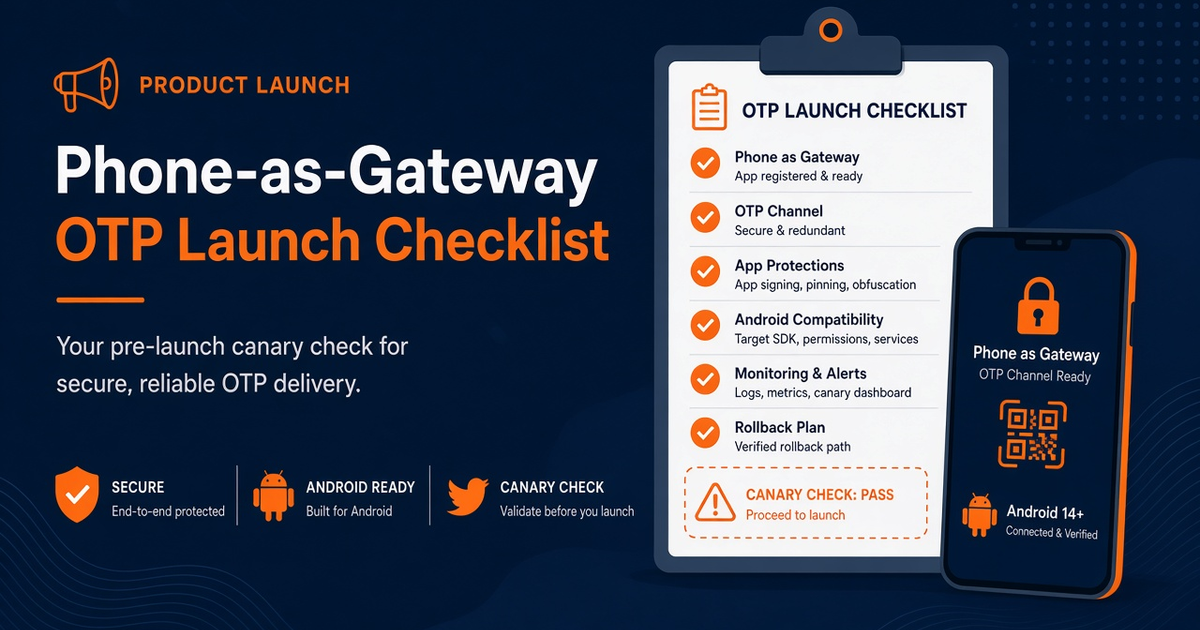
- Scenario moments listed with owners.
- OTP vs marketing isolation confirmed.
- Spare device funded and paired.
- Canary on staff numbers passed.
- Developer Center checked if API-shaped.
- Webhook/DLR monitoring ready.
- Airtime budget includes retries.
- On-call owner named.
- Rollback path documented.
- Hub cornerstone reviewed.
Next steps
Return to Phone as SMS gateway guide, compare device and SMS volume pricing, open device setup guide, and confirm APIs in SMS API documentation.
Deep dive: production hardening
If zero phone ops is mandatory, evaluate CPaaS for that lane instead.
Webhook signature verification is non-negotiable for scenario automation.
Document who owns SIM top-ups for multi-site scenario rollouts.
Prefer honest latency expectations over marketing claims about global SLAs on SIM paths.
Scenario playbooks still bill by devices and SMS send volume. You bring the Android phone and operator SMS credit.
Developer Center owns live API parameters. Scenario blogs teach process and failure modes, not endpoint catalogs.
Ecommerce webhooks must verify signatures before they trigger SMS sends.
Clinic reminders need consent records and STOP handling even when messages feel transactional.
Logistics ETAs should degrade gracefully when devices go offline mid-route.
Edtech OTP spikes at exam windows — capacity plan devices before the semester starts.
Fintech OTP is high-stakes: isolate devices, rotate keys, and avoid logging full codes.
Real-estate nurture is promotional; keep it off OTP SIMs and honor quiet hours.
Restaurant reservation SMS still needs STOP on marketing lanes.
SaaS onboarding OTPs should canary on staff numbers before paid scale.
Field-service dispatch needs two-way inbox ownership so techs are not double-booked.
Marketplace seller alerts need multi-device failover when a single phone is the SPOF.
NGO outreach must separate fundraising blasts from operational alerts.
Appointment businesses live on reminder deliverability the morning of the visit.
Bulk CSV import needs validation before radio send; bad rows burn airtime.
Scheduled SMS must survive device sleep and timezone mistakes.
Auto-reply and STOP protect promotional lanes — never auto-reply into OTP threads.
Dual SIM routing fails when slot maps drift after reboot without re-pair.
Multi-device failover only helps if spare phones stay charged and paired.
MMS attachments inherit carrier size and APN limits.
USSD requests are carrier- and region-sensitive; treat timeouts as expected.
Contact lists need consent metadata stored with the number.
OTP priority queues fail when marketing blasts share the same device pool.
Spare charged devices matter more than brochure SLAs when phones send the SMS.
Airtime surprise bills happen when bulk loops ignore radio pace.
OTP and marketing must stay on separate lanes on every scenario.
Never claim unlimited free cloud SMS credits with no device or volume meter.
Name an on-call owner before unattended schedules go live.
Canary on staff numbers before customer OTP.
Battery exemptions and OEM killers dominate overnight reliability.
Cross-link Setup, Pricing, Downloads, and Developer Center with keyword-rich anchors.
If zero phone ops is mandatory, evaluate CPaaS for that lane instead.
Webhook signature verification is non-negotiable for scenario automation.
Document who owns SIM top-ups for multi-site scenario rollouts.
Prefer honest latency expectations over marketing claims about global SLAs on SIM paths.
Scenario playbooks still bill by devices and SMS send volume. You bring the Android phone and operator SMS credit.
Developer Center owns live API parameters. Scenario blogs teach process and failure modes, not endpoint catalogs.
Ecommerce webhooks must verify signatures before they trigger SMS sends.
Clinic reminders need consent records and STOP handling even when messages feel transactional.
Logistics ETAs should degrade gracefully when devices go offline mid-route.
Edtech OTP spikes at exam windows — capacity plan devices before the semester starts.
Fintech OTP is high-stakes: isolate devices, rotate keys, and avoid logging full codes.
Real-estate nurture is promotional; keep it off OTP SIMs and honor quiet hours.
Restaurant reservation SMS still needs STOP on marketing lanes.
SaaS onboarding OTPs should canary on staff numbers before paid scale.
Field-service dispatch needs two-way inbox ownership so techs are not double-booked.
Marketplace seller alerts need multi-device failover when a single phone is the SPOF.
NGO outreach must separate fundraising blasts from operational alerts.
Deep dive: scaling and failure modes
Marketplace seller alerts need multi-device failover when a single phone is the SPOF.
NGO outreach must separate fundraising blasts from operational alerts.
Appointment businesses live on reminder deliverability the morning of the visit.
Bulk CSV import needs validation before radio send; bad rows burn airtime.
Scheduled SMS must survive device sleep and timezone mistakes.
Auto-reply and STOP protect promotional lanes — never auto-reply into OTP threads.
Dual SIM routing fails when slot maps drift after reboot without re-pair.
Multi-device failover only helps if spare phones stay charged and paired.
MMS attachments inherit carrier size and APN limits.
USSD requests are carrier- and region-sensitive; treat timeouts as expected.
Contact lists need consent metadata stored with the number.
OTP priority queues fail when marketing blasts share the same device pool.
Spare charged devices matter more than brochure SLAs when phones send the SMS.
Airtime surprise bills happen when bulk loops ignore radio pace.
OTP and marketing must stay on separate lanes on every scenario.
Never claim unlimited free cloud SMS credits with no device or volume meter.
Name an on-call owner before unattended schedules go live.
Canary on staff numbers before customer OTP.
Battery exemptions and OEM killers dominate overnight reliability.
Cross-link Setup, Pricing, Downloads, and Developer Center with keyword-rich anchors.
If zero phone ops is mandatory, evaluate CPaaS for that lane instead.
Webhook signature verification is non-negotiable for scenario automation.
Document who owns SIM top-ups for multi-site scenario rollouts.
Prefer honest latency expectations over marketing claims about global SLAs on SIM paths.
Scenario playbooks still bill by devices and SMS send volume. You bring the Android phone and operator SMS credit.
Developer Center owns live API parameters. Scenario blogs teach process and failure modes, not endpoint catalogs.
Ecommerce webhooks must verify signatures before they trigger SMS sends.
Clinic reminders need consent records and STOP handling even when messages feel transactional.
Logistics ETAs should degrade gracefully when devices go offline mid-route.
Edtech OTP spikes at exam windows — capacity plan devices before the semester starts.
Fintech OTP is high-stakes: isolate devices, rotate keys, and avoid logging full codes.
Real-estate nurture is promotional; keep it off OTP SIMs and honor quiet hours.
Restaurant reservation SMS still needs STOP on marketing lanes.
SaaS onboarding OTPs should canary on staff numbers before paid scale.
Field-service dispatch needs two-way inbox ownership so techs are not double-booked.
Marketplace seller alerts need multi-device failover when a single phone is the SPOF.
NGO outreach must separate fundraising blasts from operational alerts.
Appointment businesses live on reminder deliverability the morning of the visit.
Bulk CSV import needs validation before radio send; bad rows burn airtime.
Scheduled SMS must survive device sleep and timezone mistakes.
Auto-reply and STOP protect promotional lanes — never auto-reply into OTP threads.
Dual SIM routing fails when slot maps drift after reboot without re-pair.
Multi-device failover only helps if spare phones stay charged and paired.
MMS attachments inherit carrier size and APN limits.
USSD requests are carrier- and region-sensitive; treat timeouts as expected.
Contact lists need consent metadata stored with the number.
OTP priority queues fail when marketing blasts share the same device pool.
Spare charged devices matter more than brochure SLAs when phones send the SMS.
Airtime surprise bills happen when bulk loops ignore radio pace.
OTP and marketing must stay on separate lanes on every scenario.
Never claim unlimited free cloud SMS credits with no device or volume meter.
Name an on-call owner before unattended schedules go live.
Deep dive: integration discipline
Field-service dispatch needs two-way inbox ownership so techs are not double-booked.
Marketplace seller alerts need multi-device failover when a single phone is the SPOF.
NGO outreach must separate fundraising blasts from operational alerts.
Appointment businesses live on reminder deliverability the morning of the visit.
Bulk CSV import needs validation before radio send; bad rows burn airtime.
Scheduled SMS must survive device sleep and timezone mistakes.
Auto-reply and STOP protect promotional lanes — never auto-reply into OTP threads.
Dual SIM routing fails when slot maps drift after reboot without re-pair.
Multi-device failover only helps if spare phones stay charged and paired.
MMS attachments inherit carrier size and APN limits.
USSD requests are carrier- and region-sensitive; treat timeouts as expected.
Contact lists need consent metadata stored with the number.
OTP priority queues fail when marketing blasts share the same device pool.
Spare charged devices matter more than brochure SLAs when phones send the SMS.
Airtime surprise bills happen when bulk loops ignore radio pace.
OTP and marketing must stay on separate lanes on every scenario.
Never claim unlimited free cloud SMS credits with no device or volume meter.
Name an on-call owner before unattended schedules go live.
Canary on staff numbers before customer OTP.
Battery exemptions and OEM killers dominate overnight reliability.
Cross-link Setup, Pricing, Downloads, and Developer Center with keyword-rich anchors.
If zero phone ops is mandatory, evaluate CPaaS for that lane instead.
Webhook signature verification is non-negotiable for scenario automation.
Document who owns SIM top-ups for multi-site scenario rollouts.
Prefer honest latency expectations over marketing claims about global SLAs on SIM paths.
Scenario playbooks still bill by devices and SMS send volume. You bring the Android phone and operator SMS credit.
Developer Center owns live API parameters. Scenario blogs teach process and failure modes, not endpoint catalogs.
Ecommerce webhooks must verify signatures before they trigger SMS sends.
Clinic reminders need consent records and STOP handling even when messages feel transactional.
Logistics ETAs should degrade gracefully when devices go offline mid-route.
Edtech OTP spikes at exam windows — capacity plan devices before the semester starts.
Fintech OTP is high-stakes: isolate devices, rotate keys, and avoid logging full codes.
Real-estate nurture is promotional; keep it off OTP SIMs and honor quiet hours.
Restaurant reservation SMS still needs STOP on marketing lanes.
SaaS onboarding OTPs should canary on staff numbers before paid scale.
Field-service dispatch needs two-way inbox ownership so techs are not double-booked.
Marketplace seller alerts need multi-device failover when a single phone is the SPOF.
NGO outreach must separate fundraising blasts from operational alerts.
Appointment businesses live on reminder deliverability the morning of the visit.
Bulk CSV import needs validation before radio send; bad rows burn airtime.
Scheduled SMS must survive device sleep and timezone mistakes.
Auto-reply and STOP protect promotional lanes — never auto-reply into OTP threads.
Dual SIM routing fails when slot maps drift after reboot without re-pair.
Multi-device failover only helps if spare phones stay charged and paired.
MMS attachments inherit carrier size and APN limits.
USSD requests are carrier- and region-sensitive; treat timeouts as expected.
Contact lists need consent metadata stored with the number.
OTP priority queues fail when marketing blasts share the same device pool.
Spare charged devices matter more than brochure SLAs when phones send the SMS.
Airtime surprise bills happen when bulk loops ignore radio pace.
Related product pages
Jump to the live product docs for this topic—not another long-form article.
- OTP and 2FA SMS on AndroidAuthentication flows
- multi-device and dual SIM routingCapacity and failover
- SMS delivery reports (DLR)Delivery status tracking
- SMS API documentationLive endpoint reference