Key Takeaways
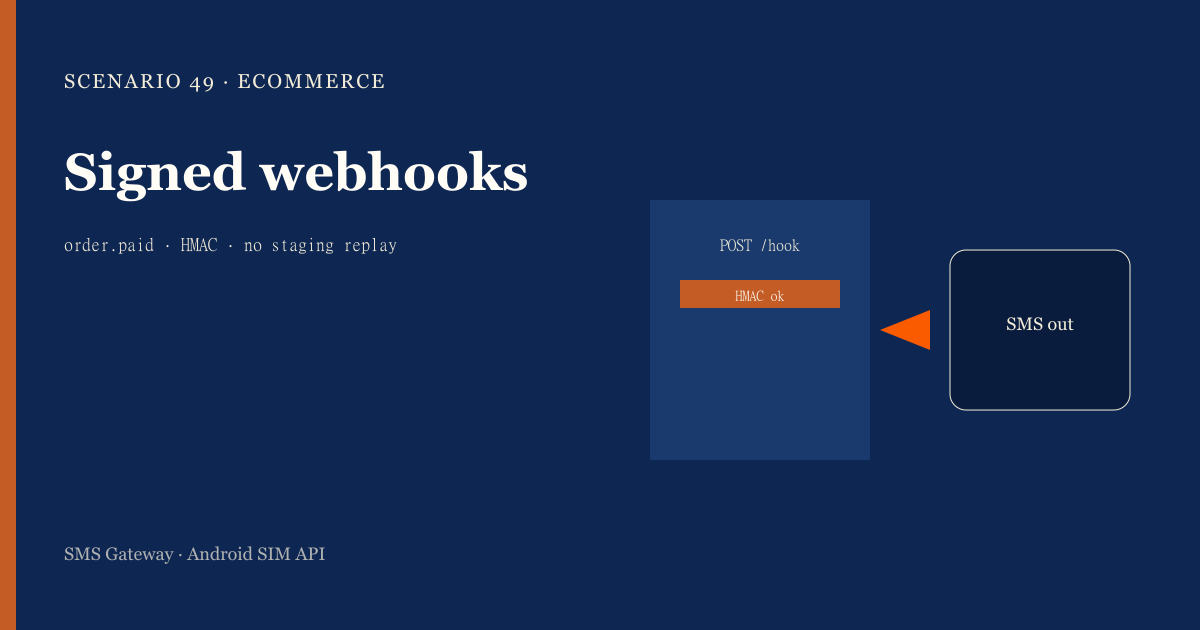
- Ecommerce webhooks must verify signatures before they enqueue SMS. Staging replays will otherwise text the catalog.
- Map order.paid, shipped, and cancelled to templates. Do not fire OTP from a storefront hook.
- Idempotency keys stop duplicate “thanks for your order” texts when Shopify or Laravel retries.
- Service pricing is devices plus SMS send volume. You bring the Android phone and operator credit.
- Free is 1 device, 300 SMS lifetime, 300 contacts.
- A dead gateway phone means paid orders go silent — monitor last-seen next to checkout error rates.
Summary
Ecommerce webhooks on an Android SMS gateway are a checkout-to-radio path: order.paid, fulfillment, refund, back-in-stock. Scenario 49 is the Laravel (or sibling) shop that wired a store hook straight to Send and discovered staging replays texting real buyers. The phone is still the modem. The HMAC is the gate.
Service pricing is devices plus SMS send volume. You bring the Android phone and operator SMS credit. Free is 1 device, 300 SMS lifetime, 300 contacts. Do not title the article Unlimited SMS. Paid plans may uncap platform send volume; devices still meter and the carrier still bills.
Unsigned webhooks will happily SMS your entire list when a staging store replays yesterday’s orders. The SIM does not know it was a drill.
Key takeaways
- Ecommerce webhooks must verify signatures before they enqueue SMS. Staging replays will otherwise text the catalog.
- Map order.paid, shipped, and cancelled to templates. Do not fire OTP from a storefront hook.
- Idempotency keys stop duplicate “thanks for your order” texts when Shopify or Laravel retries.
- Service pricing is devices plus SMS send volume. You bring the Android phone and operator credit.
- Free is 1 device, 300 SMS lifetime, 300 contacts.
- A dead gateway phone means paid orders go silent — monitor last-seen next to checkout error rates.
Related reading
Use Laravel SMS gateway, how an Android SMS gateway works, SMS API documentation, and HMAC (RFC 2104).
Context
Shops land here after duplicate “shipped” texts or after a webhook secret leaked into a repo. Radio reality still wins: offline phones and OEM killers break order SMS overnight even when the queue is healthy. Cross-link hub cornerstones instead of rewriting the product overview.
Keep examples conceptual until Developer Center confirms live request shapes. Budget airtime for retries — failed loops still cost operator credit, especially during a flash sale.
Core scenario guidance
Verify signature, check timestamp skew, apply idempotency, enqueue, then let a worker talk to the gateway. Map each storefront moment to a template and a device pool. Separate configuration mistakes (wrong secret) from radio failures (Doze) during incidents.
| Event | SMS action | Do not |
|---|---|---|
| order.paid | Idempotent thank-you + order id | Send from the HTTP request thread |
| fulfillment.shipped | Tracking SMS on the ops SIM | Reuse the checkout OTP device |
| refund.created | Short status; link to portal | Include full PAN or CVV-adjacent copy |
| staging replay | Reject unsigned or wrong-audience hooks | Point staging at production SIMs |
Prefer gradual rollout with feature flags when you add a new event. Write acceptance criteria before seasonal traffic: “one SMS per order id even if the hook fires four times.”
Cost and ownership
Model devices + volume + operator airtime. Duplicate webhooks duplicate spend. Assign who owns SIM top-ups and who owns the webhook secret rotation. Keep marketing abandoned-cart spend off the OTP device pool.
Free (1 / 300 / 300) is a signed-path lab. Flash sales need a device-and-volume plan. Developer’s yearly SMS cap is the wrong shape for a viral drop.
Operations
Daily: pairing health, battery, queue depth, DLR anomalies, and webhook error rate. After OEM updates, re-test a paid sandbox order end to end. Keep a spare charged device. Name an on-call owner before unattended night drops.
Security and compliance
Protect API keys and webhook secrets per environment. Rotate after contractor access ends. STOP and consent still apply on promotional carts. Avoid logging full OTP bodies. Verify webhook signatures and TLS on every callback path.
Decision guide
Ship when owners, metrics, idempotency, and fallbacks are written. Delay if you cannot explain offline-phone behavior during a drop. If zero phone ops is mandatory, evaluate CPaaS for that lane.
Checklist
- HMAC + timestamp + idempotency in production.
- Staging cannot reach production SIMs.
- OTP isolated from order SMS.
- Spare device paired.
- Airtime includes retries and duplicates you already blocked.
- On-call named.
- Developer Center checked for live fields.
Next steps
Return to Laravel SMS gateway, compare device and SMS volume pricing, open device setup, and confirm APIs in SMS API documentation.
Deep dive: production hardening
Ecommerce webhooks must verify signatures before they trigger SMS sends. Clinic-style reminder consent does not apply here, but cart promo STOP does. Webhook signature verification is non-negotiable for scenario automation.
Battery exemptions and OEM killers dominate overnight reliability. Name an on-call owner before unattended schedules go live. Canary on staff numbers before customer OTP.
Document who owns SIM top-ups for multi-store rollouts. Prefer honest latency expectations over marketing claims about global SLAs on SIM paths.
Deep dive: scaling and failure modes
Flash sales add devices or they drop texts. Multi-device failover only helps if spare phones stay charged and paired. Scheduled SMS must survive device sleep and timezone mistakes. Bulk CSV import of a promo list still needs validation; do not bypass the webhook path with an unchecked spreadsheet during a sale.
Airtime surprise bills happen when bulk loops ignore radio pace or when retries lack idempotency. Never claim unlimited free cloud SMS credits with no device or volume meter.
Deep dive: integration discipline
Developer Center owns live API parameters. Scenario blogs teach process and failure modes, not endpoint catalogs. If zero phone ops is mandatory, evaluate CPaaS for that lane instead. Cross-link Setup, Pricing, Downloads, and Developer Center with keyword-rich anchors.
Scenario playbooks still bill by devices and SMS send volume. You bring the Android phone and operator SMS credit. SaaS onboarding OTPs for the merchant dashboard should canary on staff numbers before paid scale — on a different SIM than order.paid.
Related product pages
Jump to the live product docs for this topic—not another long-form article.
- SMS webhook integrationInbound and status events
- transactional SMS for orders and alertsEvent-driven messages
- SMS API documentationLive endpoint reference
- PHP REST send samplesPHP code examples