Key Takeaways
- Line-haul exception texts go to a dock supervisor. Last-mile ETAs go to a consignee. Do not share a default SIM.
- The hub-wall handoff is one event. Persist the scan id so both legs do not text “your freight moved.”
- Free is 1 device, 300 SMS lifetime, and 300 contacts. Platform price is devices plus send volume; roaming SIMs bill the operator harder.
- Locker OTP stays on a domestic isolated slot, never on the roaming line-haul SIM.
- Canary after the tractor phone crosses a border — registration changes without a reboot.
Summary
Scenario 111 is dual-SIM routing for line-haul and hub handoff — not the city last-mile slot map. A tractor phone may roam. A destination depot phone should not. Consignees should never get a line-haul delay template that was meant for the dock. Service pricing is devices plus SMS send volume. You bring the handsets and operator credit. Free is 1 device, 300 SMS lifetime, and 300 contacts.
Professional allows 5 devices: line-haul dual-SIM, two dest depots, OTP, spare. That is not unlimited carrier roaming. Confirm routing in Developer Center.
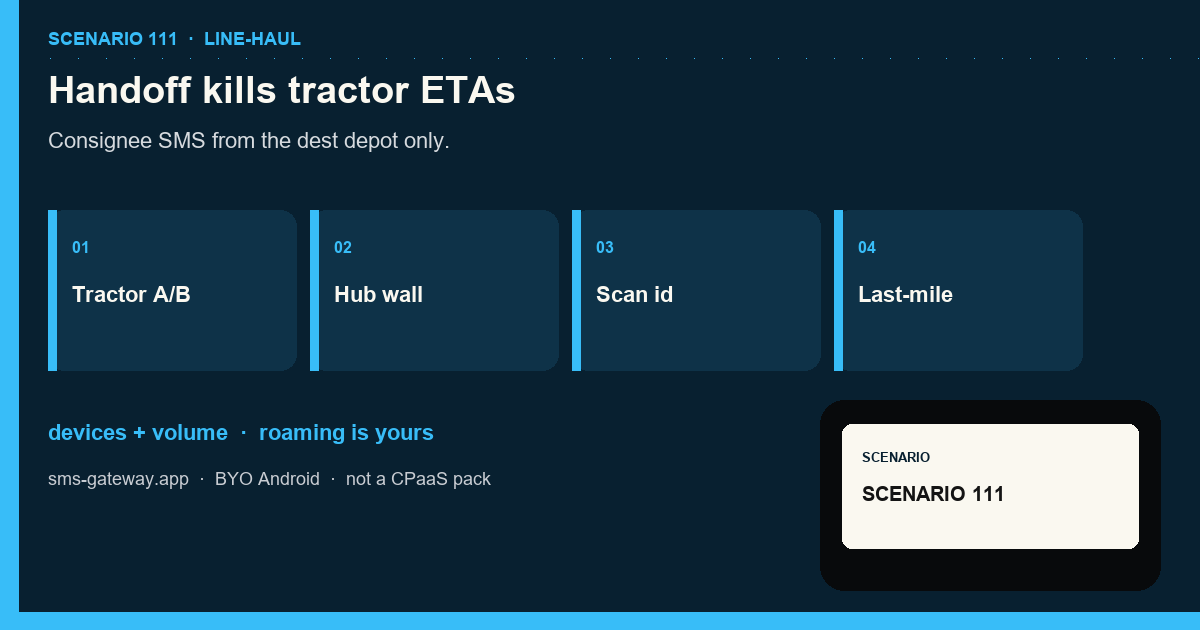
line-haul SIM · hub wall · last-mile SIM
one scan id, one consignee text
Line-haul vs last-mile are different radios
Line-haul slot A: home-country operator for dispatcher SMS. Slot B: roaming or partner operator for “truck delayed at border.” Last-mile phones are a separate chassis at the destination hub. Do not keep sending consignee ETAs from the tractor after the freight is on the destination dock.
Multi-device and dual SIM, transactional SMS.
If the hub wall scan fires on both the line-haul webhook and the last-mile TMS, the consignee gets two “arrived at depot” texts and you pay two radios. Key the public SMS on the inbound dock event only.
Line-haul dual-SIM matrix
| Audience | Radio | Failure |
|---|---|---|
| Dispatcher | Tractor slot A | Roaming slot B used; surprise bill |
| Border exception | Tractor slot B if A has no reg | Consignee copied on dock slang |
| Consignee ETA | Destination depot device | Tractor still sending after handoff |
| Locker OTP | Domestic isolated last-mile SIM | Roaming OTP timeout |
Handoff SMS at the hub wall
Persist the inbound scan id. Suppress further line-haul consignee templates for that freight. Signed webhooks only. Webhooks, DLR.
Roaming SIMs and surprise bills
Roaming SMS is still operator credit you buy — we do not sell it. Cap exception templates. Alert finance when slot B volume spikes. After a border cross, canary registration before the next dispatcher burst.
Devices, volume, and airtime
Count tractor phones, depot phones, platform sends, and roaming vs domestic ledgers. Free (1/300/300) is a single-lane proof.
Relay-desk operations
Shift start: pairing, both slot balances, dest depot online. After OEM or border: slot canary. Setup, Downloads, pricing.
Decision guide
Ship when consignee SMS cannot originate from a roaming tractor after handoff. Delay if one dual-SIM phone is “the whole network.” Aggregators are the no-phone-ops path.
Relay checklist
- Line-haul vs last-mile device pools named.
- Handoff scan id is the only consignee trigger.
- Locker OTP on domestic isolated SIM.
- Roaming volume alerted.
- Border canary on staff numbers.
- Developer Center fields confirmed.
Next steps
Gateway overview, scenario 51 city dual-SIM, GSMA SIM / eSIM.
Related product pages
Jump to the live product docs for this topic—not another long-form article.
- multi-device and dual SIM routingCapacity and failover
- transactional SMS for orders and alertsEvent-driven messages
- SMS delivery reports (DLR)Delivery status tracking
- SMS API documentationLive endpoint reference


