Key Takeaways
- Plan SMS volume as successful deliveries plus failures plus retries plus extra segments — not “users × one message.”
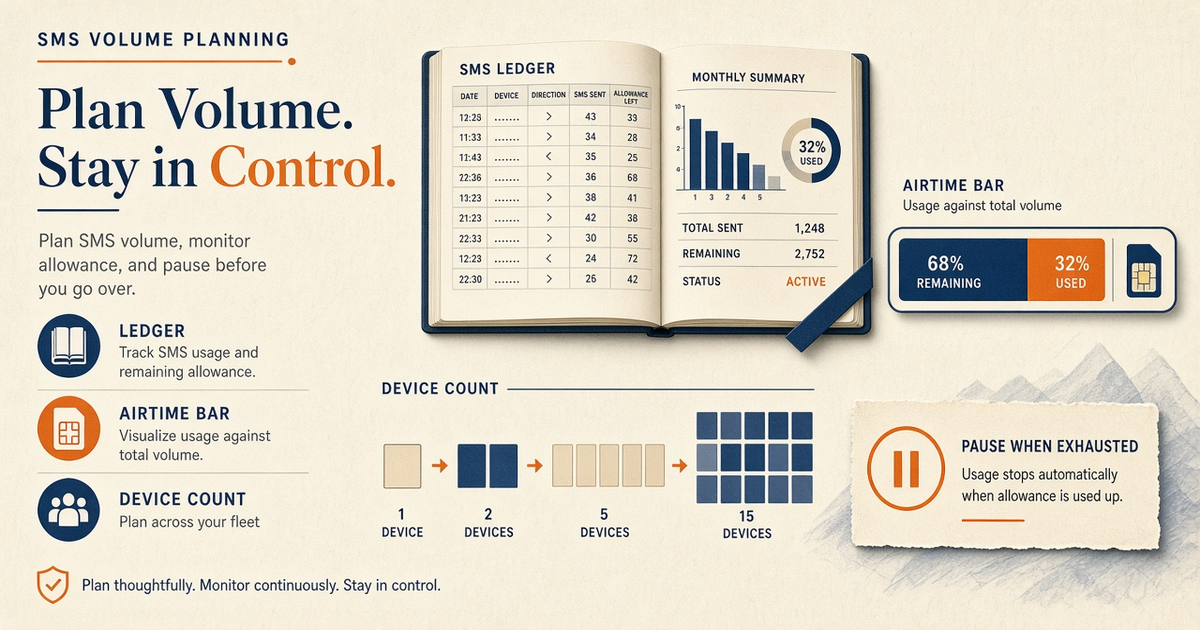
- Free is 300 SMS lifetime; Developer is 25,000 SMS per year. Those lanes pause when the allowance is gone until you upgrade.
- Starter, Professional, and Business uncap platform send volume. Devices still cap (2 / 5 / 15). Operator airtime and OEM rate ceilings still apply.
- Peak OTP minute sizes the fleet. Monthly totals size the carrier bill. Mixing them is how finance and on-call fight.
- Priced by devices and SMS send volume. You use your own phone and operator SMS credit. There is no unlimited carrier SMS SKU.
Two meters, plus the carrier
Canonical numbers: device and SMS volume pricing. We charge for connected Android devices and platform send volume. You buy SMS from Jazz, AT&T, Telkomsel, or whoever actually delivers the PDU. Service pricing is based on device count and total SMS sent through the gateway. You need a working Android phone with a SIM and SMS credit from your mobile operator. Operator message costs are yours—we do not sell carrier SMS balance.
If the spreadsheet has one column called “SMS,” it is already lying. Splitting send, retry, and segments is the work.
What to count
| Line | Counts toward platform volume | Burns operator credit |
|---|---|---|
| First OTP | Yes | Yes |
| User mashed resend | Yes if you actually POST again | Yes |
| Concatenated parts | Per segment the radio submits | Per segment |
| HTTP 4xx you never queued | No | No |
| MMS | Follow live metering in the panel | Usually higher than SMS |
When platform volume pauses
Free: 300 SMS lifetime, then sends pause until you upgrade. Developer: 25,000 SMS per year, then pause. Starter ($19/mo, 2 devices), Professional (5 devices), and Business (15 devices) do not cap platform send volume the way Developer does. Devices still cap. Carrier fair-use still caps. Raise OEM/Android SMS rate ceilings if the phone throttles — that is not “unlimited operator SMS.”
Peak minute vs monthly total
A quiet 40,000-month with a 09:02 reminder spike still needs radios awake at 09:02. Fleet design: multi-device. Dual SIM ≠ spare device.
Build a volume worksheet
- Split volume by class. OTP, transactional, promo. Different SIMs, different retry rates, different STOP rules.
- Count segments, not campaigns. UCS-2 and long copy multiply PDUs. GSM-7 first.
- Add retry and DLR-unknown. Pending forever still burned a send. Include a measured retry fraction.
- Size peak minute separately. Exam windows, payday, 09:00 reminders. That number picks device count, not the monthly sum.
- Map to plan meters. Free/Developer pause at allowance. Paid catalog uncaps platform volume; devices still meter.
- Line-item operator airtime. Finance sees two bills: platform fee and carrier. Never merge them into “SMS credits from us.”
Operator-cost sibling: estimate monthly operator cost. OTP isolation: OTP verification.
Concatenation and retries
UCS-2 (emoji, Urdu, Bangla script) explodes segment count. Idempotent resend saves you from double-debiting when the client times out. DLR pending is not a free extra send — see delivery reports.
Next steps
Three volume columns, a peak-minute row, and airtime on a different ledger line than the platform fee.
Related product pages
Jump to the live product docs for this topic—not another long-form article.
- device and SMS volume pricingPlans and allowances
- Android SMS gateway product guideDefinition, product, and how to buy
- SMS API documentationLive endpoint reference
- download the Android gateway appGet the APK