Key Takeaways
- android sms gateway for edtech architecture is school/LMS events → your API → Android SIMs you operate — not an aggregator inbox.
- Split OTP (student/parent login) from bulk attendance or campaign lists. Different deviceIds.
- Size devices for peak bell-time, not average Sunday night. OEM ceilings still apply.
- Quiet hours and exam blackouts are product rules in your app, not a carrier feature.
- Priced by devices and SMS send volume. You use your own phone and operator SMS credit. The institution funds operator airtime.
- Counsel owns student-data law. The gateway is transport.
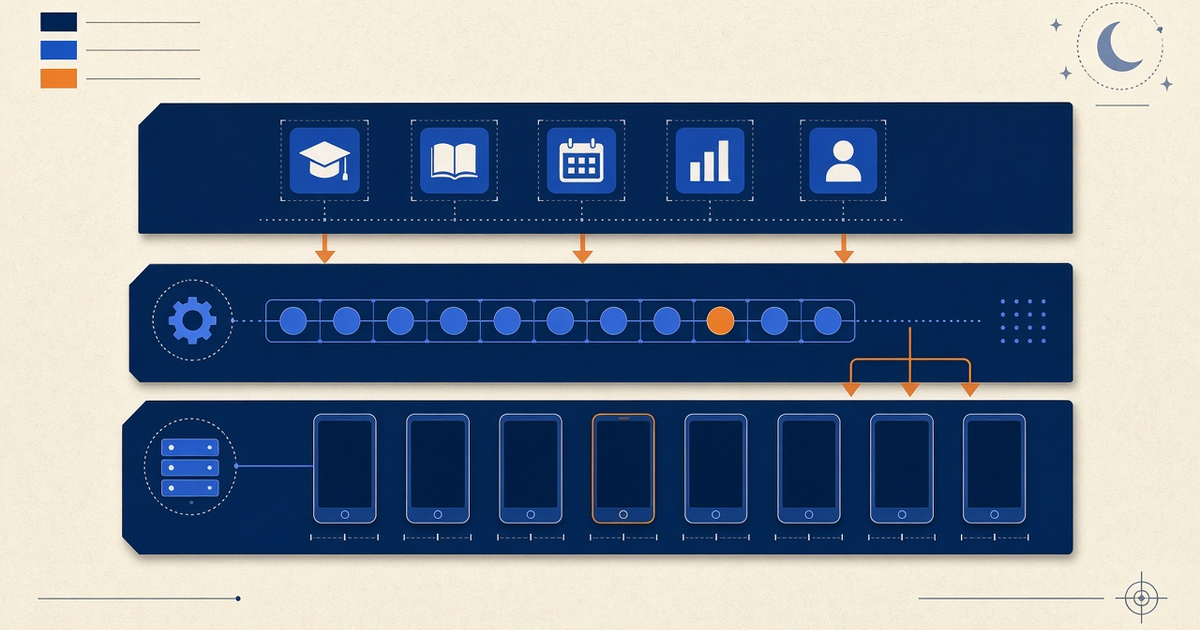
Three layers: app, queue, radios
Vertical intent for android sms gateway for edtech is architecture: how a school product emits SMS without putting a modem in every classroom laptop. Service pricing is based on device count and total SMS sent through the gateway. The LMS decides content; the worker calls the control plane; paired Androids transmit.
Bell-time is a DDoS you scheduled yourself. If OTP and “your bus is late” share one radio at 08:55, login loses.
Traffic classes in a school
- Auth OTP for parent/student portals — pinned device, short TTL, no bulk.
- Transactional: closures, bus, attendance — consented operational lists.
- Marketing: open days, fundraising — STOP, separate SIM.
OTP: OTP verification. Bulk: bulk SMS. Lists: contacts and lists.
How many phones to plan
Count peak concurrent sends, then OEM per-hour ceilings, then add a spare. Starter is 2 devices; Professional is 5. Multi-device routing: multi-device guide. Dual SIM can add an operator without a second charger — still one meter.
| Layer | Owns | Must not |
|---|---|---|
| LMS / SIS / auth | Who to text, template, consent flags, quiet hours | Hold the gateway Bearer token in a public client |
| School API worker | Idempotency, deviceIds, retries, suppress join | Firehose a 4k list at one modem in 30 seconds |
| Control plane | Queue, pairing, DLR, webhooks | Be mistaken for the operator SMSC |
| Android radios | Transmit on the SIM; last-seen; OEM exemptions | Sit in a teacher’s personal pocket overnight |
Quiet hours and exam windows
Encode blackouts in the worker (timezone per campus). The gateway will send what you POST at 01:00 if you ask. Scheduled SMS: scheduled campaigns. Raise OEM ceilings where allowed; carrier fair-use remains.
Parents, students, STOP
Minors, household shared phones, and school marketing are a counsel problem. Store consent with the SIS id. STOP on promotional SIMs. Auto-reply and STOP. Minimize bodies — GDPR-minded handling.
Architecture failure modes
- Cron retry without idempotency → duplicate “school closed” texts.
- Teacher-owned gateway phone that leaves campus.
- One CSV of mixed staff OTP and parent promo.
- Webhook down so attendance SMS has no DLR in the SIS.
Keys server-side: API keys in env. Pilot size: 300 SMS lifetime on Free.
Architecture checklist
- Device map: otp / ops / promo / spare.
- Quiet-hours config per campus timezone.
- Idempotency-Key on every event SMS.
- DLR webhook into SIS.
- Physical security for the modem rack.
Next steps
Draw the three layers, pair a spare from setup, send a staff OTP plus one ops canary, then load a 5% slice. Pricing for device caps. Docs: docs.sms-gateway.app.
Related product pages
Jump to the live product docs for this topic—not another long-form article.
- SMS API documentationLive endpoint reference
- device and SMS volume pricingPlans and allowances
- Android SMS gateway product guideDefinition, product, and how to buy
- download the Android gateway appGet the APK