
Key Takeaways
- Dual SIM routing is a slot map on a specific Android, not a magical extra throughput switch.
- Many phones share one radio — two SIMs does not mean two simultaneous sends.
- Write down which operator is slot 1 after every reboot or SIM swap; maps drift.
- OTP and marketing should not share a slot if one can starve the other.
- You still buy airtime per SIM. Platform pricing is devices plus send volume.
Two SIMs, one radio
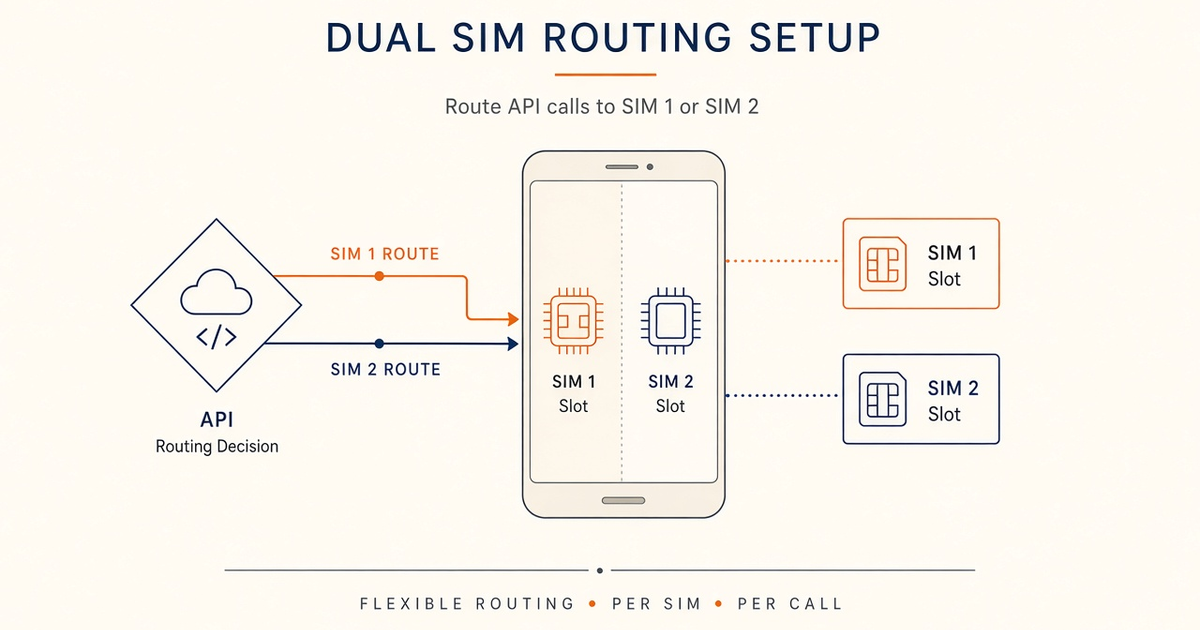
Dual SIM setup is the unglamorous work of labeling slots before production OTP uses the cheap prepaid by accident. Search intent is “android sms gateway dual sim” as a how-to, not a promise that two plastic cards erase OEM rate ceilings.
Feature pillar: dual SIM and multi-device. This page is setup only. Multi-device (several phones) is how you add throughput. Dual SIM is how one phone speaks two operators. Pricing: devices plus volume. One handset with two SIMs still counts as one device. You fund both operators.
Active slot
The puck is the radio. It is not two radios.
Before you pair
- Both SIMs can send SMS (not data-only eSIM data packs unless they actually SMS).
- PIN disabled or entered; a locked SIM looks like “routing is broken.”
- Default SMS SIM in Android settings matches what you think slot 1 is — then ignore that and verify in-app.
- Labels: operator name + purpose (OTP vs bulk) on tape on the tray. Software labels drift. Tape does not.
“If slot 2 is ‘the other SIM’ in your runbook, you will page the wrong prepaid at 2 a.m. Name the operator.”
Slot map
After pairing, send a canary that forces slot 1, then slot 2, to staff numbers that will tell you the From MSISDN. Write the result in the runbook: deviceId / slot / MSISDN / purpose.
Re-run that map after: SIM swap, Android update, factory reset, “repair mode,” or a colleague who “just reseated the tray.” The API will happily send “slot 2” to whatever Android now thinks slot 2 is.
Setup checklist
| Step | Pass when | Fail looks like |
|---|---|---|
| Physical SIMs seated | Both show bars / operator names | Missing SIM icon |
| App dual-SIM UI | Two slots listed, not one | OEM hid the second subscription from the SMS API |
| Canary slot 1 | Recipient sees MSISDN A | Wrong From; remap |
| Canary slot 2 | Recipient sees MSISDN B | Same From as slot 1 — not actually dual SMS |
| Inbound test | Reply to A and B both hit inbox | Only default SMS SIM receives |
| Reboot retest | Map unchanged | Slots swapped; update runbook |
Choosing a slot on send
Live parameter names: Developer Center. Your adapter should take purpose: 'otp' | 'bulk' and resolve device + slot from config, not from a hardcoded `1` in five services.
Samples: PHP, C#. REST JSON, not a dual-SIM SDK.
If you omit routing, you get the primary. That is fine for a single-SIM phone. It is a production incident on a dual-SIM OTP box that defaults to the marketing prepaid.
What failover is not
Dual SIM is not automatic “if operator A is congested, use B” unless you built that in your app. Some OEMs fail over data. SMS slot selection is still your send call. Multi-device failover (another phone) is the real spare. Multi-device.
Do not put OTP and a 20,000-row CSV on the two slots of one radio and call it isolation. They still queue on the same modem. Isolation means another device.
Prove it
Weekly: two canaries, two From numbers, screenshot the runbook date. After OEM updates, do it the same day. Delivery reports can differ per operator; do not use DLR on slot 1 as proof slot 2 sent.
Airtime: both SIMs hit zero independently. “Routing broken” is often an empty prepaid. Free plan pause (300 SMS lifetime) is a platform meter — it is not per slot.
GSMA SIM identity is boring on purpose. Your operator’s SIM manager docs beat a blog for PIN/PUK. GSMA SIM technology.
Next steps
Tape labels, two canaries, commit the map, then point OTP at a slot that is not the blast SIM. Plans: pricing.
Related product pages
Jump to the live product docs for this topic—not another long-form article.
- multi-device and dual SIM routingCapacity and failover
- SMS API documentationLive endpoint reference
- device and SMS volume pricingPlans and allowances
- device setup guidePair and go live


