
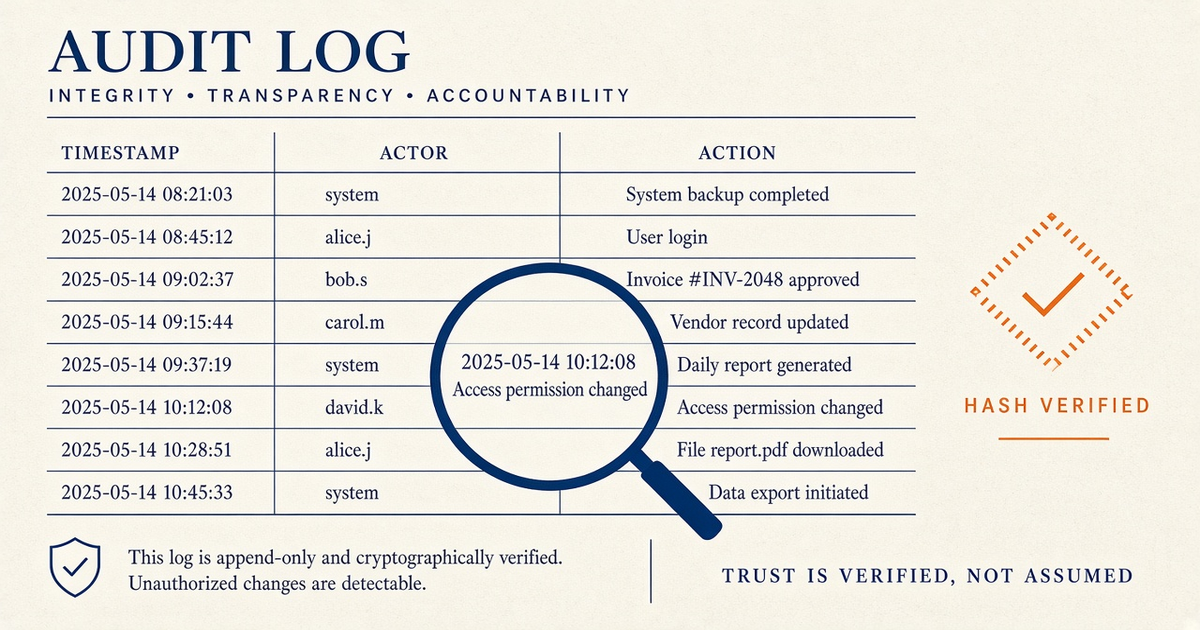
Key Takeaways
- Audit logs on an Android SMS gateway are about who queued what, through which device, not a full copy of every OTP body.
- Keep message ids, actor, timestamp, device id, destination (hashed or truncated), and result. Redact one-time codes in support exports.
- Panel history, webhook receipts, and on-device logs are three different stores. Incidents need all three clocks.
- Retention is a policy you write. The gateway is not your compliance archive unless you export.
- You bring the phone and operator credit. Platform pricing is devices plus send volume.
Teams searching android sms gateway audit logs usually have a security questionnaire or a “who sent that OTP” ticket, not a hobby interest in log formats. On a SIM gateway the awkward part is that the last mile is a phone in a cupboard. If you only log the HTTP accept, you cannot tell a radio failure from a staff mistake.
This Hub A deep dive stays on logging discipline. Live API fields: Developer Center. You bring the Android phone and operator SMS credit. We meter devices and send volume.
What audit logs are for on a SIM gateway
You are reconstructing a chain: application → control plane → Android radio → operator SMSC. Each hop can fail. Audit logs should let a human answer four questions without grepping OTP digits: who, when, which device, what happened next.
If a contractor can export a CSV of full message bodies from last quarter with no row in the audit log, you do not have auditing. You have a download button.
Three layers: panel, API, Android
- Control plane — accepts, routes, stores status, fires webhooks. This is the system of record for message ids.
- Your backend — should log the same message id, your user id, and the business event (login, reset). That join is how you prove a code belonged to a session.
- The handset — OEM logs, last-seen, battery, SIM state. Export them when the radio is the suspect; see log export for support.
Webhooks belong in your store with signature verification. Guide: API webhook in-depth.
What to record vs what to redact
| Field | Keep in audit / ops | Default support export | Why |
|---|---|---|---|
| Message id, device id, timestamps | Yes | Yes | Correlation without the secret |
| Destination MSISDN | Truncated or hashed | Truncated | PII; enough to debug routing |
| OTP / password-reset body | No (or sealed short TTL) | Redact | The code is the credential |
| API key / webhook secret | Never | Never | Rotate if it ever lands in a ticket |
| Actor (user, key prefix) | Yes | Yes | Who queued the send or changed routing |
Related: log retention policy and GDPR-minded data handling.
Retention and legal hold
Pick numbers. Example: 90 days of send metadata, 365 days of privileged actions (key rotate, device pair, user invite), 7 days of verbose Android exports. Legal hold is a flag on export, not “we never delete anything.” Operator CDRs are a separate world; you do not get the carrier’s legal intercept log through our panel.
Plan analytics retention varies by SKU. Do not promise a customer a seven-year archive because a questionnaire had a checkbox. Export to their SIEM if they need it.
Integrity and access control
Who can read logs should be narrower than who can send SMS. Sending is a runtime permission; audit read is a trust permission. Prefer SSO + role, not a shared dashboard password on a TV in the office.
Append-only in your warehouse (object lock, WORM bucket) is how you survive “delete the row.” The live panel is for operations, not courtroom storage.
Using logs in an incident
Outage runbook: last-seen per device, queue depth, error codes, webhook failure rate, then Android log export. Do not start by dumping OTP bodies into Slack. Incident process: incident response for outage.
If a device was unpaired and re-paired, that is a privileged event. Treat it like a key rotation.
API correlation
Every send should carry your idempotency key and store the gateway message id. Webhook handlers upsert on event id. Without that join, audit logs are a pile of timestamps. Send patterns: Android SMS Gateway API.
Checklist
- Message id on every support ticket; bodies redacted by default.
- Privileged actions (keys, pairing, exports) logged with actor.
- Retention written down; SIEM export if a customer requires years.
- Access to logs is a role, not “everyone in the Slack.”
- Canary: rotate a test key and confirm an audit row exists.
Next steps
Write the three-layer diagram on a wiki page, pick retention numbers, and redact OTP in the next support template. Hardware still matters: setup. Pricing remains devices plus volume; Free is 300 SMS lifetime.
Related product pages
Jump to the live product docs for this topic—not another long-form article.
- device and SMS volume pricingPlans and allowances
- Android SMS gateway product guideDefinition, product, and how to buy
- SMS API documentationLive endpoint reference
- download the Android gateway appGet the APK


