Key Takeaways
- First launch is paired + permitted + a canary SMS with a DLR you can point at — not a splash screen.
- Install only from the official Downloads page so you are not running a stale or unofficial APK.
- SMS, phone, notifications, and battery exemptions are the usual blockers; work profiles make them worse.
- Name the device and an owner in the runbook before it leaves the desk.
- Priced by devices and SMS send volume. You use your own phone and operator SMS credit. Free tier is 300 SMS lifetime — enough to prove install, not to soak a list.
- After every APK or OEM update, repeat the canary and last-seen check.
Searchers for android sms gateway app install help usually have a phone in one hand and an API key in the other. The splash screen is not the finish line. First launch means the Android SMS gateway app is paired, permissions stuck, OEM battery policy tamed, and a canary SMS left the SIM.
This Hub D spoke stays on install. Pairing architecture lives in device setup and how to use an Android phone as an SMS gateway. Priced by devices and SMS send volume. You use your own phone and operator SMS credit.
If last-seen is still “never” after you close the app, you installed a launcher icon — not a gateway.
What first launch actually means
Write the exit criteria before you tap Install: dashboard shows the device online, a named owner exists in the runbook, and a staff number received a test body you can find by message id. Anything less is a demo you will re-do at 2am.
Keep Developer Center as the source of truth for live API shapes. This page is the handset ritual.
Get the official APK
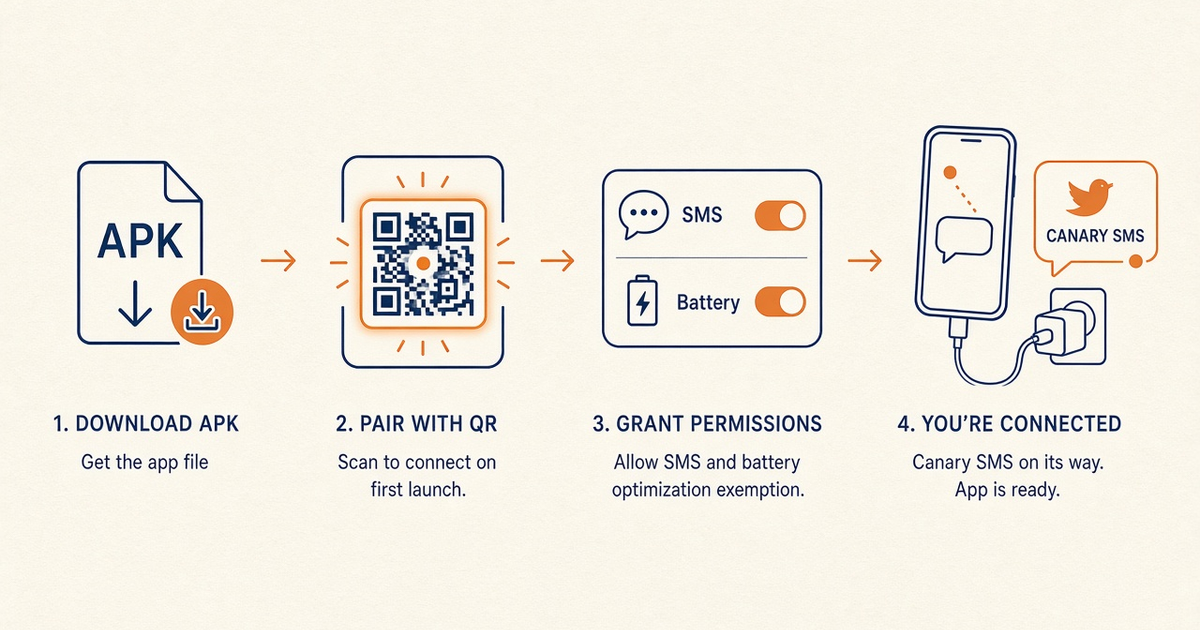
Use download the Android gateway app. Record the version in the runbook next to the phone’s nickname. Unofficial mirrors and “newer” random APKs are how pairing tokens and permission models drift from what support expects.
Android will warn about unknown sources. That is expected for a sideloaded gateway APK. Confirm the publisher path on the Downloads page, not a Telegram dump. Google’s unknown-app install notes explain the OS prompt — they are not a substitute for using our current build.
Pick the handset
- Dedicated phone on a charger. Personal daily-driver phones get killed by OEMs and people.
- SIM that sends SMS (not data-only). Known prepaid balance or postpaid SMS bundle.
- Android 8.0+ if you have a choice; 5.0 is the floor.
- Stable Wi-Fi where the phone will live. The control channel is IP; the SMS path is radio.
- A second phone to receive the canary. Do not canary to the gateway SIM itself.
Permission table
Grant these on first launch, then screenshot the screen into the ticket for that device. Work profiles can show “allowed” in one profile and deny in another — prefer no work profile on gateway iron.
| Permission / setting | Why first launch needs it | If missing |
|---|---|---|
| SMS send/read (as the app requests) | Modem access | API accepts; nothing leaves the radio |
| Phone / device state (if prompted) | SIM slot, dual-SIM routing | Wrong slot or empty device ids |
| Notifications | Some OEMs use this as a keep-alive hint | App “fine” until Doze |
| Ignore battery optimizations | Survive overnight | Last-seen stalls at ~02:00 |
| Autostart / lock in recents | Reboot recovery | Works until the cleaner runs |
Pair without typing secrets
QR pairing exists so the phone never holds your REST API key. The app credential is a device pairing, not the cloud token your Laravel box uses. Do not paste Bearer tokens into the handset.
Name the device in the panel the same night: “otp-rack-1”, not “Xiaomi”. Support will thank you.
The canary send
- Send from the panel to a staff handset you control.
- Confirm the body arrived (not only HTTP 200).
- Check DLR terminal state if the operator provides it.
- Leave the phone plugged in and look at last-seen in the morning.
Skip the overnight check and OEM policy will introduce itself via customer OTP. The free 300 lifetime SMS are for this ritual, not a purchased list.
OEM settings that kill you overnight
Battery exemption is not optional on Xiaomi/HyperOS, ColorOS, One UI, Harmony-ish forks, and many others. After a system update, Android often resets the exemption. Treat “OS updated” as “re-run first launch.”
Lock the app in recents. Disable MIUI “clean up memory” on that device. Do not install extra battery savers.
First-hour failure modes
- Installed, not paired — dashboard empty.
- Paired, SMS permission denied — queue grows, radio silent.
- SIM has no SMS credit — stock Messages also fails; that is not an API bug.
- Work profile — permissions look granted in the wrong user.
- Updated APK without canary — pairing looks fine, sends do not.
Live request fields stay in SMS API documentation. If the panel canary works and your client does not, you left the install path and entered API troubleshooting.
Checklist
- APK from Downloads; version recorded.
- Dedicated SIM with known airtime.
- Permissions + battery exemption screenshotted.
- QR paired; device nicknamed; owner named.
- Canary received; DLR checked; overnight last-seen planned.
- No REST key on the phone.
- Rollback APK kept for the next update.
Next steps
Keep the process alive with the app uptime guide, then wire production via the API guide. Budget the device on device and SMS volume pricing. First launch is a release gate. Treat it like one.
Related product pages
Jump to the live product docs for this topic—not another long-form article.
- device and SMS volume pricingPlans and allowances
- device setup guidePair and go live
- download the Android gateway appGet the APK
- Android SMS gateway product guideDefinition, product, and how to buy